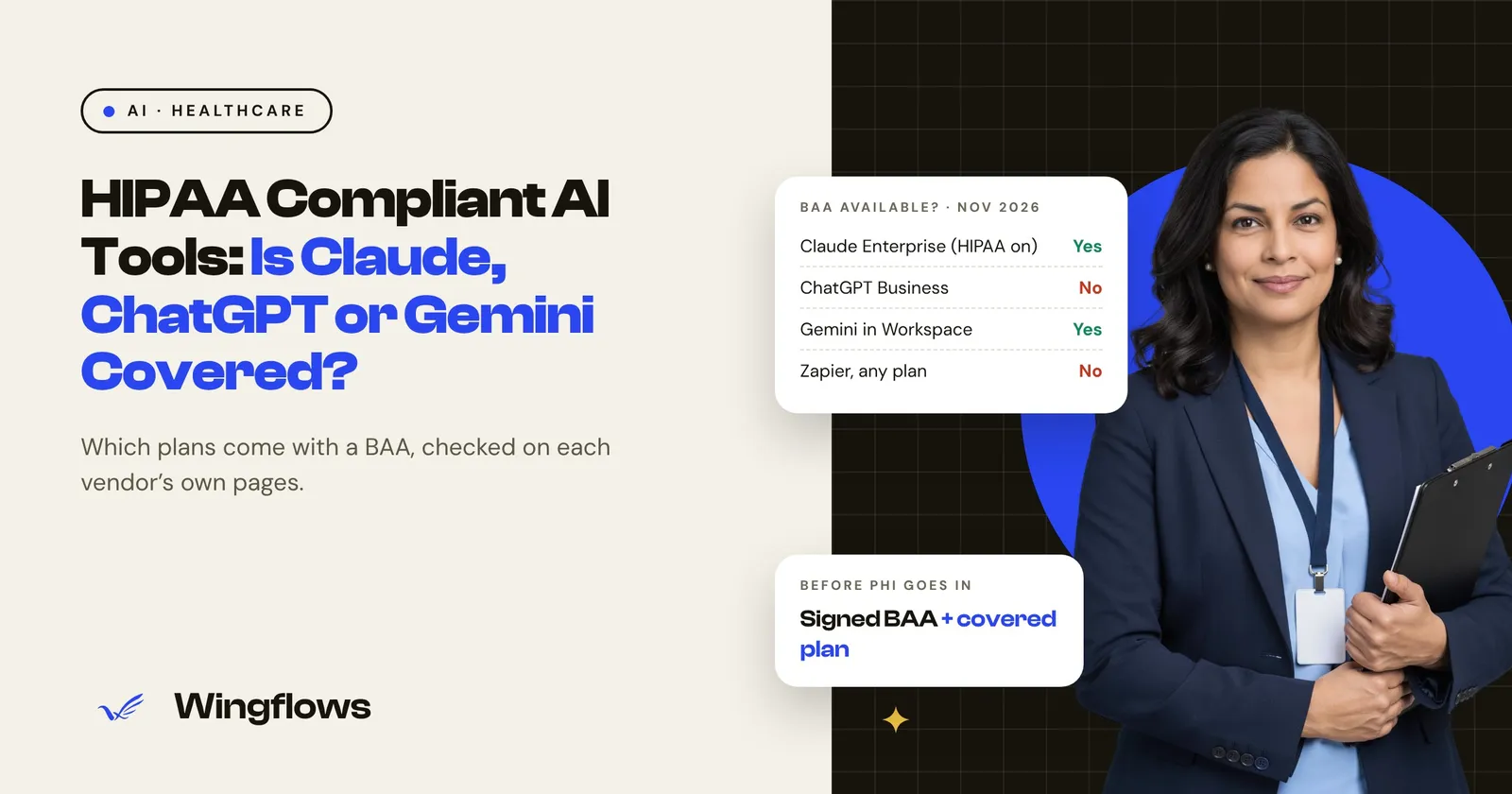
HIPAA compliant AI tools are the specific plans whose vendor signs a business associate agreement (BAA) with you, used only for the features that agreement covers. Claude Enterprise, the Claude API, the OpenAI API with Modified Retention, ChatGPT for Healthcare, Gemini in Google Workspace and Amazon Bedrock all qualify; free and personal plans, Claude Team, ChatGPT Business and Zapier do not.
A signed BAA lets patient data go into the tool. Your clinic still decides what goes in, who has access and which features stay off.
Key takeaways
- Claude: covered on Claude Enterprise (after the Primary Owner turns HIPAA on) and the first-party API. Anthropic says Team, Free, Pro, Max and Ultra “can’t enable HIPAA”.
- ChatGPT: covered on ChatGPT for Healthcare, Enterprise with Regulated Workspace, ChatGPT for Clinicians and the API with Modified Retention. “We do not offer a BAA for ChatGPT Business.”
- Gemini: the Gemini app and Gemini in Workspace are on Google’s covered list once a Workspace admin accepts the BAA. Gemini in Chrome is excluded.
- Turning HIPAA on can’t be undone from settings on Claude Enterprise or the OpenAI API, and both vendors exclude some features even after you sign.
- Zapier “can’t sign” BAAs. For automations that carry PHI, run the workflow tool on infrastructure you already have a BAA for.
Checked on November 23, 2026 against Anthropic, OpenAI, Google, Microsoft, AWS, Zapier, n8n and HHS pages, linked inline. Vendors change these pages often. This is general information, not legal advice: confirm your setup with your compliance officer or a HIPAA attorney before patient data goes into any AI tool.
Who this is for: owners and practice managers at US clinics, therapy practices and health startups, and the agencies building their websites and automations.
What makes an AI tool HIPAA compliant
HIPAA binds covered entities (your clinic) and their business associates. HHS describes a business associate as someone who “performs certain functions or activities regulated by the HIPAA administrative simplification regulations” on behalf of a covered entity, and its examples include a “Cloud service provider engaged to create, receive, maintain, or transmit electronic PHI (ePHI)” (HHS, business associates, last reviewed October 21, 2026). An AI vendor that receives your patients’ messages fits that description.
Before PHI goes to a business associate, the covered entity must obtain “satisfactory assurances, in the form of a contract or other written arrangement”. That contract is the BAA, and it has to “describe the permitted and required uses and disclosures of PHI”. HHS’s cloud guidance adds that the rule holds “even if the CSP processes or stores only encrypted ePHI and lacks an encryption key for the data” (HHS, cloud computing). Encryption doesn’t replace the agreement.
There is also no badge to look for. “The U.S. Department of Health and Human Services (HHS) doesn’t offer a certification program for HIPAA compliance,” as Google’s compliance page puts it (Google Cloud). A “HIPAA certified AI” banner is a vendor’s own claim.
The Security Rule you work under today is the current one. HHS has proposed an overhaul, but law firm Davis Wright Tremaine reported on July 8, 2026 that HHS “pushed back the date of the final amendments to the HIPAA Security Rule from May 2026 to July 2027” and moved it to “long term actions” (DWT).
Which AI is HIPAA compliant: plan-by-plan table
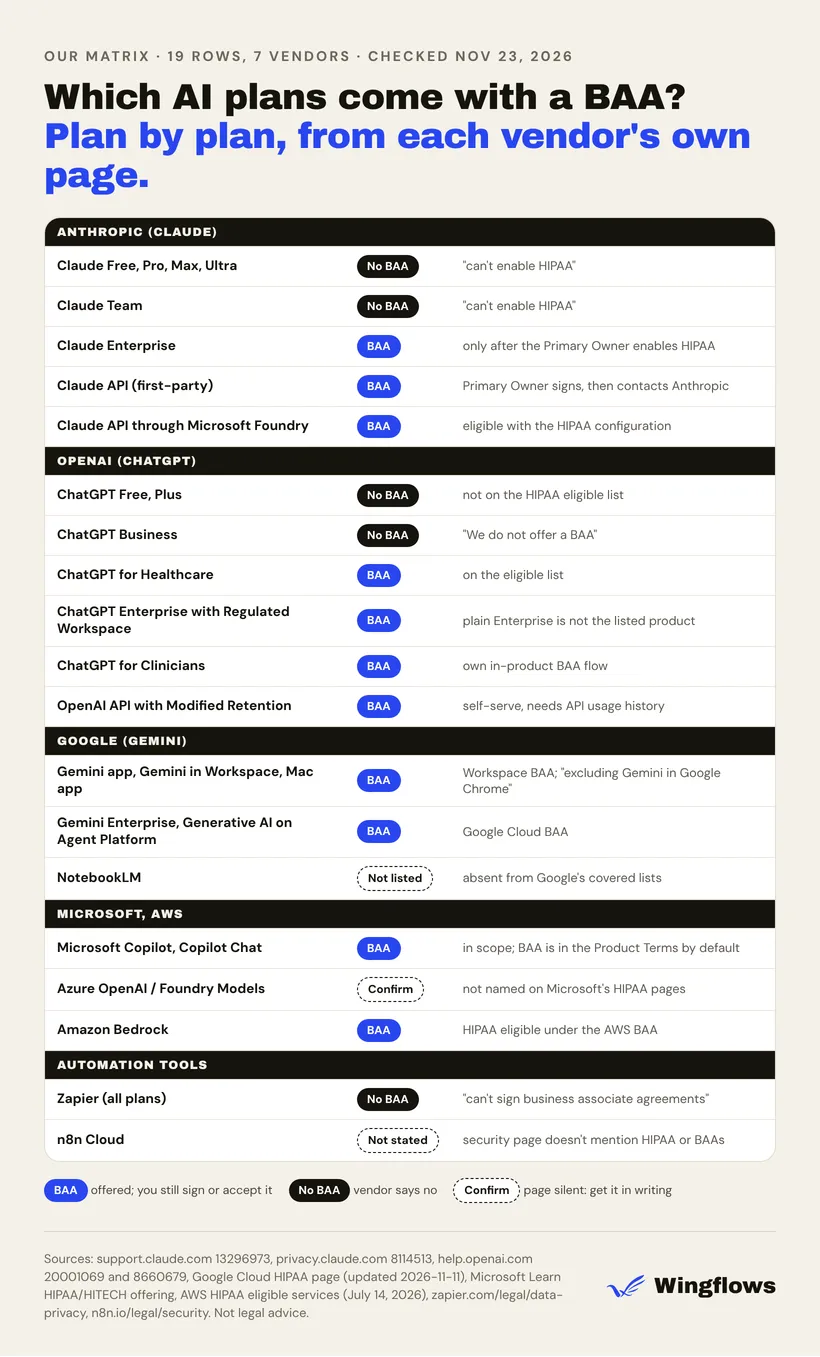
We built this matrix from each vendor’s own page on November 23, 2026. “BAA” means the vendor offers one for that product; you still have to sign or accept it.
Sources: Anthropic support, Anthropic BAA article, OpenAI eligible products, OpenAI BAA, Google Cloud (Workspace list updated October 28, Cloud list November 11, 2026), Microsoft HIPAA/HITECH, AWS (updated July 14, 2026), Zapier, n8n.
If you’re a small practice:
- Already on Google Workspace: accept the BAA in the Admin console and use Gemini there.
- A developer building an automation: use the Claude API or OpenAI API with a signed BAA, behind self-hosted n8n.
- Need a team chat assistant: Claude Enterprise or ChatGPT for Healthcare (sales-managed).
Healthcare-specific AI tools
Some vendors sell BAA-backed AI chat to practices instead of asking you to configure a big-vendor plan. BastionGPT says “every plan we offer includes the HIPAA Business Associate Agreement” (BastionGPT support), and Hathr.AI says it “accepts its BAA electronically at signup” (Hathr.AI). We haven’t tested either. Before you sign with any of them, ask which underlying model they use, what the BAA covers, how long they keep your data, and which features sit outside it.
Is Claude HIPAA compliant?
Claude is HIPAA compliant only on Claude Enterprise with HIPAA enabled and on the first-party Claude API under a signed BAA. Anthropic’s support article is blunt about the rest: “Team plans and individual plans (Free, Pro, Max, and Ultra) can’t enable HIPAA” (Anthropic support, checked November 23, 2026).
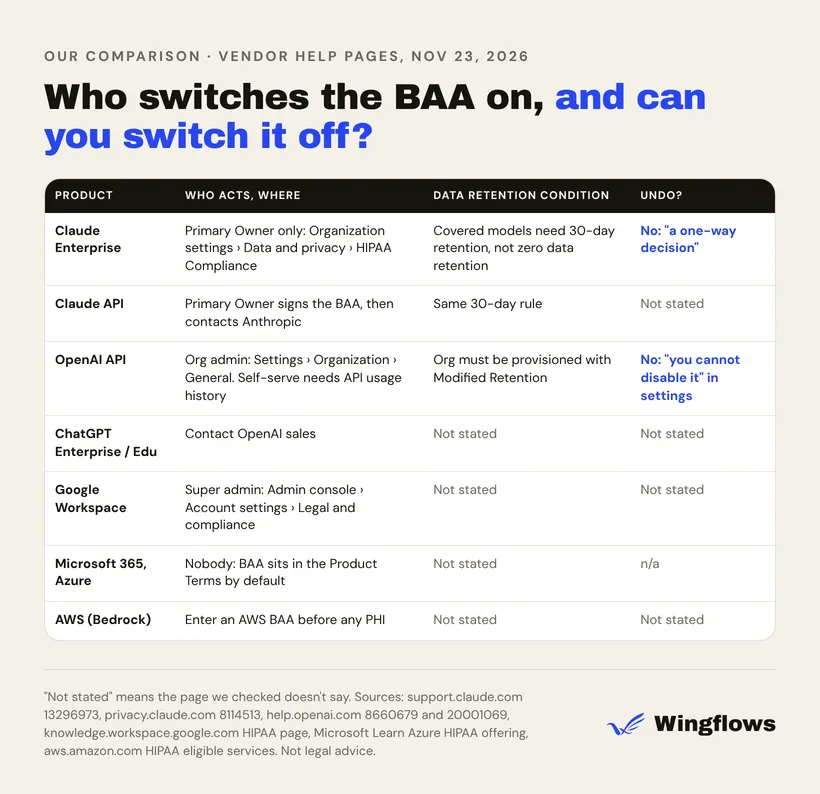
Claude Enterprise. Anthropic’s Enterprise seat-purchase article says “Enterprise plans require a minimum of 20 seats” (Anthropic support, as of November 2026). “Only the Primary Owner of the organization can accept the BAA and enable HIPAA.” The switch is under Organization settings, Data and privacy, HIPAA Compliance. Anthropic’s BAA article adds that “Standard Claude Enterprise plans do not include BAA coverage without action from a Primary Owner” (Anthropic BAA article). Covered features include chat, Projects and Artifacts in chat, file creation and code execution without network access, Voice, Web Search and Research.
Claude API. “Your organization’s Primary Owner will need to sign a BAA and then reach out to your Anthropic contact.” Covered Messages API features include prompt caching, structured outputs, memory, web search and the bash and text editor tools.
Four details we’d flag to any clinic before it signs:
- It’s a one-way switch. “This is a one-way decision.” Once HIPAA is on, “the change can’t be reversed from organization settings.” Test in a separate org if you’re unsure.
- Old API BAAs don’t stretch. A BAA signed for Claude API use before December 2, 2025 “only covers API usage”; later versions can cover the API and Enterprise.
- One organization per BAA. “The BAA only covers the single organization that accepted it, and excludes features such as Claude Console.” A second Claude org for another location needs its own.
- No zero data retention. “Covered Models require 30-day data retention and aren’t available with zero data retention (ZDR) enabled,” unless Anthropic agrees otherwise.
Claude Code and Cowork with patient data
“Enabling HIPAA alone doesn’t bring Claude Code or Cowork under your BAA.” The Primary Owner has to apply a separate HIPAA configuration for local mode, and Anthropic says “This configuration is currently only available to organizations with an Anthropic account team.” After it’s applied, cloud sessions, Remote Control and Cowork in the cloud switch off. Where your team runs Claude Code decides coverage:
So a developer who builds your patient-intake tool inside VS Code with Claude is outside the BAA even if your org has HIPAA on. Ask them which route they use.
Is ChatGPT HIPAA compliant?
ChatGPT is HIPAA compliant only on the products OpenAI lists: “OpenAI makes the following HIPAA eligible products available with a Business Associates Agreement (BAA)”: ChatGPT for Healthcare, ChatGPT for Enterprise with Regulated Workspace, ChatGPT FedRAMP, ChatGPT for Clinicians, API with Modified Retention, and API FedRAMP with Modified Retention (OpenAI, HIPAA eligible products, checked November 23, 2026). ChatGPT Free and Plus aren’t on that list.
For the API, “API HIPAA eligibility requires an executed OpenAI BAA” and “Your organization must also be provisioned with Modified Retention, unless OpenAI specifies otherwise.” Listed endpoints include /v1/chat/completions and /v1/responses. An org admin enables it under Settings, Organization, General. “An enterprise agreement is not required to sign a BAA for API services,” but self-serve needs “an established history of API usage”; if the page shows “Not eligible yet”, OpenAI says to retry in a few days or email baa@openai.com (OpenAI BAA). And: “Once HIPAA compliance support is enabled for your organization, you cannot disable it in the API Platform settings.”
Two plan traps. “We do not offer a BAA for ChatGPT Business.” And sales-managed ChatGPT Enterprise or Edu goes through OpenAI sales; the eligible product is Enterprise with Regulated Workspace, so check that wording in your contract.
Features a signed BAA still doesn’t cover
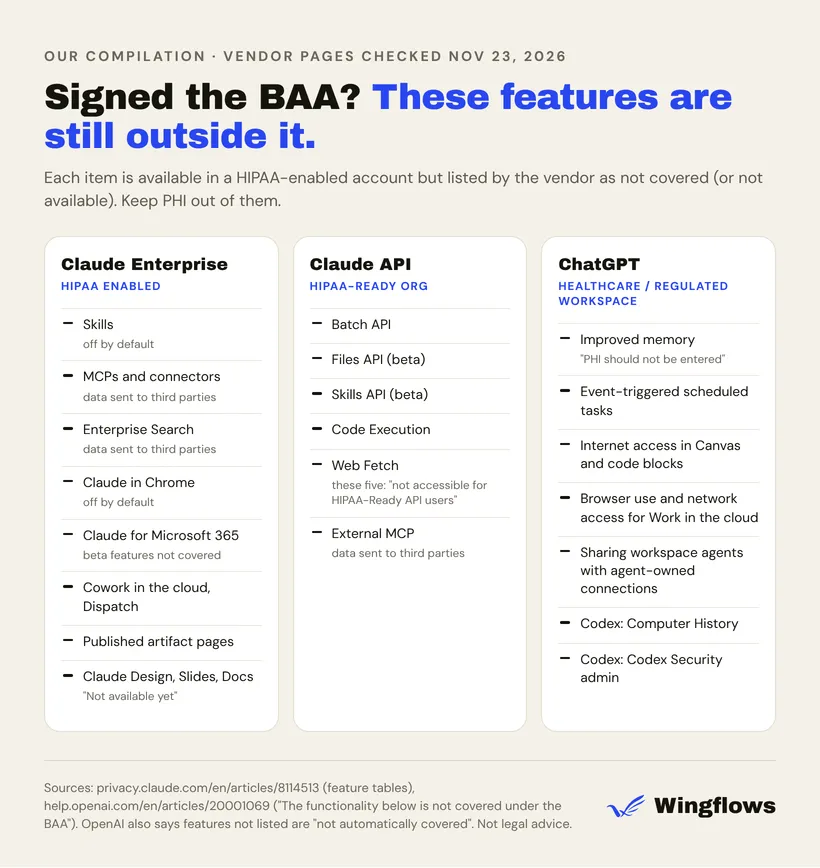
Both Anthropic and OpenAI list features that stay outside the BAA inside a covered account, and several of them are one toggle away for any admin.
Anthropic lists Skills, MCPs and connectors, Enterprise Search, Claude in Chrome, Claude for Microsoft 365 and published artifact pages as not covered on a HIPAA-enabled Enterprise org, and says of connectors: “Your BAA doesn’t cover any of them, even after an Owner turns them on.” Cowork in the cloud and Dispatch are not covered; Claude Design, Slides and Docs are “Not available yet for HIPAA-ready organizations”. On the API, the Batch API, Files API, Skills API, Code Execution and Web Fetch are “Not covered under Anthropic BAA and not accessible for HIPAA-Ready API users”. External MCP still works, but Anthropic says sending data to third parties through it “isn’t covered under Anthropic’s BAA” (Anthropic BAA article).
OpenAI lists its own exclusions under “The functionality below is not covered under the BAA”: improved memory (“PHI should not be entered when using this feature”), event-triggered scheduled tasks, internet access in Canvas and code blocks, browser and network access for Work in the cloud, sharing workspace agents with agent-owned connections, Computer History in Codex, and administering Codex Security. It also says “Features not listed here are not automatically covered” (OpenAI).
Is Gemini HIPAA compliant?
Yes, on a Google Workspace or Google Cloud account where the BAA is accepted. Google’s Workspace list names “Gemini App (excluding Gemini in Google Chrome)”, “Gemini in Google Workspace” and “Gemini Mac App”; the Cloud list names “Gemini Enterprise”, “Gemini Enterprise Agent Platform” and “Generative AI on Agent Platform” among others (Google Cloud, page updated November 11, 2026). NotebookLM isn’t on either list.
“Administrators must review and accept a BAA before using PHI in Google services,” and a super administrator does it in the Admin console under Account settings, then Legal and compliance (Google Workspace). Expect some limits after you sign: Google’s Gemini FAQ says “some features might be blocked for customers who have signed the HIPAA Business Associate Amendment (BAA)” (Google). That page covers Workspace and Cloud Identity customers only, so a personal Gmail account has no BAA to accept.

HIPAA compliant LLMs on Microsoft and AWS
If your developer calls a model from your own cloud account, the cloud vendor’s BAA is the one that counts.
Microsoft: “There is no separate contract to sign to enter into a HIPAA Business Associate Agreement (BAA) with Microsoft because the HIPAA BAA is available via the Microsoft Product Terms (formerly Online Services Terms) by default to all customers who are covered entities or business associates under HIPAA.” It also warns that using its cloud “doesn’t automatically impart compliance onto your cloud solutions” (Microsoft Learn, Azure HIPAA; that page’s visible date is April 6, 2023). Microsoft’s HIPAA/HITECH page lists Microsoft Copilot and Microsoft Copilot Chat as in scope for Office 365 commercial and GCC, but neither page names Azure OpenAI or Foundry Models (Microsoft Learn). Get written confirmation from Microsoft for the exact service you deploy.
AWS lists Amazon Bedrock and Bedrock AgentCore as HIPAA eligible, and says you must not use them with PHI “without first entering into an AWS business associate agreement” (AWS, updated July 14, 2026). One catch: Claude Code routed through Bedrock is outside Anthropic’s HIPAA configuration, per the table above.
Is Zapier HIPAA compliant? And n8n?
Zapier says no. “The use of regulated healthcare and medical data including Protected Health Information (PHI) under HIPAA isn’t supported on Zapier,” and “Zapier also can’t sign business associate agreements (BAAs) or equivalent agreements for handling PHI” (Zapier).
n8n’s security page doesn’t mention HIPAA or BAAs. It says n8n Cloud data “is currently hosted in the European Union” on Microsoft Azure, and that for self-hosted installs “encrypting other data at rest is the responsibility of the user” (n8n). The setup we recommend is self-hosted n8n on a server under a cloud BAA the clinic already holds (AWS lists Amazon EC2 as HIPAA eligible), so only the AI call leaves, and it goes to a covered endpoint. We compare the three tools in n8n vs Make vs Zapier, and our n8n pricing guide covers what self-hosting costs.
The hidden cost in that setup is the log. n8n’s defaults save execution data on success and on error (EXECUTIONS_DATA_SAVE_ON_SUCCESS and ..._ON_ERROR both all) and keep it 336 hours before pruning (n8n docs). On a clinic workflow, that’s two weeks of patient messages in a database someone has to secure, back up and include in the risk analysis. Set those variables, or turn saving off for successful runs, before the first real record goes in.
How to build a HIPAA compliant AI workflow
Every system the data touches needs to sit under a BAA: form, workflow tool, model, inbox, CRM. Our pre-flight check before any AI step sees patient data:
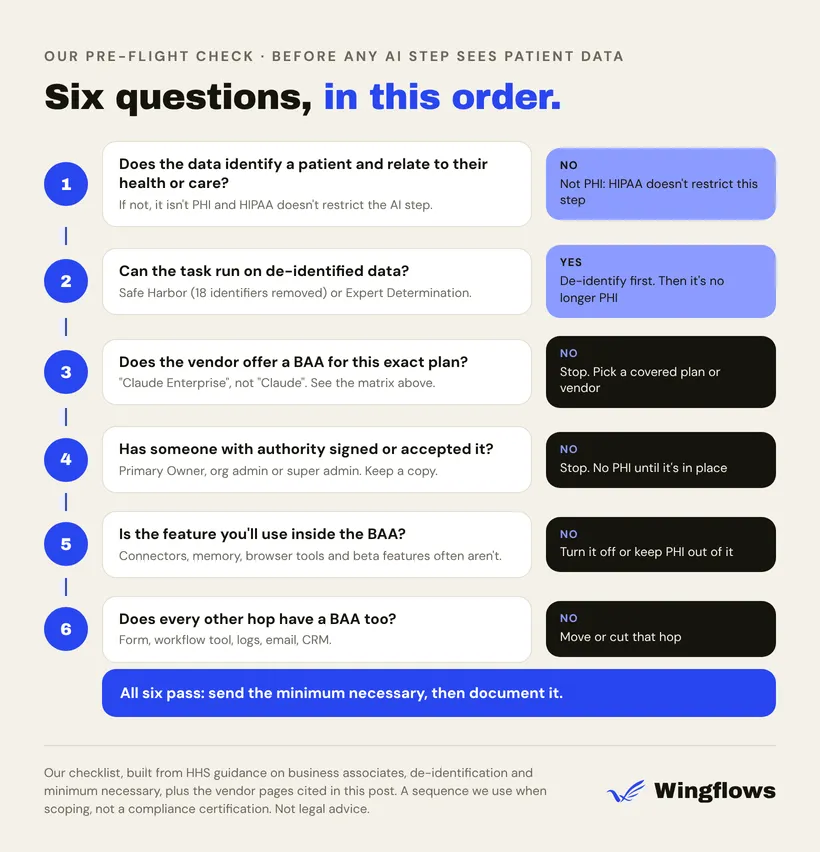
Two rules run through all six steps.
Minimum necessary. Covered entities must “take reasonable steps to limit the use or disclosure of, and requests for, protected health information” to “the minimum necessary to accomplish the intended purpose” (HHS). Disclosures to a provider for treatment are exempt; an AI step that drafts a reminder email is not treatment. If the prompt needs an appointment type and a weekday, send those and nothing else.
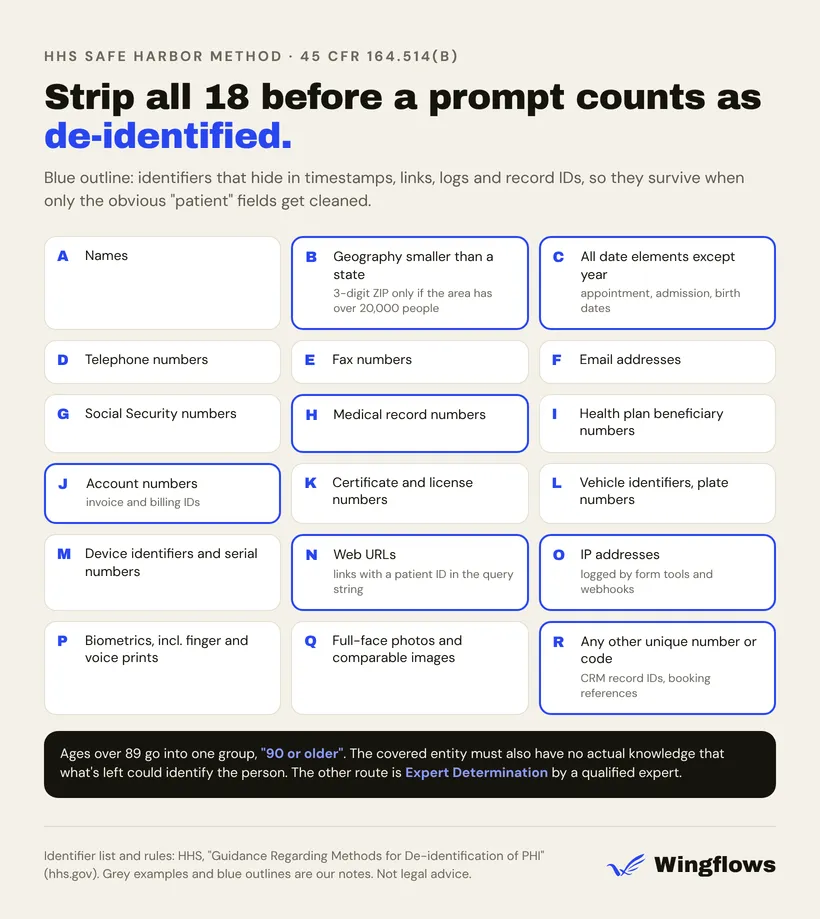
De-identify when the task allows it. HHS recognizes Expert Determination and Safe Harbor. Safe Harbor removes 18 identifier types, including “All elements of dates (except year)”, and allows a 3-digit ZIP only where the area “contains more than 20,000 people” (HHS, de-identification). Data de-identified this way is no longer PHI. The identifiers that survive a quick clean-up are the ones outside the obvious name and phone fields: timestamps, booking links with an ID in the URL, IP addresses captured by the form tool, CRM record numbers.
The layout we recommend when PHI has to reach a model:
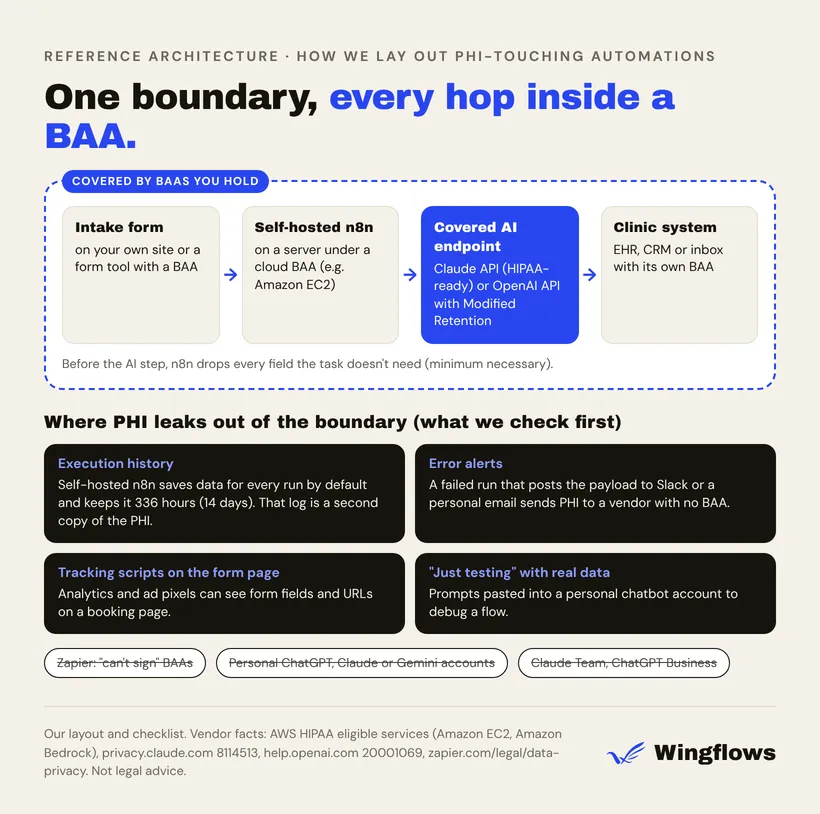
None of the leak points on that diagram is the AI model itself. An error alert posts the failed payload to a team chat app, an analytics pixel reads the booking page, a staff member pastes a real message into a personal chatbot to “test the prompt”. Each one sends PHI to a vendor with no BAA.
Where Wingflows fits
We build websites for clinics, AI integrations and n8n automations under our custom software and AI work. We are not a HIPAA compliance firm and we don’t certify anything. What we do is design the workflow so patient data only moves through systems your BAAs cover, keep the AI step to the minimum it needs, and write down which vendor covers which hop so your compliance lead can check it. If you’re pricing a build, what an AI agent costs to build breaks down the parts.
We don’t sign BAAs. We set projects up so we never need access to patient records: test data during the build, and your own accounts holding the real data.
FAQ
Is Claude HIPAA compliant?
Only on Claude Enterprise with HIPAA enabled by the Primary Owner, and on the first-party Claude API after the Primary Owner signs Anthropic’s BAA. Anthropic says Team, Free, Pro, Max and Ultra “can’t enable HIPAA”. Inside a covered org, connectors, Skills, Claude in Chrome and some API features stay outside the BAA.
Does Anthropic sign a BAA?
Yes, for commercial customers: Claude Enterprise owners accept it when they enable HIPAA, and API customers sign it and then contact Anthropic. It covers one organization and requires 30-day data retention on covered models.
Is ChatGPT Plus or ChatGPT Business HIPAA compliant?
No. Plus isn’t on OpenAI’s HIPAA eligible list, and OpenAI states “We do not offer a BAA for ChatGPT Business.” Look at ChatGPT for Healthcare, Enterprise with Regulated Workspace, ChatGPT for Clinicians or the API with Modified Retention instead.
Is Gemini HIPAA compliant?
On Google Workspace or Google Cloud with the BAA accepted, yes for the Gemini app and Gemini in Workspace. Gemini in Google Chrome is excluded by name, and NotebookLM isn’t on Google’s list.
Can I use Claude through AWS Bedrock or Google Cloud for HIPAA?
The cloud vendor’s BAA applies to the model service: AWS lists Amazon Bedrock as HIPAA eligible. But Anthropic marks Claude Code run through Bedrock, Google Cloud’s Agent Platform or Microsoft Foundry as not covered under its HIPAA configuration, so check each tool route separately.
What happens if I put patient data into an AI tool without a BAA?
HHS lets a covered entity disclose PHI to a business associate once it “obtains satisfactory assurances, in the form of a contract or other written arrangement”. Without that, the disclosure lacks the basis HIPAA requires. Talk to your compliance officer or a HIPAA attorney about what it means for your practice, including any breach-notification duties.
Is there a HIPAA certification for AI tools?
No. HHS runs no HIPAA certification program. Ask the vendor for its BAA and the list of covered products and features.
Is Zapier HIPAA compliant?
No. Zapier says PHI “isn’t supported on Zapier” and that it “can’t sign business associate agreements”. Use it only for workflows that carry no PHI.
Running a clinic and want to know which steps of your booking, intake or follow-up can safely use AI, and which vendors you’d need a BAA with? Talk to us and we’ll map it with you before anything is built.