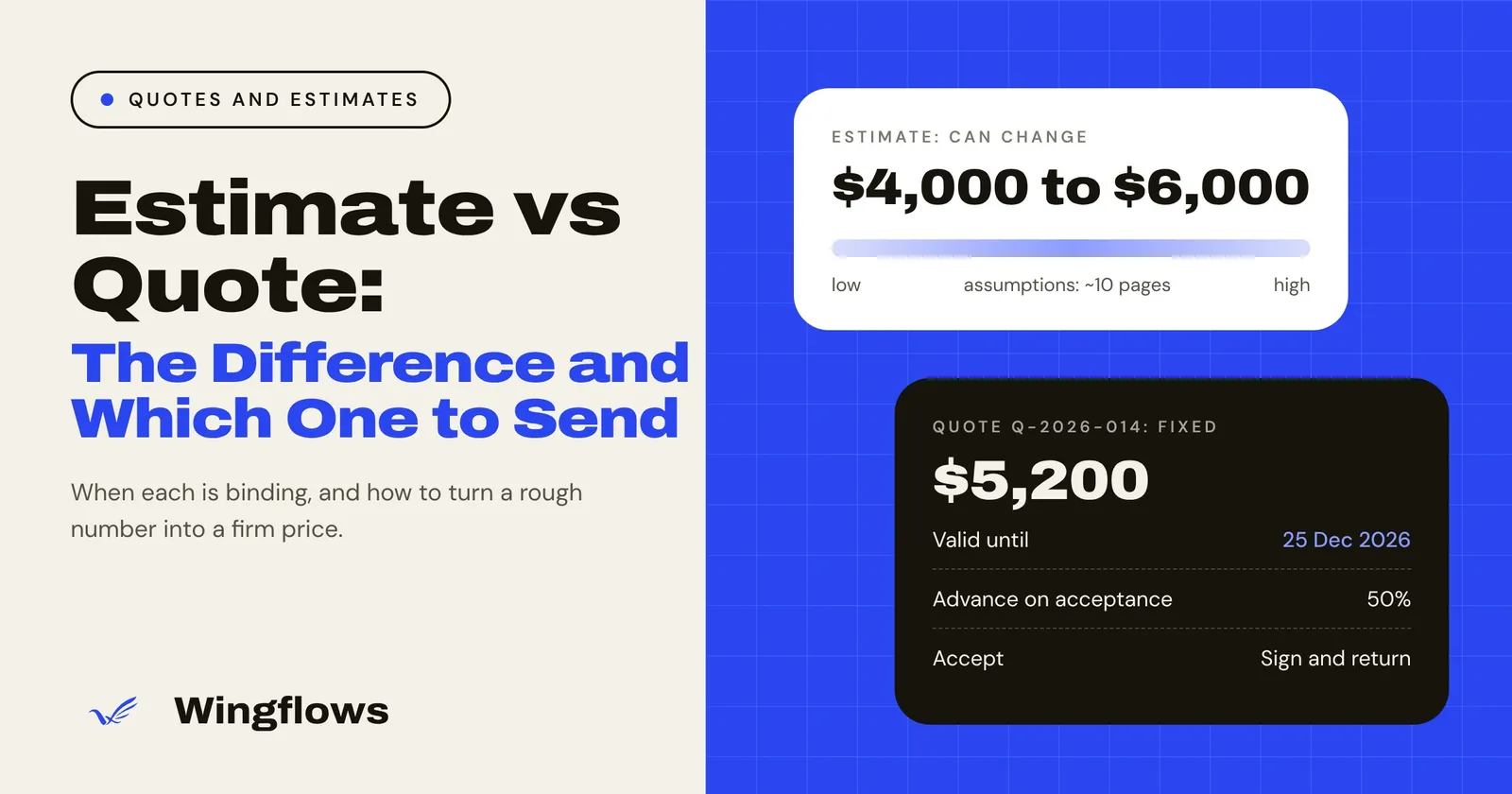
An estimate is your best guess at what a job will cost, and the final bill can move up or down. A quote is a fixed price for a defined job that the client can accept until a stated date. An estimate says “about this much”. A quote says “this much, if you say yes by this date”.
Call a rough number a quote and the client will hold you to it when the bill differs. Call a firm price an estimate and the client may wonder what else will change.
Wingflows’ free quotation maker covers the quote step. We typed the worked example below into it and converted the quote into an invoice, to see what carries over.
Key takeaways
- An estimate is an approximate cost that can change. A quote is a fixed price for a defined scope, valid for a set time.
- Send an estimate when you can’t yet see the full job. Send a quote once the scope is clear enough to price it exactly.
- Under US contract law, price quotations are generally not treated as offers on their own, but a detailed quote with clear terms that the client accepts can become a binding agreement.
- Some industries have their own estimate rules. California auto repair shops need the customer’s consent before charging above the written estimate, and interstate movers can’t require more than 110% of a non-binding estimate at delivery.
- Every quote needs a valid-until date, a written scope and a clear way to accept.
General information, not legal advice.
Estimate vs quote: what is the difference?
An estimate gives the client an idea of cost before the details are known. A quote commits you to a price for an agreed scope.
Some trades and software tools use “estimate” for a fixed price, and the reverse. Go by what the document says: whether the price can change, what scope it covers and until when it holds. Put that in writing and the label stops being a problem.
What an estimate is and when to use it
An estimate is an informed guess at the cost of a job, based on what you know so far. It helps a client decide whether to go further, set a budget or compare suppliers. It is not a promise of the final price.
Use an estimate when:
- You haven’t seen the full job yet (a site visit, an audit or a discovery call is still to come).
- The work depends on things you can’t see, such as what’s behind a wall or what state an old system is in.
- The client is still deciding what they want and asks “roughly how much?”.
- The job is billed by time and materials, so the final bill depends on hours actually worked.
A useful estimate states its assumptions. “$4,000 to $6,000, assuming up to 10 pages and content supplied by you” tells the client what would push the price up. A bare number does not.
What a quote is and when to use it
A quote (or quotation) is a fixed price for a specific scope of work or set of goods, offered for a limited time. The client can accept it as written, and from then on you are expected to deliver that scope for that price.
Use a quote when:
- You know exactly what you’ll deliver: the items, quantities, hours or milestones.
- The client wants a firm number before signing off a budget or raising a purchase order.
- You’re bidding against other suppliers and the buyer will compare totals.
- You want a clean path from “yes” to an invoice.
Is a quote legally binding? Is an estimate?
Not by itself, in most cases. A US business law textbook puts the general rule plainly: “Most advertisements, price quotations, and invitations to bid are not construed as offers” (Saylor Academy, The Law of Commercial Transactions, 9.2). A bare unit price lacks the quantity, delivery time and other terms an offer needs. A quote that sets out the exact scope, price, terms and a way to accept looks much more like an offer, and once the client accepts it you have an agreement.
In practice:
- An accepted detailed quote binds both sides. You deliver the scope for the price; the client pays it. Changing the price later needs the client’s agreement.
- An estimate does not promise the final price, but calling a firm offer an estimate won’t protect you if the client accepted it as one.
- Before acceptance you can withdraw or revise a quote, except under the firm-offer rule for goods below.
The firm-offer rule for goods (UCC 2-205)
If you sell goods as a merchant, your signed quote can bind you before the buyer says yes. Under the Uniform Commercial Code firm-offer rule, a merchant’s offer to buy or sell goods, made in a signed writing that gives assurance it will be held open, can’t be revoked for lack of consideration during the time stated, or a reasonable time if none is stated, and “in no event may such period of irrevocability exceed three months” (New York UCC § 2-205). That is New York’s text; each state enacts the UCC itself, so check your own state’s version.
If you sign a quote for goods that says “this price is held open until 31 January”, you can’t pull it on 10 January because your supplier raised prices. A bare “valid until” date may not give that assurance in every court, so say “held open”. The rule covers goods, not services. For services, a stated validity date still tells the client when the offer lapses.
Where the law sets rules for estimates
Some industries don’t leave the estimate vs quote question to the parties. Regulators set rules on when a written estimate is required and how far a bill may go above it, as in these cases:
Sources: California BAR, Write It Right and Cal. Bus. & Prof. Code § 9884.9; Fla. Stat. § 559.905; FMCSA, binding estimates, 49 CFR § 375.403 and 49 CFR § 375.405; CMS, rights without insurance. State laws change, so open the current text for your state before relying on a figure.
Whatever your trade, put the number in writing and get the client’s consent before the bill goes above it.
Outside the US
The rules differ by country. In the UK, the Northern Ireland business guidance says a quotation is typically a fixed-price offer that can’t be changed once the customer accepts it, while an estimate isn’t binding (Business Information Service, Northern Ireland); the Consumer Rights Act 2015 adds a rule for services sold to consumers when no price was agreed. In India, whether a quote is an offer depends on the Indian Contract Act, 1872 (sections 2(a) and 4 on proposals and when they are communicated); our quotation letter guide covers the GST lines, HSN/SAC codes and acceptance wording Indian buyers expect. Elsewhere, check local law.
Quote vs bid vs proposal
A proposal often contains a quote: the pricing section is the quote, and the rest explains why the client should pick you. A bid is a quote sent in reply to someone else’s request. Once a client has accepted a quote, some buyers still want a proforma invoice before they pay an advance.
When to send an estimate and when to send a quote
Ask whether you can price the job exactly today:
- No, and the client wants a number now: send an estimate, with a range and the assumptions behind it.
- No, and the client doesn’t need a number yet: offer a paid or free discovery step (a site visit, an audit, a scoping call), then quote.
- Yes: send a quote with a valid-until date.
- Partly: quote the parts you can see and estimate the rest. For example, a fixed price for the build and an hourly rate, with a cap, for content migration. The client gets certainty on most of the price, and you aren’t stuck absorbing the unknown part.
Pricing the work: fixed fee, time and materials, or a range
Freelancers and agencies usually pick one of these before writing the quote:
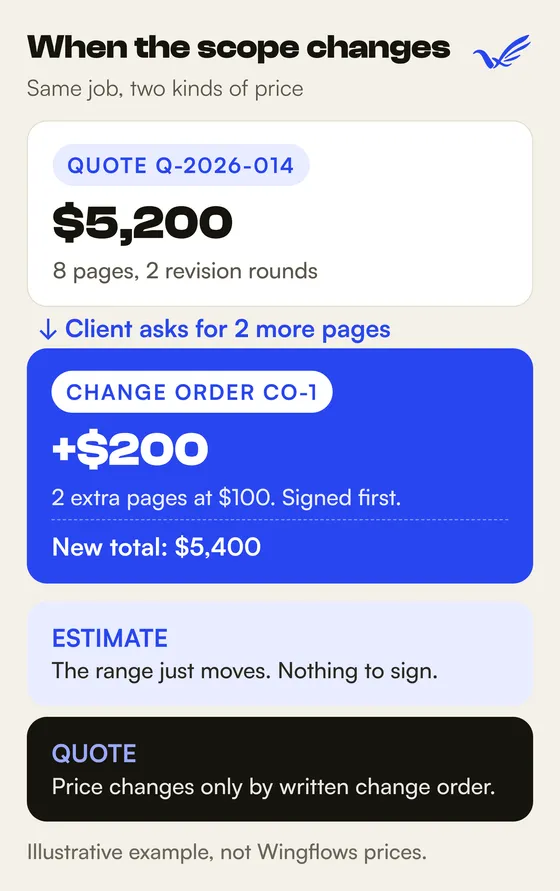
- Fixed fee. One price for a written scope, as in the $5,200 example below. It fits work you can describe in deliverables. Anything outside the list is a change order.
- Time and materials with a cap. An hourly rate plus a not-to-exceed amount, for example “$100 an hour, not to exceed $1,200 without your written approval”. It fits work with unknowns, and the cap gives the client a ceiling.
- A range. “$4,000 to $6,000” works as an estimate. Once the unknowns close, turn it into a fixed fee or a capped quote.
Whichever you pick, add change-order wording to the quote: “Work outside this scope will be quoted separately and started only after written approval.” If the job turns out bigger than estimated, tell the client before you do the extra work, not on the invoice.
How to turn an estimate into a quote
Most work starts as an estimate and ends as a quote.
Close the unknowns. Visit the site, audit the system or hold the scoping call. Write down every assumption from your estimate and confirm or replace each one.
Write the scope as deliverables. List what you'll hand over, in numbers where you can: pages, units, hours, rounds of revisions. Then list what is not included.
Price each line. Quantity × rate for each item, then taxes and the total. If a line still can't be fixed, give it a rate and a cap rather than a guess.
Set the terms. A quote number, the date, the client's name and PO number if they gave one, a valid-until date (a date, not just "30 days"), the advance you need to start, when the rest is due (for example net 30), and the delivery date.
Say how to accept, and what changes cost. A signature, a written reply or a purchase order quoting your number, with space for a name, signature and date. Add one line on how extra work is priced: a written change order before it starts.
Send it and follow up before it expires. A short reminder a few days before the valid-until date often gets the decision made.
Worked example: from a $4,000 to $6,000 estimate to a $5,200 quote
This is a made-up example for a small website redesign; the numbers are illustrative, not Wingflows prices.
On the first call, the client asks what a new site for their accounting firm would cost. Without seeing their content or systems, the honest answer is a range: $4,000 to $6,000, assuming about 10 pages and content supplied by the client.
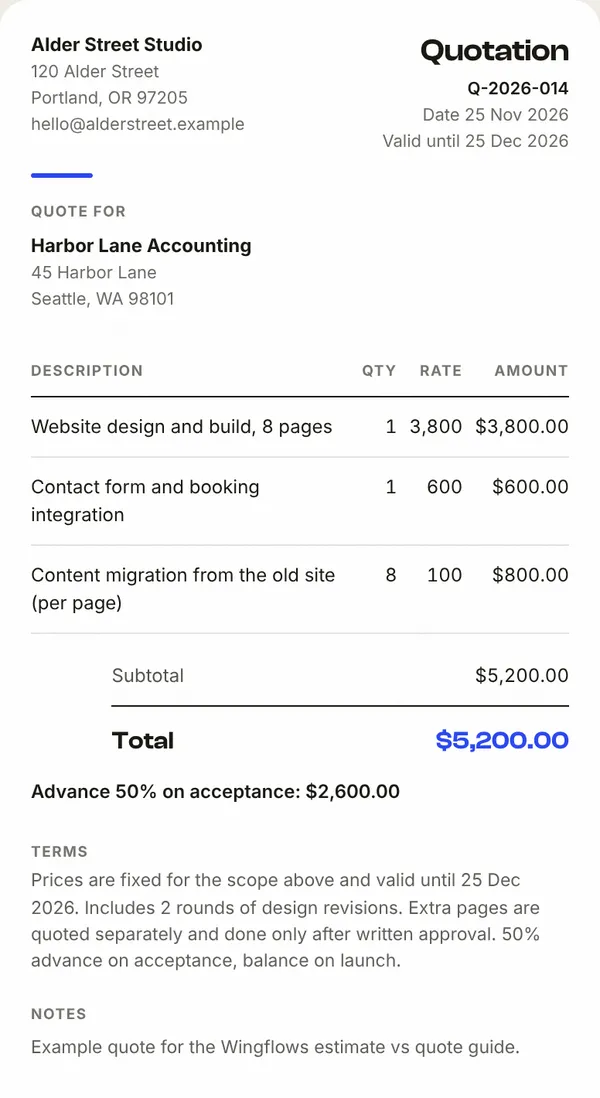
After a scoping call, the open questions are settled: 8 pages, a contact form, a booking link and copy supplied by the client. The quote becomes:
Terms on the quote: valid until 25 December 2026; 50% advance ($2,600) on acceptance and 50% on launch; two rounds of design revisions; any extra page is migrated at $100, approved in writing before the work starts. Sales tax would be added where it applies to the service in your state.
Each estimate assumption became a quote line, and extra pages got a rate of $100 each.
What happened when we converted this quote to an invoice
We entered quote Q-2026-014 in the quotation maker on 25 November 2026 with the “Simple tax” preset (tax rate left at 0% for the example), USD and a 50% advance. The quote shows the valid-until date, the three lines, the $5,200 total and “Advance 50% on acceptance: $2,600.00”.
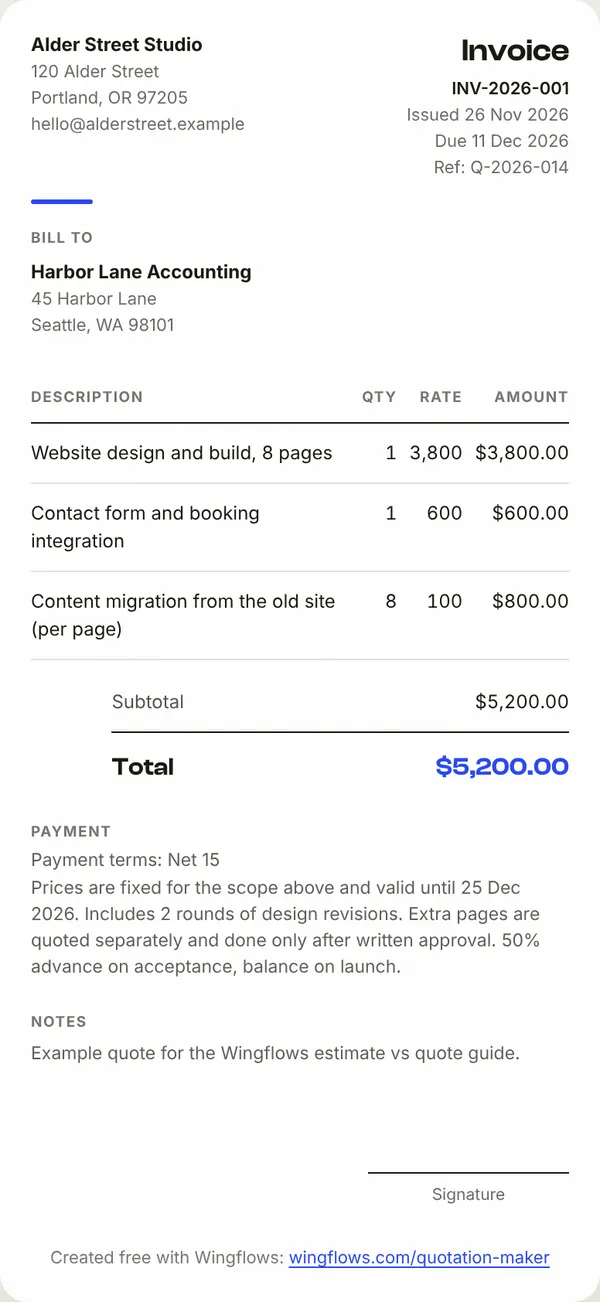
On 26 November, pressing “Convert to invoice” produced invoice INV-2026-001 with “Ref: Q-2026-014”, the same client and the same three lines. Check these before you send it:
- The terms came across word for word, including “valid until 25 Dec 2026”. On an invoice that line means nothing, so replace it with the payment terms.
- The invoice asked for the full $5,200, with a default due date 15 days out. If the client has already paid the $2,600 advance, record it in the “Deposit received” field so the balance due is right.
Wording you can copy for the terms
This quote is valid until 25 December 2026. Prices are fixed for the scope above. Work outside this scope will be quoted separately and started only after written approval. A 50% advance is due on acceptance; the balance is due on completion.
FAQ
What is the difference between an estimate and a quote?
An estimate is an approximate price that can change as the job becomes clear. A quote is a fixed price for a defined scope, offered for a set time. Estimates come early; quotes come once you can price the job exactly.
Is an estimate legally binding?
Usually not as a promise of the final price. But in some industries the law limits how far a bill can go above an estimate, for example car repair in California or interstate moves, where a mover may not collect more than 110% of a non-binding estimate at destination. Check the rules for your trade and state.
Can a contractor charge more than the quote?
Not for the same scope, once the client has accepted it, unless the quote or contract allows for it. If the client asks for extra work, a written change order with its own price is the usual way to handle it.
How long is a quote valid?
As long as the quote says. Pick a period that matches how fast your costs change, such as 30 days, and write it as a date.
Should I charge for an estimate?
That’s your call. Small estimates given on a call are usually free. If an accurate quote needs real work, such as a site survey, an audit or a technical scoping session, you can charge for that step and credit it against the job if the client goes ahead. Say so before you start.
What is the difference between an estimate, a quote and an invoice?
An estimate and a quote both come before the work: the estimate is an approximate price, the quote a fixed one. An invoice comes after delivery (or for an agreed advance) and asks for payment. An accepted quote becomes the invoice, with the same lines. See invoice vs receipt for what comes after the invoice.
What is the difference between a quote and a proposal?
A quote is a price for a defined scope. A proposal explains your approach and makes the case for hiring you, and usually contains a quote as its pricing section.
Turn your estimate into a quote for free
When the scope is clear, open the free quotation maker: add your lines, sales tax and a valid-until date, set the advance you need, and download a PDF the client can accept. For a one-off invoice without a quote, use the invoice generator.
If quotes, change orders and invoices live in three different places in your business, that’s worth fixing once. We build business systems where an accepted quote becomes a project and an invoice without retyping. Talk to us if you want one built, or if you’re an agency looking for a build partner.