How to make a delivery challan
- 1
Add the consigner (you) and the consignee: names, addresses, GSTINs and states.
- 2
Pick the reason for transport, then check the challan number (16 characters at most) and the date.
- 3
List the goods with HSN code, quantity and value. Switch on GST only if the movement is a supply.
- 4
Add the transporter, vehicle number and LR number, then download all three copies as one PDF.
What is a delivery challan?
A delivery challan is the document that travels with goods when they move without a tax invoice. It records who is sending the goods (the consigner), who is receiving them (the consignee), what the goods are, how many there are and what they are worth.
It is not a tax invoice and it does not ask anyone to pay. You use it when goods leave your premises for a reason other than an ordinary sale: sending material to a job worker, sending samples on approval, sending a machine for repair, moving stock to another branch, or dispatching goods before the invoice is ready. Under GST, CGST Rule 55 sets out when a challan may be issued and what it must contain.
Download a blank delivery challan format (Word, Excel, PDF)
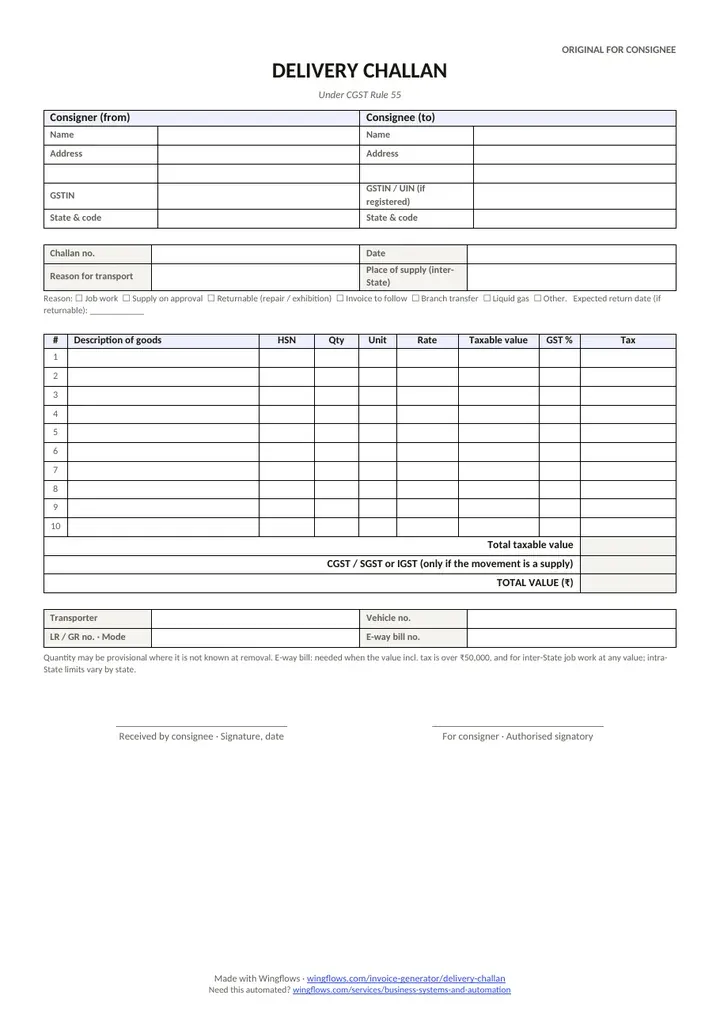
Prefer to fill it in offline? These blank challan formats carry the same Rule 55 fields as the maker above. They are free, with no sign-up and no email gate.
The Excel file has three tabs: Standard, Returnable (with an expected return date) and Job work (with the return time limits). Each tab has a reason-for-transport dropdown and adds up the value as you type.
- Download delivery challan format in Excel (.xlsx)Excel · 22 KB
Three tabs, reason dropdown, HSN, quantity and value columns with totals, transport block. Works in Excel and Google Sheets.
- Download delivery challan format in Word (.docx)Word · 39 KB
Editable A4 challan with all Rule 55 fields, set up as three pages: Original, Duplicate and Triplicate.
- Download delivery challan format in PDFPDF · 157 KB
Blank, print-ready A4, one page per copy, for filling in by hand.
Free to use and share. No sign-up, no email. A4, with a small Wingflows credit in the footer.
Delivery challan format under GST: Rule 55 fields
CGST Rule 55(1) lists the particulars a delivery challan must carry. The maker above and the blank formats include every one of them:
- Date and number of the challan. The serial number can run in one or more series and may not be longer than 16 characters.
- Name, address and GSTIN of the consigner, if registered.
- Name, address and GSTIN or UIN of the consignee, if registered.
- HSN code and description of the goods.
- Quantity (provisional, where the exact quantity is not known when the goods are removed).
- Taxable value.
- Tax rate and tax amount (central tax, State tax, integrated tax, Union territory tax or cess), where the transport is for supply to the consignee.
- Place of supply, for inter-State movement.
- Signature.
Three copies: Original, Duplicate, Triplicate
When goods move for supply, Rule 55(2) asks for the challan in triplicate: the original marked ORIGINAL FOR CONSIGNEE, the duplicate marked DUPLICATE FOR TRANSPORTER and the triplicate marked TRIPLICATE FOR CONSIGNER. Many businesses print three copies for every challan anyway, so each party has the same record.
Leave "Print 3 copies" switched on and the PDF has one page per copy, each labelled at the top. The credit line and page numbers are repeated on every page.
When do you need a delivery challan?
Rule 55(1) allows a challan instead of an invoice in these cases:
- Job work: inputs or capital goods sent to a job worker for processing, and goods coming back from the job worker.
- Supply of liquid gas where the quantity at the time of removal is not known.
- Transport of goods for reasons other than supply, such as goods sent for repair, for an exhibition, or on approval where no sale has happened yet.
- Other supplies notified by the Board.
When the invoice comes later, or goods go in batches
If goods leave for a supply and the tax invoice could not be issued at the time of removal, Rule 55(4) says the supplier must issue the invoice after delivery. Pick "Supply — invoice to follow" as the reason and switch on GST, so the challan shows the tax that the invoice will charge.
For goods sent in completely or semi knocked-down condition, or in batches or lots, Rule 55(5) works the other way round: the complete invoice is issued before the first consignment, each consignment travels with its own challan that refers to that invoice and a certified copy of it, and the original invoice goes with the last consignment.
Delivery challan vs tax invoice vs bill of supply vs cash memo
| Document | Purpose | Price shown | Asks for payment |
|---|---|---|---|
| Delivery challan | Moves goods without a sale (job work, approval, repair, transfer) | Taxable value; tax only if the movement is a supply | No |
| Tax invoice | Records a taxable sale by a GST-registered supplier | Yes, with GST | Yes |
| Bill of supply | Sale by a composition dealer, or of exempt goods | Yes, without GST | Yes |
| Cash memo | Records a sale paid on the spot (shop term) | Yes | Already paid |
See also: GST invoice generator · Cash memo maker
Returnable and job work challans
A returnable challan is for goods you expect back: material sent for job work, a machine sent for repair, samples sent on approval or goods sent to an exhibition. Fill in the expected return date so both sides know when the goods are due, and keep a register of challans that are still open.
For job work, the inputs and capital goods you send must come back within the time limits in the GST law: within one year for inputs and three years for capital goods, counted from the day they were sent. Moulds and dies, jigs and fixtures, and tools are not covered by this return requirement. If the goods are not returned in time, the law treats them as supplied on the day they left, so tracking the return date matters.
The Job work tab of the Excel format carries a note on these limits, and the maker prints the expected return date under the challan number.
Delivery challan vs e-way bill
A challan and an e-way bill are different documents and you often need both. The challan describes the goods; the e-way bill is generated on the government portal before the goods move, and is needed when the consignment value is over ₹50,000 under CGST Rule 138. The consignment value is the value in the challan or invoice and includes the GST shown on it.
There is one important exception for job work: when a principal sends goods to a job worker in another State, an e-way bill is needed whatever the value. For movement within a State, each State sets its own limits, so check your State's limit before you skip it.
The e-way bill checker in the maker reads the value and the two state codes from your challan and tells you whether an e-way bill is likely needed. The vehicle number and transporter fields map to Part B of the e-way bill. Generate the e-way bill itself on ewaybillgst.gov.in.
Sample delivery challan for job work
A Kolkata fabricator sends flanges to a machining firm in Pune for job work. The goods will come back, so this is not a supply and no GST is charged, but the value is shown.
| Description | HSN | Qty | Rate | Value |
|---|---|---|---|---|
| MS flanges, 150 mm (for machining) | 7307 | 200 Nos | 320 | ₹64,000.00 |
- Taxable value
- ₹64,000.00
- GST
- Not charged (not a supply)
- Total value
- ₹64,000.00
Common delivery challan mistakes
- Using a challan when a sale has happened. If the goods are sold, a tax invoice is due. A challan is for movement without a sale, or a sale where the invoice follows after delivery.
- No value or HSN. Rule 55 asks for the HSN code and the taxable value even when no tax is charged.
- Reused or long numbers. Use one consecutive series and keep each number to 16 characters or fewer. The maker warns you if it is longer.
- Only one copy. For a supply, print the original, duplicate and triplicate so the consignee, transporter and you each keep one.
- Losing track of returnable goods. Note the expected return date and follow up; job work goods that don't come back in time are treated as supplied.
- No e-way bill above the limit. Check the value including tax against ₹50,000, and remember that inter-State job work needs one at any value.
Related: GST invoice generator · Cash memo maker · All-in-one invoice generator · Online quotation maker · Automating returns · Business systems and automation
Sources: CBIC: CGST Rule 55 (delivery challan) · CBIC: GST flyer on job work · E-way bill portal