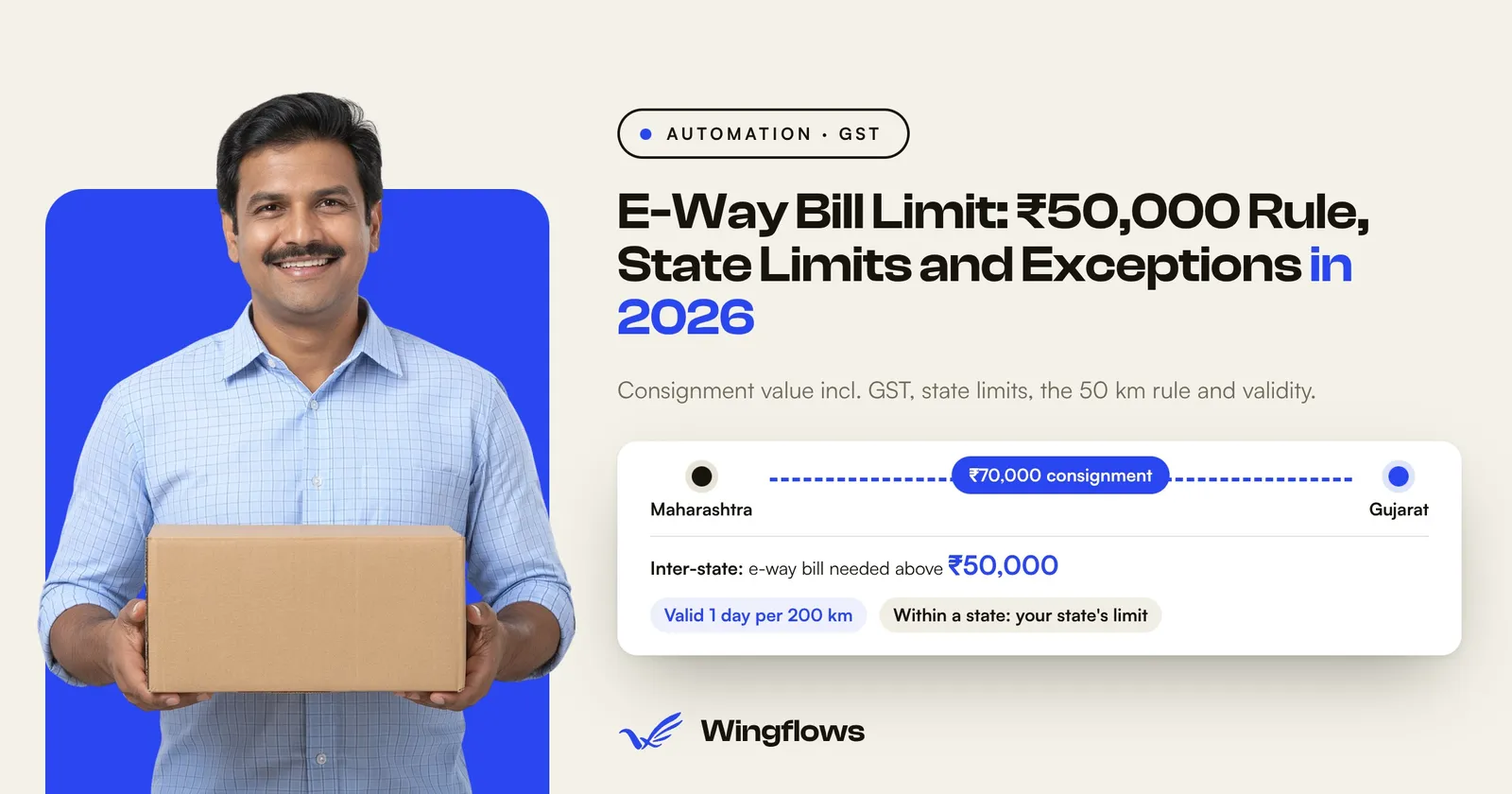
The e-way bill limit is ₹50,000. Under CGST Rule 138, a registered person who moves goods with a consignment value above ₹50,000 must create an e-way bill on the government portal before the goods leave. The consignment value includes the GST on the invoice or challan. That limit always applies to inter-state movement. For movement inside one state, each state sets its own limit: many use ₹50,000, while Maharashtra, Delhi, Tamil Nadu and a few others use ₹1,00,000. Two cases need an e-way bill at any value: goods sent to a job worker in another state, and handicraft goods moved between states by certain unregistered sellers.
I built the e-way bill check in Wingflows’ free delivery challan tool. It compares the challan total, tax included, with ₹50,000 and flags inter-state job work at any value, so I checked each of those rules against Rule 138 first.
Checked against CGST Rule 138, CBIC Circular 64/38/2018-GST and state notifications on 19 November 2026. General information, not tax advice.
Key takeaways
- The national e-way bill limit is a consignment value above ₹50,000, and that value includes CGST, SGST, IGST and cess shown on the document.
- Exempt goods on a mixed invoice don’t count toward the ₹50,000.
- Within a state, the limit depends on the state. Several use ₹1,00,000; check your own state’s notification.
- Inter-state job work and certain inter-state handicraft movements need an e-way bill whatever the value.
- An e-way bill is valid for one day per 200 km (20 km for over-dimensional cargo), can be cancelled within 24 hours, and can only be made for documents dated within the last 180 days.
- Moving taxable goods without a required e-way bill can cost ₹10,000 or the tax evaded, whichever is higher, and the vehicle can be detained.
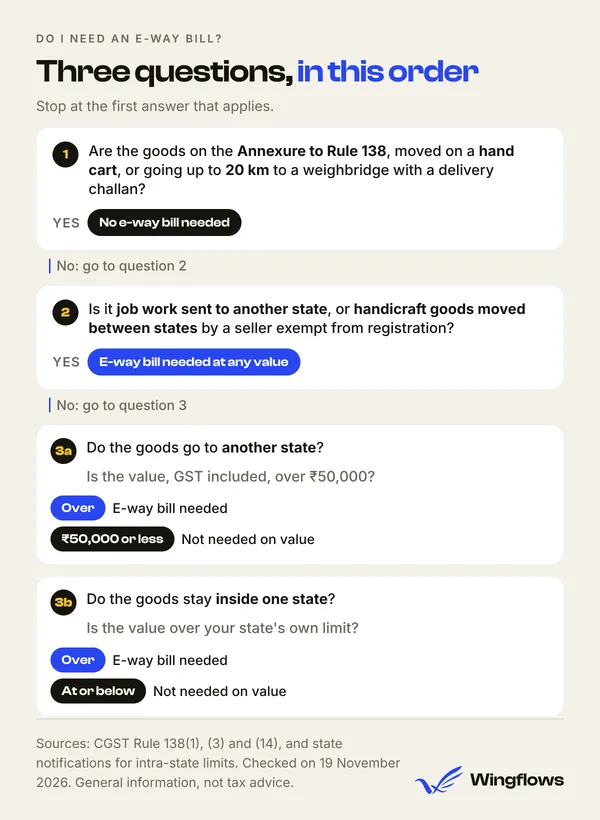
E-way bill limit at a glance
The rule text used here is Rule 138 as published by the Chhattisgarh Commercial Tax (GST) department, a state copy of the central rule.
How to work out consignment value
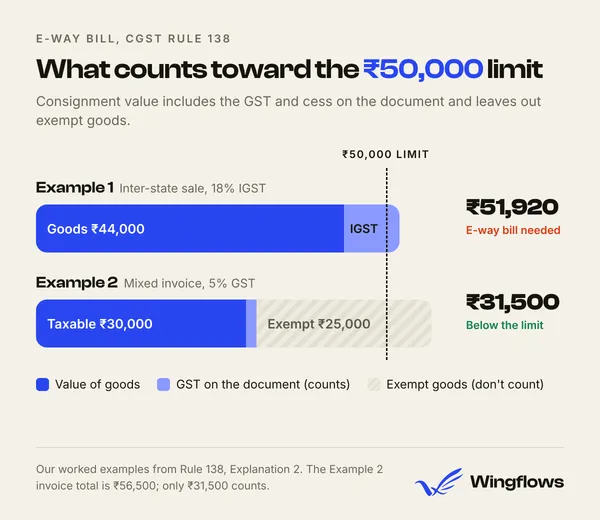
Most mistakes with the e-way bill limit come from comparing the wrong number with ₹50,000. Rule 138 defines consignment value as the value of the goods declared in the invoice, bill of supply or delivery challan, including central tax, state or UT tax, integrated tax and cess charged on it. It excludes the value of exempt supplies when one invoice covers both exempt and taxable goods (Rule 138, Explanation 2). Whether a sale is inter-state, and so carries IGST, follows its place of supply.
Our worked examples
These are our own calculations, using the rule above.
Example 1: the goods are under ₹50,000, the invoice is not. You sell goods worth ₹44,000 to a buyer in another state at 18% IGST. IGST is ₹7,920, so the consignment value is ₹51,920. That is over ₹50,000, so you need an e-way bill, even though the goods alone were below the limit.
Example 2: a mixed invoice. One invoice has taxable goods worth ₹30,000 at 5% GST (₹1,500 tax) plus exempt goods worth ₹25,000. The invoice total is ₹56,500, but the exempt goods don’t count. The consignment value is ₹31,500, so no e-way bill is needed for an inter-state move on value alone.
Example 3: goods sent on a delivery challan. You send goods worth ₹60,000 to a job worker in your own state on a delivery challan. No invoice exists yet, but the rule counts the value on the challan. Within the state, whether you need an e-way bill depends on your state’s limit. If the job worker were in another state, you would need one at any value.
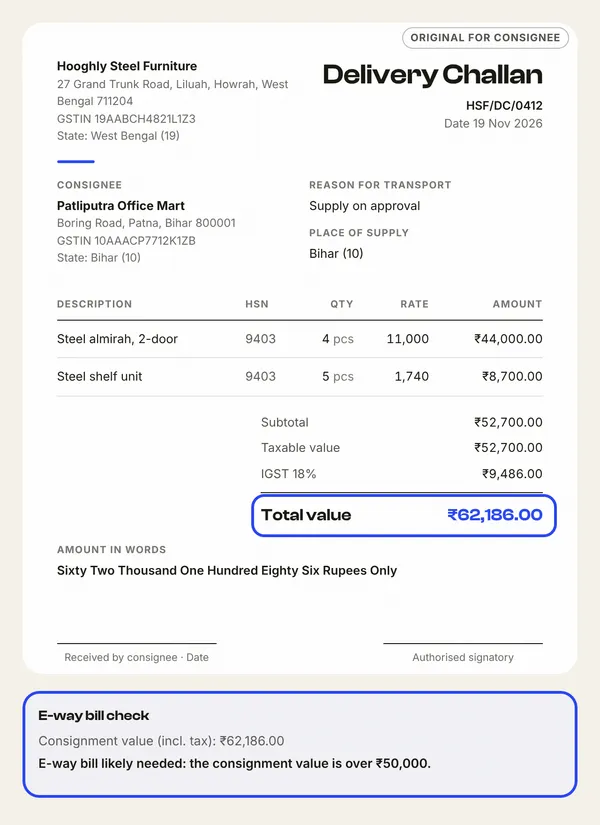
If you make challans by hand, the free delivery challan maker does the first part of this check for you: it reads the challan total and the two state codes, compares the total with the ₹50,000 central limit, and flags inter-state job work at any value. Within your state, compare with your state’s own limit, and leave out any exempt goods yourself.
State-wise e-way bill limit for intra-state movement
For goods that stay inside one state, the state decides the limit, and some states only apply it to certain goods. The table follows two commercial compilations, Busy’s state-wise list and MyBillBook’s e-way bill limit page, which agree on the limits except Kerala (Busy also still shows West Bengal’s old December 2023 change). West Bengal comes from the state’s own trade circular of 25 May 2026. Rechecked on 19 November 2026. States change these limits by notification, so confirm yours with its GST department before relying on the table.
West Bengal’s limit comes from Notification 02/2026-C.T./GST of 22 May 2026, which took it from ₹1,00,000 to ₹50,000 from 1 June 2026. The trade circular says intra-state job work movement stays exempt whatever the value.
Kerala is the row to check yourself. ClearTax’s Kerala page says there is no intra-state e-way bill except for movements named in Kerala notifications 3/2018 and 9/2018, and for gold from 20 January 2025. Taxscan’s report on Kerala Trade Circular 1/2025 gives the gold threshold as ₹10 lakh. One compilation lists Kerala at ₹50,000, so read the notifications on keralataxes.gov.in before you dispatch.
A higher intra-state limit doesn’t change the inter-state rule: a Maharashtra trader sending ₹70,000 of goods to Gujarat still needs an e-way bill. Some states apply their e-way bill only to a notified list of goods, so check the product as well as the value.
E-way bill limit in Maharashtra
Maharashtra issued Notification 15E/2018-State Tax on 29 June 2018, which removed the e-way bill requirement for movement inside the state up to ₹1 lakh from 1 July 2018 (the notification as reproduced by TaxHeal, a commercial copy). Movement from Maharashtra to another state stays at ₹50,000.
Worked example (our calculation): ₹80,000 of goods going from Pune to Nashik stay inside the state, so on value alone no e-way bill is needed. The same ₹80,000 going from Pune to Surat crosses into Gujarat, is over ₹50,000, and needs one.
Part A and Part B of the e-way bill
The e-way bill form, GST EWB-01, has two parts.
Within a state, Part B can be left blank for legs of up to 50 km between your place of business and the transporter’s, or from the transporter to the buyer; Part A is still needed. Part A comes from Rule 138(1) and its provisos. Part B comes from Rule 138(2) and (3), and the 50 km relief from Rule 138(3) and (5).
E-way bill distance limit: the 50 km and 20 km rules
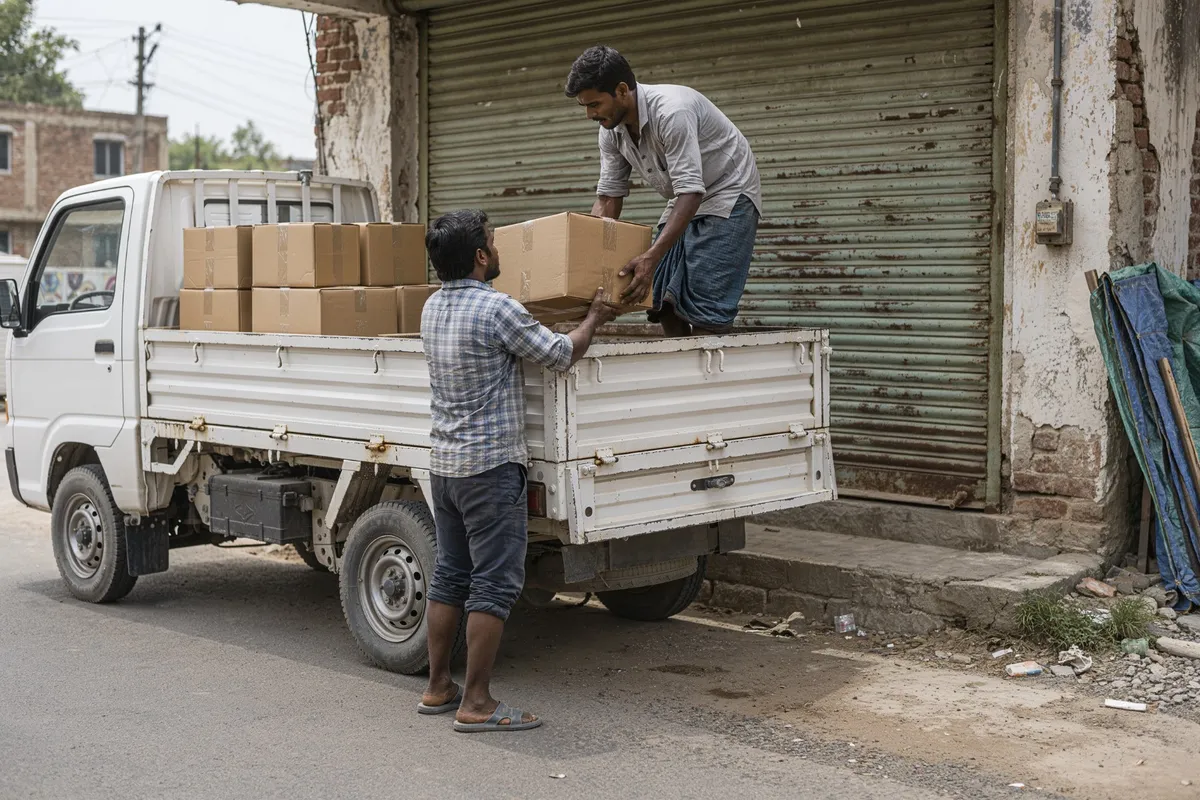
There is no national minimum distance below which the e-way bill limit stops applying. A ₹60,000 inter-state consignment needs an e-way bill even if the buyer is just across the border. Two short-distance rules lighten the process:
- 50 km to or from the transporter. Within one state, when goods go up to 50 km from your place of business to the transporter’s place of business for onward transport, you don’t have to fill Part B (the vehicle details) of the e-way bill (Rule 138(3)). The same relief applies to the leg from the transporter to the buyer, up to 50 km within the state (Rule 138(5), proviso). You still need Part A.
- 20 km to a weighbridge. Moving goods up to 20 km from your place of business to a weighbridge and back needs no e-way bill, as long as the goods travel with a delivery challan under Rule 55 (Rule 138(14)(n)).
If someone tells you “no e-way bill is needed under 10 km”, ask which rule they mean. The current Rule 138 text we checked uses 50 km for Part B and 20 km for weighbridge trips, and neither removes Part A for a sale above the limit.
E-way bill validity and other time limits
Validity counts from the time the e-way bill is generated, and each day expires at midnight of the day immediately following the date of generation (Rule 138(10), Explanation 1).
Validity, extension and cancellation come from Rule 138(9) and (10). The 180-day and 360-day limits come from the GSTN advisory on e-way bill and e-invoice updates, an official copy on the Maharashtra GST site. Because of the 180-day limit, an invoice dated in April can’t get an e-way bill in November, so goods that sat in stock on an old invoice need a fresh document.
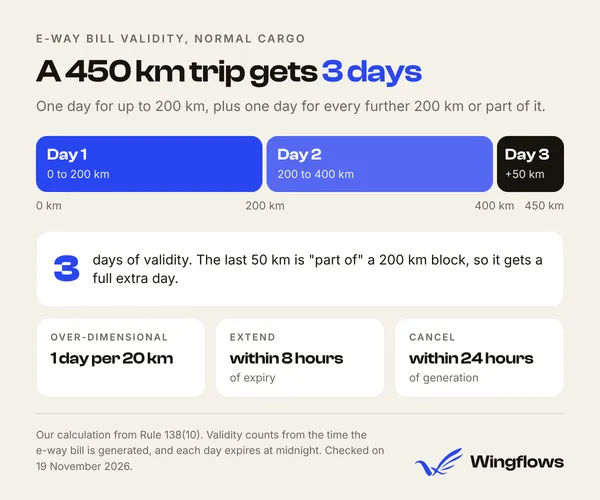
Worked example (our calculation): a truck carries normal cargo 450 km. The first 200 km gets one day, the next 200 km a second day, and the last 50 km is “part of” 200 km, so it gets a third day. The e-way bill is valid for 3 days. Because each day runs to midnight, read the expiry time on the portal instead of counting 24-hour blocks.
Several invoices in one truck
Consignment value is measured on each invoice, bill of supply or delivery challan (Rule 138, Explanation 2), and the vehicle is not the unit. Take three invoices of ₹30,000 each, for three buyers, on one truck. The load is worth ₹90,000, but each consignment is ₹30,000, so none of them crosses ₹50,000 by itself.
Rule 138(7) would let a transporter generate the e-way bill for an inter-state supply when the goods in one conveyance add up to more than ₹50,000. It has not been brought into force: a Kerala GST FAQ quoted in court said it was yet to be notified, and we found no later notification. The question has also reached court. In Bon Cargos Pvt Ltd v Union of India (W.P.(C) 1918 of 2020, Kerala High Court, 4 February 2020) the court did not decide it, left the competing arguments to the tax officer’s adjudication, and released the vehicle against a bank guarantee. Published summaries of a later Bon Cargos ruling disagree with each other and the judgments sit behind paywalls, so we have not relied on them.
For a mixed load, the practical step is to generate an e-way bill for each invoice anyway. Rule 138(3), first proviso, lets the registered person or the transporter do this below ₹50,000, and the portal can combine the bills in one vehicle into a consolidated e-way bill (e-way bill portal FAQ).
When no e-way bill is needed, whatever the value
The cases where you don’t need an e-way bill at all are listed in Rule 138(14). The ones a trader or manufacturer is most likely to meet:
- Goods listed in the Annexure to Rule 138
- Goods moved by a non-motorised conveyance, such as a hand cart
- Goods moved from a port, airport, air cargo complex or land customs station to an inland container depot or container freight station for customs clearance
- Goods moved within an area the state has notified for this purpose
- Goods moved up to 20 km to a weighbridge and back with a delivery challan
- Empty LPG cylinders moved for reasons other than supply
The same sub-rule exempts empty cargo containers, goods under customs seal and goods in transit to or from Nepal or Bhutan.
Some of my clients ship goods that end up at a port for export. The truck that takes them from the factory to the port still needs an e-way bill when the value is over the limit. ₹50,000 is the safe figure even when the port is in your state, because an export is an inter-state supply; check whether your state’s higher limit covers it. The customs-clearance exemption in Rule 138(14)(c) covers only the move from the port or airport to the inland container depot or container freight station.
E-way bill rules in 2026
The ₹50,000 limit is the same in 2026. These are the changes since January 2025:
- From 1 January 2025, the portal only accepts documents dated within the last 180 days, and an e-way bill can’t be extended beyond 360 days from when it was first made (the GSTN advisory linked above).
- From 1 June 2026, West Bengal’s intra-state limit is ₹50,000 instead of ₹1,00,000 under Notification 02/2026-C.T./GST, with intra-state job work still exempt.
- In 2026, GSTN announced that the Ship-To GSTIN field would become mandatory for bill-to-ship-to transactions, along with a voluntary closure option after delivery, with 1 August 2026 as the planned date. A GSTN advisory dated 29 July 2026 put both changes on hold until further notice (TaxGuru’s summary of the advisory, a commercial summary). When we checked on 19 November 2026, we found no newer date. If you use bill-to-ship-to often, ask your software vendor whether they already capture the ship-to GSTIN, so you’re ready if it comes back.
Penalty for moving goods without an e-way bill
Transporting taxable goods without the required documents is an offence under section 122(1)(xiv) of the CGST Act. The penalty is ₹10,000 or an amount equal to the tax evaded, whichever is higher.
Officers can also detain the goods and the vehicle in transit under section 129. If the owner of taxable goods comes forward, the penalty is 200% of the tax payable on them. If nobody comes forward, it is the higher of 50% of the value of the goods or 200% of the tax payable. We checked both figures against reproductions of the Act on GST Gyaan and KnowYourGST, because the CBIC pages did not load for our tools. Read the Act text before you quote an amount to a client.
Small mistakes that still cost you
A CBIC circular says officers should not start detention proceedings under section 129 for minor errors in an e-way bill (Circular 64/38/2018-GST). Its list:
- Spelling mistakes in the consignor or consignee name, when the GSTIN is correct
- A wrong PIN code with a correct address, if the error doesn’t extend validity
- An error in the consignee address, where the locality and other details are correct
- One or two wrong digits in the document number
- A wrong 4- or 6-digit HSN, when the first 2 digits and the tax rate are correct
- One or two wrong digits or characters in the vehicle number
Even these attract a penalty of ₹500 each under the CGST and SGST Acts (₹1,000 under the IGST Act) per consignment. Create the e-way bill from the same data as your invoice or challan, so nothing is typed twice.
A 5-minute check before your next dispatch
Find the consignment value. Take the invoice, bill of supply or challan value including GST and cess, minus any exempt goods.
Check where the goods go. Another state (see place of supply): compare with ₹50,000. Same state: compare with your state's limit from its notification.
Check the exceptions. Job work to another state or inter-state handicraft goods: e-way bill at any value. Annexure goods, hand cart, weighbridge trip: none needed.
Check the document date. If the invoice or challan is more than 180 days old, issue a fresh document first.
Work out validity. One day per 200 km (20 km for over-dimensional cargo). If the trip is tight, plan the extension window before the truck leaves.
You’ll come out with a clear yes or no for the e-way bill and a validity date to give your transporter.
Frequently asked questions
Is the e-way bill limit ₹1,00,000?
Not nationally. The CGST limit is a consignment value over ₹50,000. Some states, including Maharashtra, Delhi and Tamil Nadu, use ₹1,00,000 for movement within the state only. Inter-state movement from those states still uses ₹50,000.
What is the e-way bill limit within the same state?
Each state sets its own. Karnataka, Telangana, Uttar Pradesh, Haryana, Odisha and, from 1 June 2026, West Bengal use ₹50,000. Maharashtra, Delhi, Tamil Nadu, Punjab, Bihar, Madhya Pradesh, Jharkhand and Rajasthan use ₹1,00,000. Kerala generally has no intra-state requirement apart from specified goods such as gold. The state table above has the notes.
Can I generate an e-way bill below ₹50,000?
Yes. Rule 138(3), first proviso, lets the registered person or the transporter generate and carry an e-way bill at their option when the value is less than ₹50,000. It is voluntary, and some people do it for mixed loads.
Is the limit per invoice or per vehicle?
The rule counts consignment value for each invoice, bill of supply or delivery challan. Whether several small invoices in one vehicle add up is not settled by the rule text we found, so see the section on several invoices in one truck.
Does the e-way bill limit include GST?
Yes. Consignment value includes CGST, SGST or UTGST, IGST and cess charged on the document. It leaves out exempt goods on a mixed invoice.
Is an e-way bill required within 10 km?
There is no general 10 km exemption. Within a state, Part B (vehicle details) is not needed for movement up to 50 km between your place of business and the transporter. Trips up to 20 km to a weighbridge and back need no e-way bill if the goods have a delivery challan.
What is the time limit to cancel an e-way bill?
24 hours from generation. It can’t be cancelled after an officer has verified it in transit.
How long is an e-way bill valid?
One day for up to 200 km, plus one more day for every further 200 km or part of it. For over-dimensional cargo, it is one day per 20 km. Each day expires at midnight (Rule 138(10)).
Can an unregistered person generate an e-way bill?
Yes. Rule 138(3), second proviso, lets an unregistered person or their transporter generate one at their option. An unregistered consignor or consignee is entered as “URP” on the e-way bill, and a citizen can enrol on the portal to make one (CBIC FAQ (2019)).
What is the penalty for moving goods without an e-way bill?
Section 122 sets a penalty of ₹10,000 or the tax evaded, whichever is higher. If the vehicle is detained under section 129 and the owner comes forward, the penalty for taxable goods is 200% of the tax payable. See the penalty section above.
Make the challan and check the limit in one step
The quickest way to avoid a wrong e-way bill is to start from a correct challan. The delivery challan maker builds a Rule 55 challan with Original, Duplicate and Triplicate copies, works out the value in words, and flags when an e-way bill is likely needed under the ₹50,000 central limit. For sales, the GST invoice generator builds the tax invoice; use the 5-minute check above to decide on the e-way bill. Then generate the e-way bill itself on the government portal.
Teams that key the same dispatch into Tally, a spreadsheet and the e-way bill portal can cut that double entry; see how to automate your accounting process and our business systems and automation work. If that is your day, send us one day’s dispatch list and we’ll show where the repeat typing can go.