A bill of supply is the document a GST-registered business issues instead of a tax invoice when it can’t charge GST on the sale. It shows the value of the sale but no tax, and CGST Rule 49 sets its contents.
The first version of the bill-of-supply switch in our free GST invoice generator was labelled “unregistered / composition” and printed the composition declaration as a footer note. Reading Section 31(3)(c) and Rule 5(1)(f) showed that unregistered sellers don’t issue a bill of supply at all, and that the declaration belongs at the top of the bill, so I changed both.
Checked on 19 November 2026 against the CBIC texts of the CGST Act and the CGST Rules linked below, including the current CBIC page for Rule 46. General information, not tax advice.
Key takeaways
- Issue a bill of supply if you are GST-registered and either pay tax under the composition scheme or sell exempt goods or services.
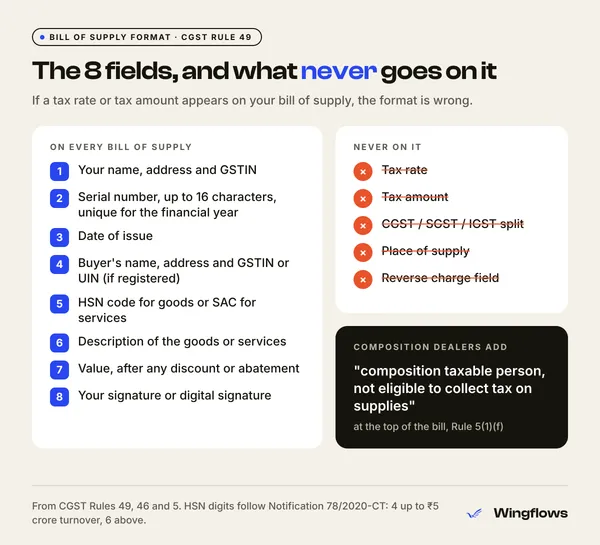
- It carries 8 fields under Rule 49: your details and GSTIN, a serial number, date, buyer details, HSN/SAC, description, value and signature. It shows no tax rate and no tax amount.
- Composition dealers must print “composition taxable person, not eligible to collect tax on supplies” at the top of every bill.
- To an unregistered buyer, taxable and exempt items can go on one invoice-cum-bill of supply (Rule 46A).
- Exports are billed on a tax invoice with the export endorsement, and a composition dealer can’t make inter-State outward supplies of goods at all.
What is a bill of supply in GST?
Section 31(3)(c) of the CGST Act names two cases: a registered person supplying exempted goods or services, and a registered person paying tax under the composition scheme (section 10). In both cases the bill shows the value of the sale but no GST (CGST Act, CBIC consolidated text). The contents are set by Rule 49 (CGST Rules, CBIC consolidated text).
A composition dealer pays tax as a percentage of turnover, and Section 10(4) says such a person “shall not collect any tax from the recipient on supplies made by him”, nor is he entitled to any credit of input tax (CGST Act, section 10).
Who issues a bill of supply, and who doesn’t
The law ties the document to the seller’s position and the kind of sale (Section 31, Rules 46, 46A, 49).
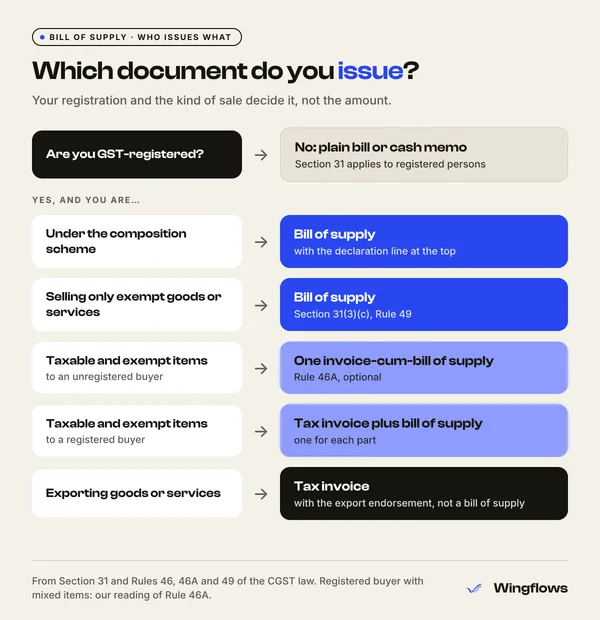
Mixed sales. Rule 46A says that where a registered person supplies taxable as well as exempted goods or services to an unregistered person, a single “invoice-cum-bill of supply” may be issued for all such supplies. It was inserted on 13 October 2017 (Notification 45/2017-CT). Since 26 December 2022 (Notification 26/2022-CT) a proviso adds that the single document must contain the particulars of Rule 46 (or Rule 54, as the case may be) and of Rule 49, so it carries tax lines for the taxable items and none for the exempt ones (Rule 46A, CBIC consolidated text). The CBIC flyer on tax invoices describes the same option (CBIC/NACIN flyer). The rule says “may”, so separate documents are still allowed.
Exports. Some online guides list “exports without payment of tax” as a bill-of-supply case. The proviso to Rule 46 beginning “in the case of the export of goods or services, the invoice shall carry an endorsement” says otherwise: the invoice carries the endorsement “supply meant for export … under bond or letter of undertaking without payment of integrated tax” (or the “on payment of integrated tax” version) (Rule 46, CBIC tax information portal). Exports are billed on a tax invoice, and the CBIC flyer on zero-rated supplies says “Normal tax invoice shall be issued” (CBIC/NACIN flyer). If the goods you export are themselves exempt, the law doesn’t say clearly which document applies; ask your CA. A composition dealer also can’t export goods: Section 10(2)(c) requires that he is “not engaged in making any inter-State outward supplies of goods”, and exports and sales to other states are inter-State (CGST Act, section 10(2)(c)).
Unregistered sellers. Section 31(3)(c) starts with “a registered person”. If you are not registered, you can’t charge GST and GST doesn’t prescribe a bill of supply for you. A plain bill or cash memo is the normal record of the sale. For how a cash memo differs from other documents, see invoice vs receipt and what a proforma invoice is.
Bill of supply format: the 8 fields in Rule 49
Rule 49 lists what every bill of supply must contain (Rule 49, CBIC consolidated text; CBIC/NACIN flyer):
- Your name, address and GSTIN
- A serial number of up to 16 characters, unique for the financial year
- Date of issue
- The buyer’s name, address and GSTIN or UIN, if the buyer is registered
- HSN code for goods or SAC for services
- Description of the goods or services
- Value, after any discount or abatement
- Your signature or digital signature, or that of an authorised representative
Rule 46 fields that a bill of supply leaves out (Rule 46): no tax rate, no tax amount, no CGST/SGST/IGST split, no place of supply and no reverse-charge field. If any of those appear on your bill of supply, the format is wrong.
Rule 49 adds provisos. The provisos to Rule 46 apply to bills of supply too. A tax invoice or similar document issued under another law for a non-taxable supply is treated as a bill of supply. An electronic bill of supply issued under the IT Act doesn’t need a signature (added by Notification 74/2018-Central Tax). And the government may, by notification, require a QR code on bills of supply (Rule 49, CBIC consolidated text).
The composition declaration line
If you are under the composition scheme, Rule 5(1)(f) requires the words “composition taxable person, not eligible to collect tax on supplies” at the top of the bill of supply. Rule 5(1)(g) also requires “composition taxable person” on every notice or signboard at your principal place of business and each additional place (Rule 5, CBIC consolidated text; CBIC composition rules page). The line isn’t in Rule 49’s list, so a template built only from Rule 49 leaves it out.
How many HSN digits?
Because Rule 49 applies Rule 46’s provisos, the HSN digit notification issued under Rule 46 is generally read as applying to bills of supply too. Since 1 April 2021 the digit count has depended on last year’s aggregate turnover (Notification 78/2020-CT):
Sellers with turnover up to ₹5 crore may leave out the HSN code on documents for unregistered buyers. Both notifications speak of tax invoices, so ask your CA if you want certainty for your own bills of supply. The 8-digit list covers specified items in Chapters 28, 29, 38 and 39 (chemicals and plastics), so most shops never meet it (Notification 90/2020-CT).
A sample bill of supply layout
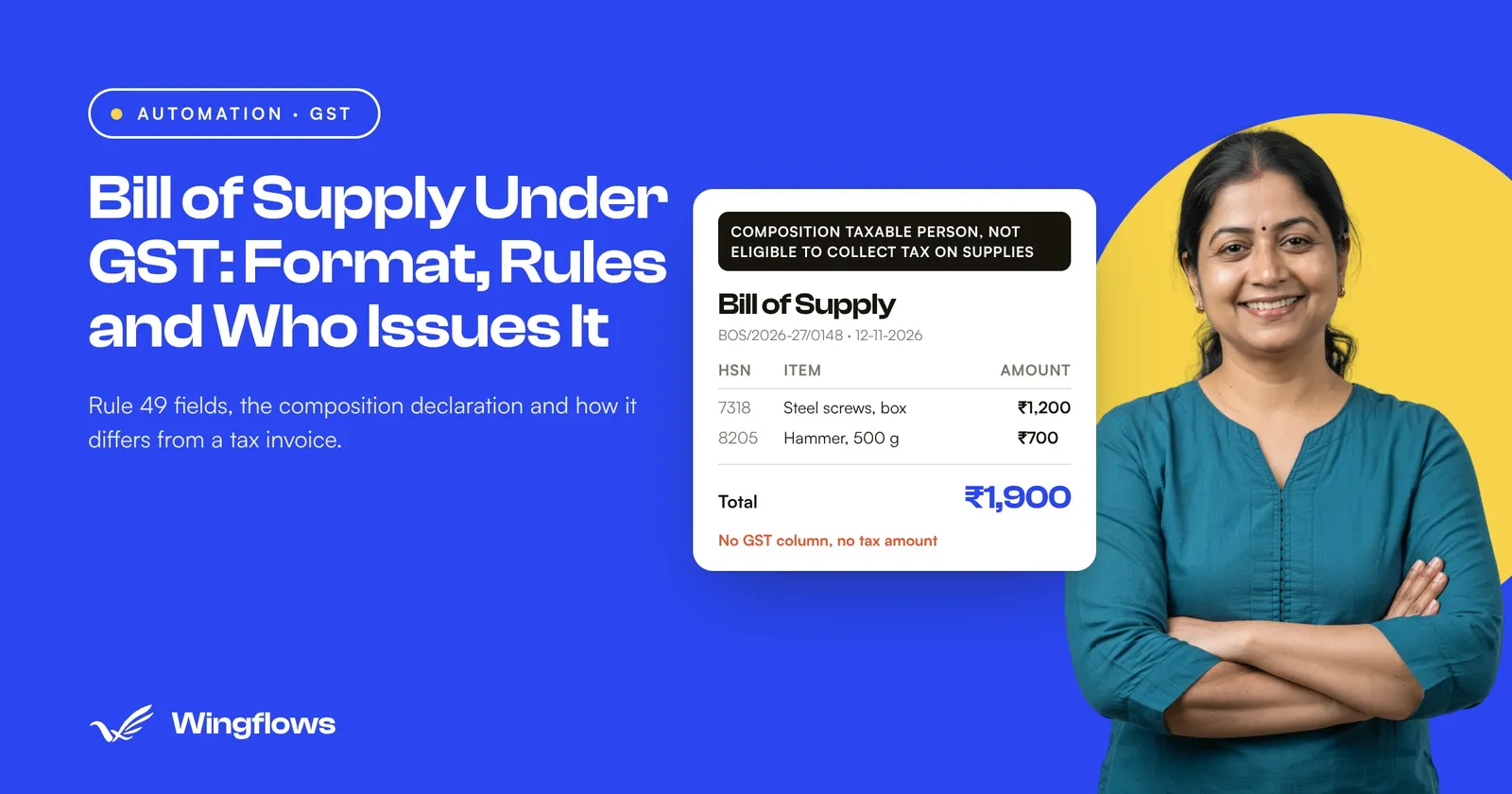
This is a real capture from our free generator, filled for a made-up composition trader. Names and numbers are invented. The declaration line sits at the top, and the bill has no place of supply, no reverse-charge field and no GST lines.
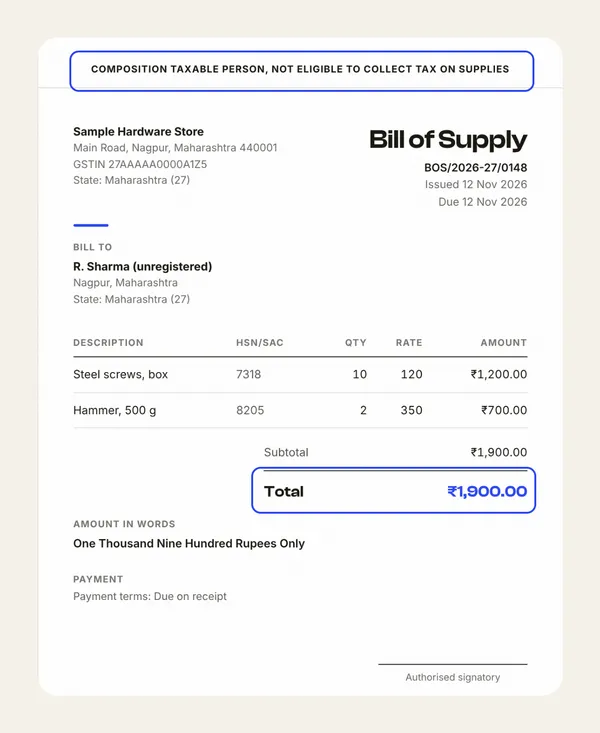
The HSN codes here are for illustration only: check the code for your own goods.
Bill of supply vs tax invoice
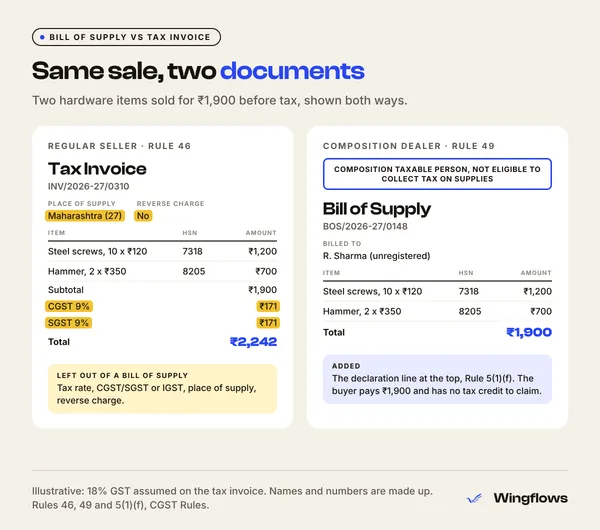
Sources: Section 31 and Section 10, Rule 46, Rules 49 and 5. On input tax credit, Section 16(2)(a) lets a buyer claim credit only while in possession of a “tax invoice or debit note”, and Section 10(4) says a composition dealer is not entitled to input tax credit himself (CGST Act). A bill of supply is neither, so a buyer has nothing to claim.
A registered buyer pays the full bill-of-supply amount and has no credit to claim back. If you sell to registered businesses under the composition scheme, tell them before they order.
Small sales under ₹200
You don’t always have to write a bill of supply. The proviso to section 31(3)(c) says a registered person may skip it when the value is less than ₹200, “subject to such conditions and in such manner as may be prescribed” (CGST Act, section 31). Rule 46 sets the conditions for the tax-invoice version, and Rule 49 applies them to bills of supply: the buyer is not registered and doesn’t ask for a bill, and you issue one consolidated document for all such sales at the close of each day (Rule 46).
For a busy counter, that means small walk-in sales can go on one end-of-day bill of supply instead of fifty slips. The moment a customer asks for a bill, or the sale is ₹200 or more, issue an individual one.
Bill of supply and the e-way bill
A bill of supply works as the base document for an e-way bill. Under Rule 138, the value that counts for the e-way bill is the one on “an invoice, a bill of supply or a delivery challan”, and exempt items on a mixed invoice are left out of it (Rule 138, Explanation 2, CBIC consolidated text). So if a composition dealer moves goods worth more than the e-way bill limit, the bill of supply number and value go into the e-way bill. For goods moved without a supply, such as goods sent for job work or stock moved between your own premises under the same GSTIN, the document is a delivery challan (Rule 55), not a bill of supply.
Common bill of supply errors
- Charging GST as a composition dealer. The bill must not add GST, and Section 10(4) bars you from collecting tax from the buyer.
- Leaving out the declaration line. Composition dealers need it at the top, word for word.
- Using a bill of supply for exports. Exports normally go on a tax invoice with the export endorsement.
- Showing a tax column “at 0%”. A bill of supply has no tax fields at all. A 0% column suggests a tax invoice and confuses the buyer’s accountant.
- Sharing the number series with tax invoices. The number must be unique for the financial year and no longer than 16 characters. A separate series such as “BOS/2026-27/0148” keeps it apart from tax invoices if you issue both.
If your bill book was printed before you joined the composition scheme, check it for a GST column and a missing declaration line.
Make a bill of supply in the free GST generator
In the free GST invoice generator, turn on the “Bill of supply” switch. It swaps the heading to Bill of Supply and drops the GST lines from the totals. A composition bill gets the declaration line at the top, and the place-of-supply and reverse-charge fields disappear.
Open the GST invoice generator and enter your business name, address and GSTIN. The tool fills the number as INV-2026-001; change it to your own bill-of-supply series, such as BOS/2026-27/0148.
Turn on "Bill of supply" in the Tax section. The heading changes and the GST lines disappear from the bill.
Add the buyer. Add their GSTIN only if they are registered.
List the items with HSN or SAC, quantity and rate. Check the total and the amount in words.
Pick your case. Composition dealers leave "Exempt goods or services" off: the tool prints "Composition taxable person, not eligible to collect tax on supplies" above the title, at the top of the bill. If you sell exempt goods or services instead, turn on "Exempt goods or services"; the declaration line is dropped and the bill says "Exempt supply. No GST charged." Then download the PDF.
Frequently asked questions
Who can issue a bill of supply?
A GST-registered person who pays tax under the composition scheme, or who supplies exempted goods or services. Both are named in section 31(3)(c) of the CGST Act.
Can a composition dealer issue a tax invoice?
No. Section 31(3)(c) requires a registered person paying tax under section 10 to issue a bill of supply instead of a tax invoice, and Section 10(4) bars the dealer from collecting tax from the buyer.
Is a bill of supply required for sales below ₹200?
Not always. The proviso to section 31(3)(c) lets a registered person skip it below ₹200, subject to the conditions in Rule 46 (an unregistered buyer who doesn’t ask for a bill, and one consolidated document at the close of each day). See small sales under ₹200 above.
Is GSTIN mandatory on a bill of supply?
Yours is, because Rule 49 requires the supplier’s name, address and GSTIN. The buyer’s GSTIN or UIN goes on only if the buyer is registered.
Is HSN code mandatory on a bill of supply?
Yes, Rule 49 lists the HSN code (or SAC for services) as a required field. The number of digits follows Notification 78/2020: 4 digits for turnover up to ₹5 crore, 6 above, and 8 for the chemicals in Notification 90/2020. Sellers up to ₹5 crore may leave it out for unregistered buyers on tax invoices; the notification doesn’t name bills of supply, so check with your CA.
Can the buyer claim input tax credit on a bill of supply?
No. A bill of supply carries no GST, and Section 16(2)(a) ties credit to a tax invoice or debit note. If your buyer needs input tax credit, they need a tax invoice from a regular-scheme supplier.
What is the difference between a bill of supply and a cash memo?
A bill of supply is a GST document for registered composition dealers and exempt suppliers, with the fields set by Rule 49. A cash memo is a simple record of a cash sale; unregistered shops use it because GST doesn’t prescribe a document for them. The cash memo maker covers that case.
Is a bill of supply needed for exports?
Usually not. Exports are billed on a tax invoice that carries the export endorsement under Rule 46, either “under bond or letter of undertaking without payment of integrated tax” or “on payment of integrated tax”. If the goods you export are themselves exempt, the law doesn’t say clearly which document applies; ask your CA.
Can I issue one bill for taxable and exempt goods?
Yes, if the buyer is unregistered. Rule 46A allows a single “invoice-cum-bill of supply” for both. For a registered buyer, issue a tax invoice for the taxable items and a bill of supply for the exempt ones.
Two series, two documents
The GST invoice generator produces the bill of supply in your browser as a PDF, so you can download it and keep your own copy.
A registered seller of both taxable and exempt goods, selling to registered buyers, issues tax invoices for one and bills of supply for the other. Two separate numbering series keep them apart; Rule 49 allows one or more series, as long as each number is unique for the financial year. In a printed bill book or a spreadsheet, two series are easy to mix up, and a number can end up used twice. Locking each series to its document type is one of the rules a business systems and automation project can add, so a bill of supply only ever takes a BOS number. Tell us which documents you issue.