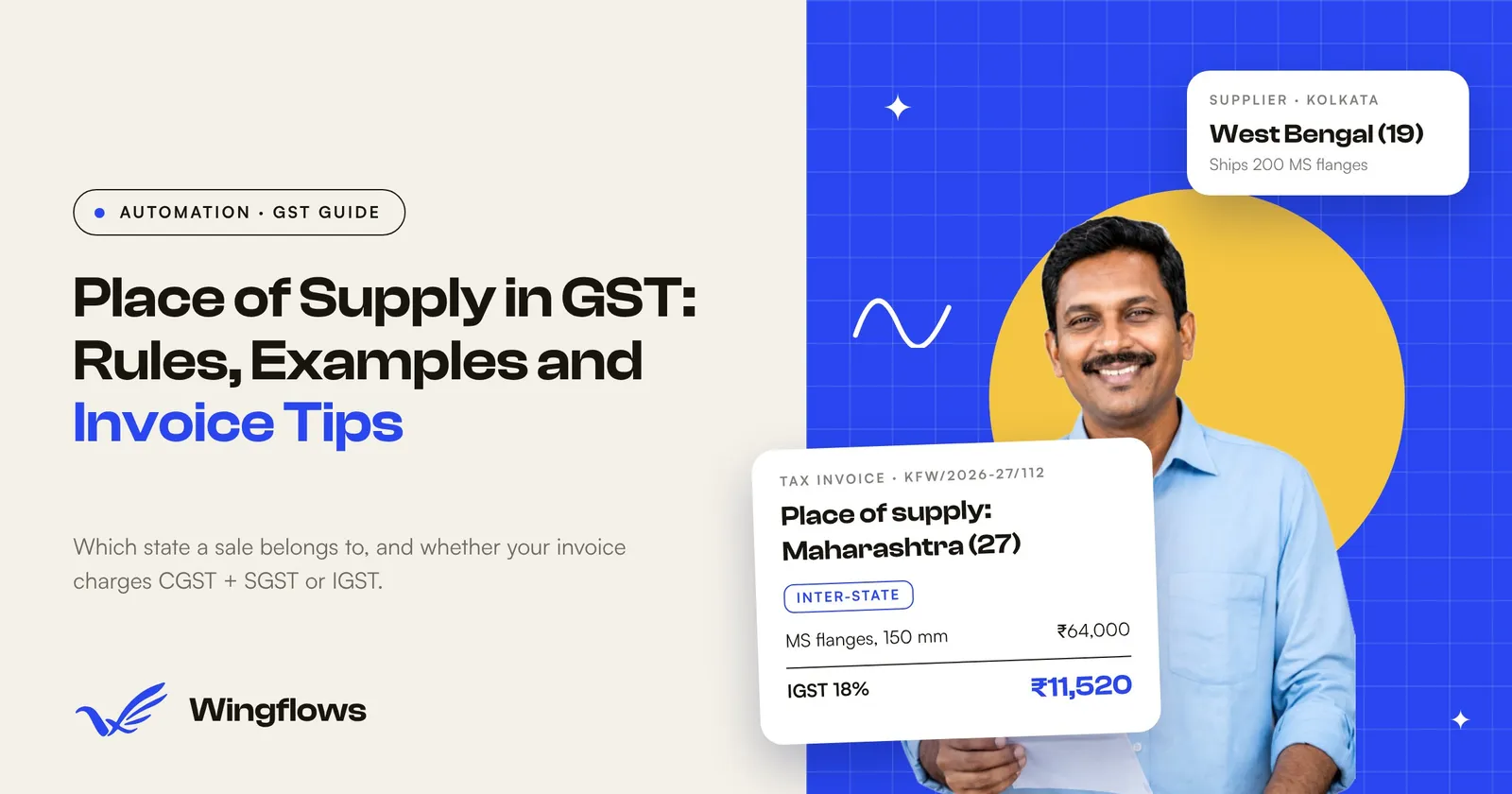
Place of supply in GST is the state where the law treats your sale as made. Check it against your own state. Same state: charge CGST + SGST. Different state: charge IGST (IGST Act, sections 7 and 8).
For goods, it is usually the state where the goods reach the buyer. For goods sold to an unregistered buyer, it is the address you write on the bill. For most services to a registered business, it is the state on the buyer’s GSTIN.
When I built the place-of-supply field in our free GST invoice generator, this was the rule that took the most care. The generator picks CGST + SGST or IGST from two state codes, so I checked every exception in this guide against the law first.
Checked against the CBIC text of the IGST Act, the CGST Act and the CGST Rules on 19 November 2026. General information, not tax advice.
Key takeaways
- Place of supply in your own state: CGST + SGST. In another state: IGST. Exports and sales to SEZ units are always inter-state, and can go out without IGST under a bond or Letter of Undertaking.
- Goods to a registered buyer: the state where the goods are delivered. Goods to an unregistered buyer: the address or state on your bill, or your own state if the bill has none.
- In a bill-to-ship-to sale, the supplier’s invoice follows the state of the party who said where to ship.
- Services to a registered buyer: the state on the buyer’s GSTIN. Hotels, restaurants, salons, events and property work have their own rules.
- If you charged IGST instead of CGST + SGST, issue a credit note and a fresh invoice in time, or pay the right tax and claim a refund within two years.
What is place of supply in GST?
Place of supply is the state or union territory where GST treats a sale as made. The rules sit in the IGST Act: section 10 for goods, section 12 for services. Sections 11 and 13 cover sales where you or the buyer is outside India (IGST Act, 2017).
Sections 7 and 8 then compare it with your own location:
- Sale inside your state (intra-state): your location and the place of supply are in the same state or union territory. You charge CGST + SGST, or CGST + UTGST.
- Sale to another state (inter-state): they are in different states. You charge IGST.
- Always inter-state: exports, and supplies “to or by a Special Economic Zone developer or a Special Economic Zone unit”, even when the SEZ is in your own state (section 7(5)).
Exports and supplies to an SEZ unit for its authorised operations are also zero-rated. They can be made “without payment of integrated tax, under bond or Letter of Undertaking” (CBIC, IGST Act section 16).
Your location is the registered place of business you bill from (CBIC IGST flier). With GST registrations in two states, use the one on the invoice.
Place of supply of goods under GST (section 10)
Section 10(1) has six rules for goods that stay within India (CBIC, IGST Act section 10):
Clause (ca) is the newest rule. It came into force on 1 October 2023 under Notification 02/2023-Integrated Tax, and for an unregistered buyer it applies instead of clauses (a) and (c) (CBIC Circular 209/03/2024-GST). Writing the buyer’s state on the bill counts as writing the address. When the bill shows a different delivery address, the circular says the delivery address decides.
For imports, the place of supply is “the location of the importer”. For exports, it is “the location outside India” (section 11).
Place of supply in case of bill to ship to
A trader in Delhi takes an order from a buyer in Mumbai. The trader has no stock and asks a Delhi manufacturer to ship straight to Mumbai. That makes two sales and two invoices (ICMAI article on bill to ship to).
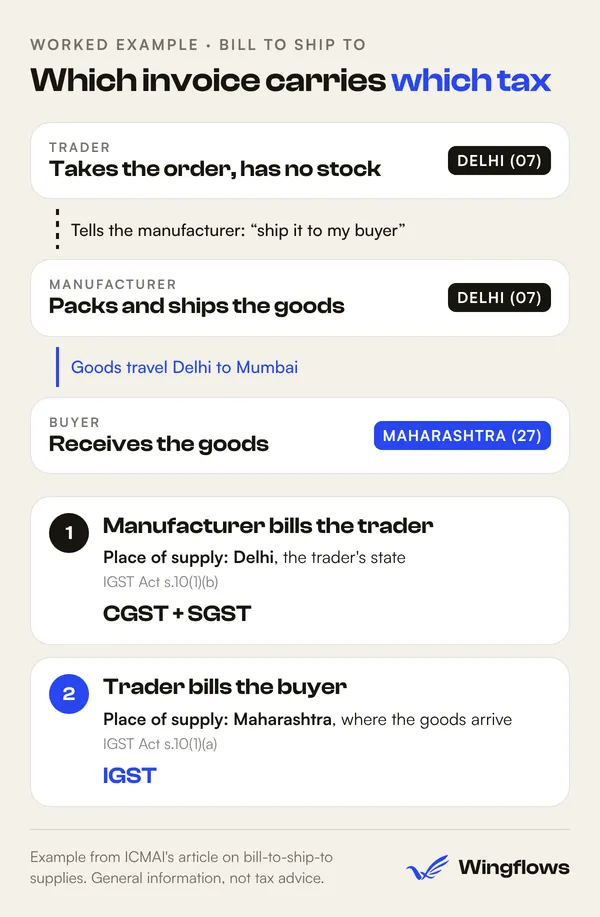
Invoice 1 is where billing staff slip. The goods cross into Maharashtra, yet the manufacturer charges CGST + SGST, because the trader gave the shipping instruction. On the e-way bill, the trader goes in “Bill to” and the Mumbai address in “Ship to”. The CBIC e-way bill FAQ says the tax is entered “as per the billing state party” (CBIC e-way bill FAQs).
Sending stock to your own branch in another state
Each GST registration counts as a separate person. A business “shall, in respect of each such registration, be treated as distinct persons”. A supply between them, made in the course of business, is a supply under GST even without payment (CBIC flier on the meaning and scope of supply).
So stock sent from your Kolkata shop to your own godown registered in Odisha is an inter-state supply. The godown’s state, Odisha (21), is the place of supply, and the transfer carries IGST on a tax invoice.
Place of supply of services under GST (section 12)
When you and the buyer are both in India, start with the general rule in section 12(2) (IGST Act):
- Registered buyer: “the location of such person”, which is the state on the buyer’s GSTIN.
- Unregistered buyer: “the location of the recipient where the address on record exists”. With no address on record, it is your own location.
Then check for a special rule. These are the ones a shop, trader or small service firm is likely to meet (CBIC, IGST Act section 12):
The freight row is about the transporter’s own bill, not your bill for the goods. From 1 October 2023 it also covers goods sent outside India, because the old exception for those shipments was removed (Taxmann on the Finance Act 2023; Khaitan & Co).
If you or the buyer is outside India, section 13 applies. Its general rule is “the location of the recipient of services”. The exceptions keep some services in India. Work on goods, or on a person who must be present, is taxed where it is done (13(3)). Hotel stays and other property services are taxed where the property is (13(4)). Events are taxed where they are held (13(5)) (IGST Act). A Kolkata hotel billing a guest from Germany therefore charges CGST + SGST.
How to determine place of supply in 4 steps
Goods or a service? Goods follow section 10, services section 12. A machine sold with installation is usually one supply of goods installed at site, so it is taxed where it is installed.
Export, import, or a sale to or by an SEZ unit? That is always inter-state. For a service to a buyer outside India, use the section 13 rules above.
Find the state. Goods: where they reach a registered buyer, the address on the bill for an unregistered buyer, or the state of whoever told you where to ship. Services: a special rule from the table, or else the state on the buyer’s GSTIN.
Compare it with your own state. That gives you CGST + SGST or IGST.
Place of supply examples for a Kolkata business
Each case below is a business registered in West Bengal (state code 19). The readings are ours. For anything unusual, check with your CA.
Rule 46(e) makes two addresses compulsory on a bill of ₹50,000 or more to an unregistered buyer: the buyer’s address and the delivery address. Where the delivery address is different, it decides the place of supply (Circular 209/03/2024). For a large counter sale to a buyer from another state, ask your CA what to enter as the delivery address.
What to print on the invoice
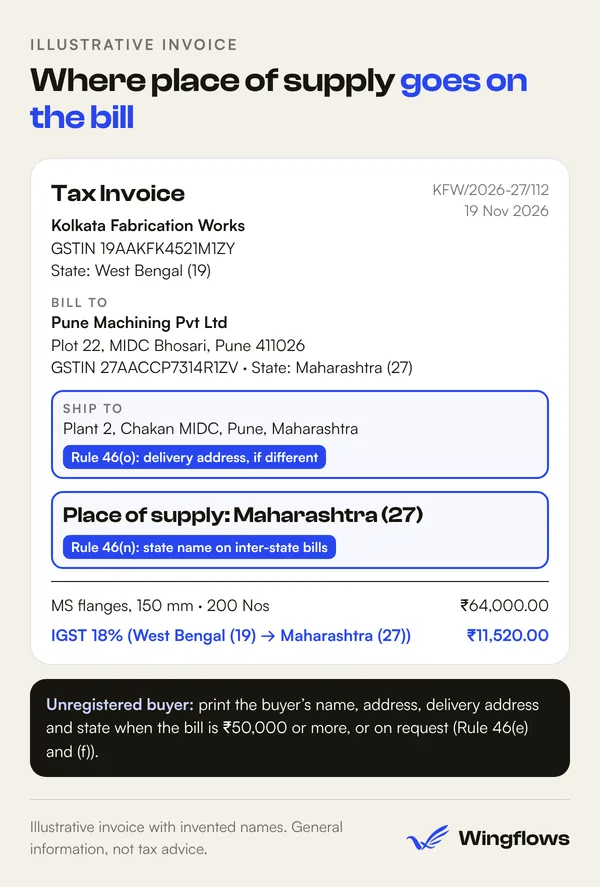
For place of supply, a GST invoice needs:
- The buyer’s name, address and GSTIN, if the buyer is registered.
- The place of supply with the state name and code, for example “Place of supply: Bihar (10)”.
- The delivery address, if it differs from the place of supply.
- For an unregistered buyer: name, address, delivery address and state when the bill is ₹50,000 or more, or when the buyer asks.
These come from Rule 46 of the CGST Rules: clauses (e) and (f) for unregistered buyers, (n) for the place of supply on inter-state bills, and (o) for the delivery address (CBIC, Rule 46). One extra case applies to online sales. For services sold to an unregistered buyer through an e-commerce operator, or online information and database services, the invoice “shall contain the name of the state of the recipient”.
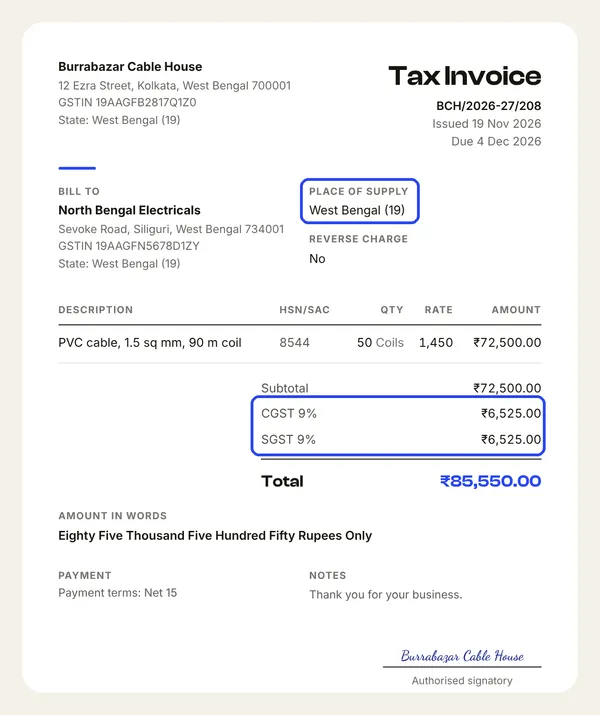
Print the place of supply on bills inside your state too, so anyone checking the bill sees why it carries CGST + SGST.
The free GST invoice generator has a place-of-supply field. Leave it empty and it uses the buyer’s state. Here is the Siliguri case from the examples table:
How to fix IGST charged instead of CGST + SGST
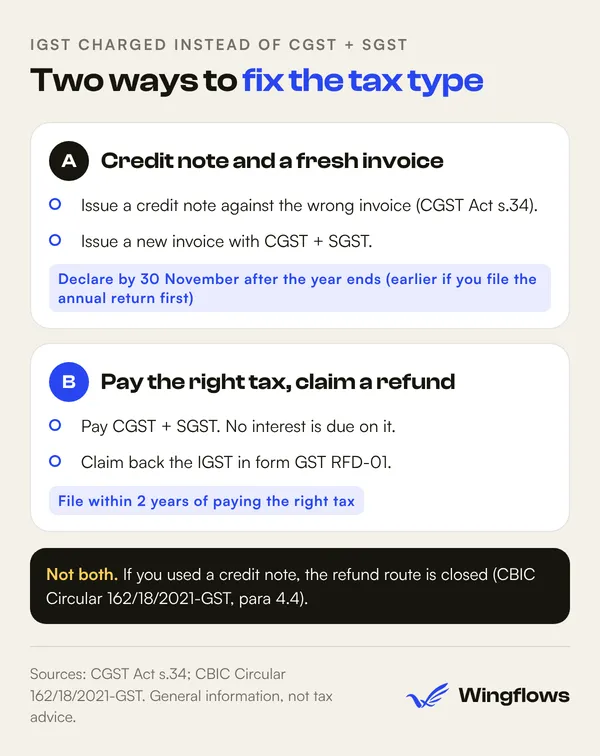
- Credit note and a fresh invoice. Section 34 of the CGST Act allows a credit note when the tax charged on an invoice is more than the tax payable. Issue one against the wrong invoice, then a new invoice with the correct tax. Declare the credit note by 30 November after the end of the financial year, or earlier if you file the annual return first (CBIC, CGST Act section 34).
- Pay the right tax and claim a refund. Pay CGST + SGST. No interest is due on it. Then claim the IGST back in Form GST RFD-01, within two years of paying the correct tax (CBIC Circular 162/18/2021-GST).
You can’t use both. The circular says the refund “would not be available where the taxpayer has made tax adjustment” through a credit note. The same two routes work the other way, for CGST + SGST charged on an inter-state sale.
Once the section 34 deadline has passed, a credit note can no longer reduce the tax, so only the refund route is left.
Common place-of-supply mistakes on GST invoices
Open your last ten bills to buyers in other states. Each should show the place of supply with the state code, IGST, and the delivery address if it differs. Then look for these:
- Billing the trader in a bill-to-ship-to sale with IGST because the goods left the state. The supplier’s invoice follows the trader’s state.
- Leaving the address off bills to unregistered buyers without knowing the effect. With no address, the sale stays in your state. With an address in another state, it usually becomes IGST.
- Using the general services rule for hotels, restaurants, events or property work.
- Billing an SEZ unit in your own state with CGST + SGST.
- Moving stock to your own branch in another state on a challan, when the branch has its own GSTIN.
Frequently asked questions
What is meant by place of supply under GST?
It is the state or union territory where a sale is treated as made. Compare it with your own state: the same state means CGST + SGST, a different state means IGST. The rules are in sections 10 to 13 of the IGST Act.
Is place of supply mandatory on a GST invoice?
Yes, on inter-state invoices. Rule 46(n) of the CGST Rules asks for the place of supply with the name of the state.
What is the place of supply in case of bill to ship to?
For the supplier who ships on a third party’s instruction, it is the third party’s principal place of business, the state on its GSTIN (section 10(1)(b)). The third party then bills the final buyer, with the place of supply where the goods arrive.
What is the place of supply for services to an unregistered person?
Under the general rule, it is the buyer’s address on your records, or your own location if you have none (section 12(2)(b)). Restaurants, salons, hotels and property work follow their own rules.
What happens if I charge IGST instead of CGST + SGST?
Issue a credit note and a new bill with CGST + SGST, within the section 34 time limit. Or pay CGST + SGST and claim the IGST back in Form RFD-01 within two years (CBIC Circular 162/18/2021). You can’t do both.
Is a sale to a customer from another state always inter-state?
No. For goods sold to an unregistered customer, the address you write on the bill decides (or the delivery address, if it is different), and with no address it is your own state (section 10(1)(ca)). Restaurant, salon and similar services are taxed where they are done (section 12(4)).
Set up your invoices once
Note the place of supply for each kind of sale you make, and set your invoice template to print it. The free GST invoice generator splits CGST + SGST or IGST from the place of supply and gives you a PDF without sign-up.
If your team picks the tax type by hand on every bill, or retypes bills from a bill book into Tally, we can automate that with business systems and automation. See also how to automate your accounting process, or talk to us about how your billing works today.
We can also connect your billing to Tally or ERPNext, so the place of supply and the tax type reach your books without retyping.