
How long does it take to build a website? With a professional, a basic 1–5 page site takes about 1–2 weeks, a small business site 4–8 weeks, a small online store 8–12 weeks and a custom web application 6–12 months or more, according to published estimates. A typical website takes our studio 2–4 weeks, and on most projects the date is set by content, feedback and approvals rather than by the build.
This guide is for owners about to hire someone for a new site or a redesign, or already waiting on one. It puts the published timelines side by side with their sources, checks whether those numbers add up, lists the outside lead times (Google, Stripe, DNS) that no builder can shorten, and ends with a week-by-week plan.
Checked on 23 November 2026 against Elementor, Shopify, Hostinger, Webstacks, Kota, PMI, Google, Stripe and Cloudflare documentation. Every source is linked below.
Key takeaways
- Published estimates for a professionally built site: 1–2 weeks (basic), 4–8 weeks (small business), 8–12 weeks (small store), 6–12+ months (custom web app). Redesigns run from 6 weeks to 6 months.
- We added up the phase durations in two well-known guides. Run back to back, Elementor’s phases come to about 5–20 weeks and Shopify’s to about 14–27 weeks, longer than either guide’s own headline answer. Short timelines only work when phases overlap.
- One week of waiting adds 25% to a 4-week project and about 8% to a 12-week one. Fast builds are the most sensitive to slow replies.
- Some clocks belong to other companies. Most Business Profile postcards arrive within 14 days, a first Stripe payout typically takes 7–14 days, and Google needs a few days to a few weeks to crawl new pages. Start the slow ones in week 1.
- None of the published timelines come with survey data. Use them to judge whether a quote is in the normal range, not as a promise.
How long does it take to build a website, by type?
Three companies that sell website tools or services publish the most detailed ranges. The table uses Elementor for new builds and Webstacks, a web agency, for redesigns. Hostinger adds up phase estimates for a site coded from scratch.
Hostinger’s figures for a site coded from scratch: 8–21 days for a single page and 11–36 days for a small store.
Sources: Elementor (modified 29 June 2026), Hostinger (dated 6 November 2026), Webstacks (updated 16 November 2026). None of the three cites survey data for these figures, so read them as estimates from people who sell the work.
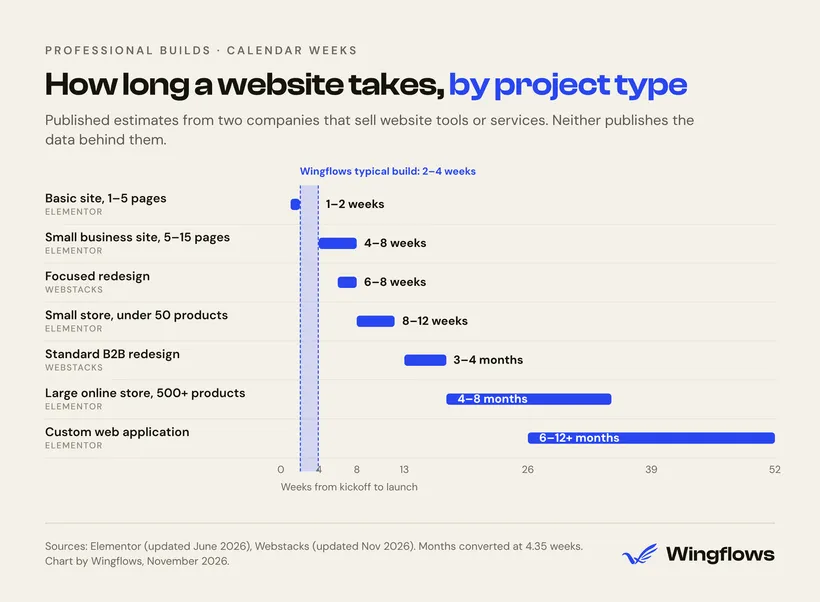
Hostinger’s coded store (11–36 days) looks faster than Elementor’s professional store (8–12 weeks). The gap is in what is counted. Hostinger adds up working days per phase. Elementor’s professional figures read as calendar time, which includes the days a site sits waiting for copy, photos or a decision. That waiting is the part an owner can shrink.
We added up the phases: where the weeks go
Most guides list a duration for each phase and then give an overall answer. We checked whether the two agree, using our own arithmetic on two of the best-known guides.
Elementor lists six phases: strategy 1–2 weeks, design 1–4, build 1–8+, content 1–3, QA 1–2 and launch 1 day to 1 week. Shopify lists seven: CMS and hosting 1–2 weeks, goals and information architecture 1–3, low-fidelity wireframes 1–2, high-fidelity 2–3, development 4–10, marketing prep 4–6, and launch and QA 3–5 days.
Sources: Elementor (above) and Shopify (8 May 2025). Our calculation, November 2026.
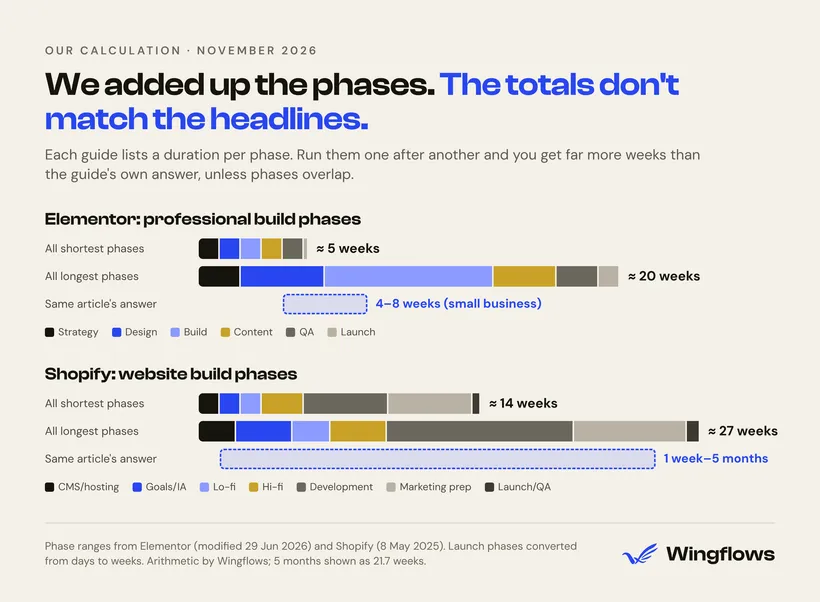
Neither guide is wrong. The phases are meant to overlap, and the overall answers quietly assume they do. That changes how you read a quote.
First, a fast timeline needs parallel work: copy is written while the design is made, and testing starts while the last pages are built. If your quote is 4 weeks and the plan shows phases in a strict line, ask where the overlap is.
Second, design and development carry most of the spread. In Elementor’s table they account for 10 of the 15 weeks between the shortest and longest totals. Elementor’s own example: “A decisive client can finalize designs in a week. A large committee can be stuck in revisions for a month.”
How long does it take to build a basic website?
A basic website here means one to five pages: home, services, about, contact, perhaps one landing page. Elementor’s estimate is 1–3 days on a DIY builder and 1–2 weeks with a professional. Hostinger puts a single-page site coded from scratch at 8–21 days, of which development is 3–10 days.
What keeps a basic site in that range is having the words and photos before work starts. On a five-page site, one week spent waiting for the About page can be half the project.
Ecommerce websites: product data, payments and shipping
Elementor puts a small store (under 50 products) at 8–12 weeks with a professional and a 500+ product store at 4–8 months. Shopify says a multi-page store with advanced features “can take more than three or four months”.
Three parts of a store take longer than owners expect, and all three sit with the owner.
Product data. Every product needs a title, price, description, photos and variants. Shopify imports products from a CSV file, and “your product CSV can’t exceed 15 MB” (Shopify Help Center). Large catalogues get split into several files. Start the spreadsheet the week you sign.
Payments. With Stripe, the first payout after your first live payment typically arrives 7–14 days later, depending on industry, country and risk level (Stripe docs). Verify the account early and run a live test order well before launch week.
Shipping, tax and policies. Shipping zones, tax settings, returns and terms all need decisions before checkout can be tested. Write them down in week 1.
If you are still choosing a platform, our Shopify vs WordPress comparison covers the cost and upkeep difference, and our e-commerce services page shows what a store build includes.
Redesigns: the redirect work a new build doesn’t have
Webstacks puts a focused redesign of priority pages, on the existing CMS and brand, at about 6–8 weeks, a standard B2B redesign at 3–4 months, and an enterprise redesign at 4–6 months (Webstacks).
A redesign has to keep what the old site already earns in search. If page addresses change, every old URL needs a redirect to its new one. Google says that for a medium-sized site “it can take a few weeks or more” before it starts showing the new URLs, and advises keeping redirects for “generally at least 1 year” (Google Search Central). Plan the redirect list as its own task with its own time. Our website migration page explains how we handle it.
A redesign is also a rare project, which is why it is worth planning properly. Orbit Media found its own clients’ sites lasted 6 years and 4 months on average between major redesigns (78 sites), while 50 top marketing brands redesigned every 2 years and 1 month (Orbit Media, updated June 2026).
Custom websites and web apps
Elementor’s estimate for a custom web application is 6–12 months or more. Booking systems, customer portals, quoting tools and anything with user accounts belong here. The fastest way to shorten it is to split the project: launch the marketing site in weeks, then build the application behind it in phases, each with its own scope and date. Our custom software and AI page covers that kind of work.
What actually delays a website project
Content that isn’t ready
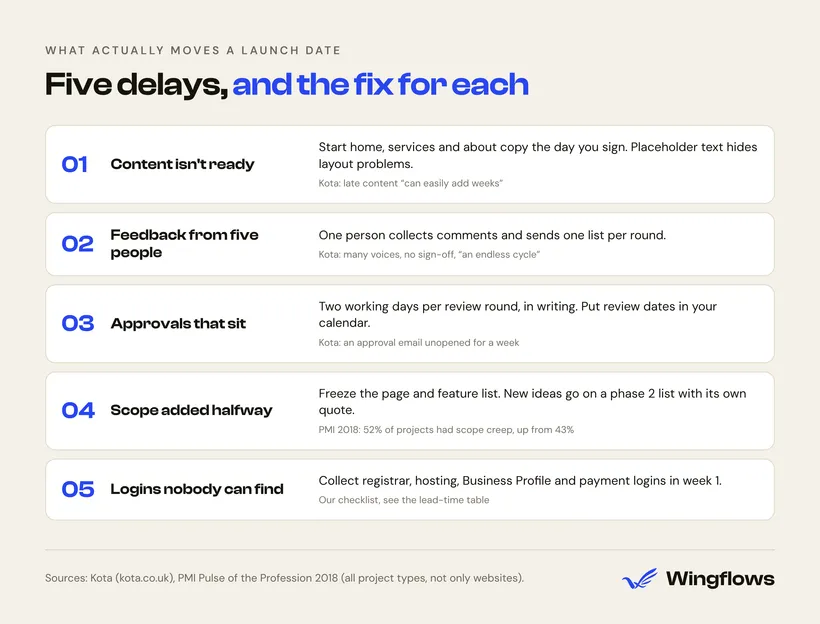
UK agency Kota lists late or incomplete copy, images and video as a main reason projects stall, and notes that “late content can easily add weeks to a timeline” (Kota). In Elementor’s phase table, content population alone is 1–3 weeks. If you are writing the copy yourself, start on the day you sign.
Feedback from too many people
When several people comment separately on the same page, the designer has to reconcile the comments before changing anything, and often has to ask which one wins. Kota describes many voices without a clear sign-off turning one round of changes into “an endless cycle”. Name one person who collects feedback and sends a single list per round.
Approvals that sit
Kota’s example is an approval email that “sits unopened for a week”. We worked out what that week costs at different project lengths.
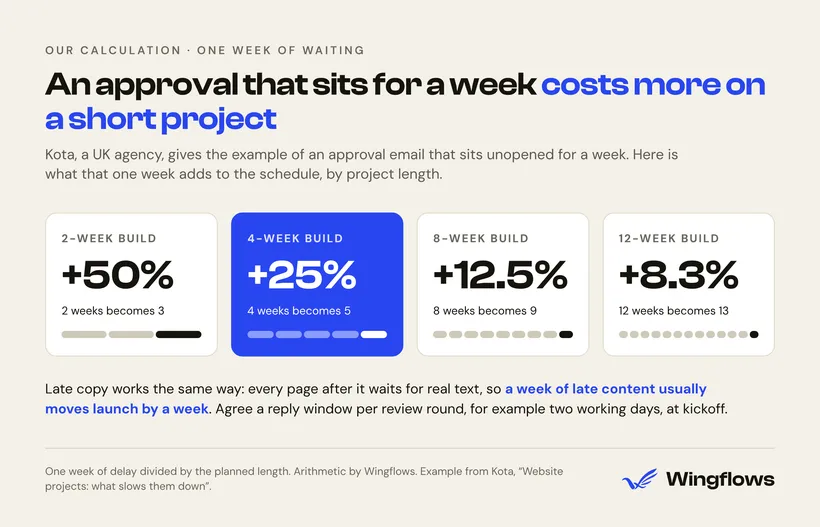
The shorter the project, the more a slow reply hurts. Agree a reply window at kickoff, for example two working days per review round, and put the review dates in your calendar.
Scope added halfway
In PMI’s Pulse of the Profession survey, 52% of projects completed in the 12 months before the 2018 survey had scope creep, up from 43% five years earlier (PMI). The survey covers projects of all kinds, not only websites. On a website, scope creep sounds like “can we also add a blog, a booking form, a second language”. Each item needs design, content and testing. Keep a phase 2 list and add to that instead.
Logins and third-party accounts
A finished site can still miss its date because nobody can log in to the domain registrar, the old hosting, the Google Business Profile or the booking tool. Collect every login in week 1, and check the domain sits in an account in your company’s name.

Lead times your builder can’t speed up
Most timeline guides stop at the build. A small business launch also depends on other companies’ schedules, and none of them move faster because the site is ready. We compiled the official numbers.
Compiled by Wingflows from official documentation, checked 23 November 2026.
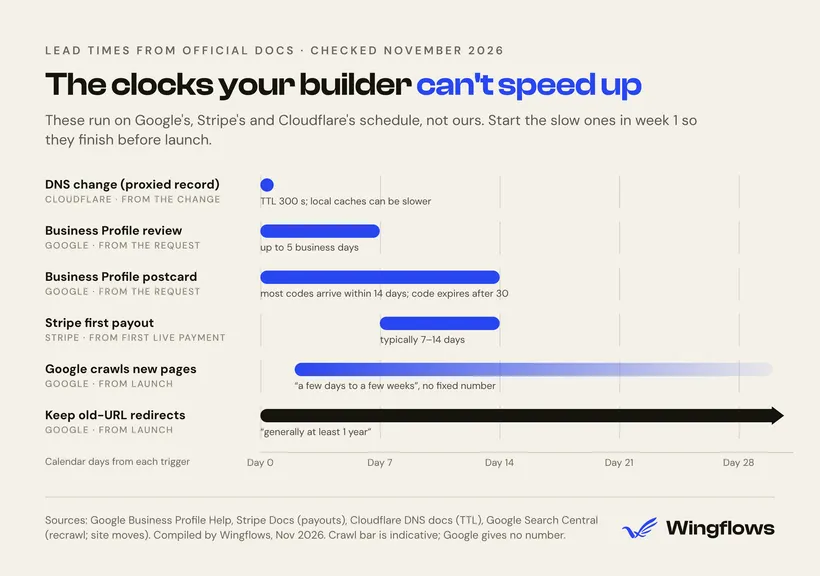
The DNS row is the fast one. On a proxied Cloudflare record, resolvers cache a change for at most five minutes, so pointing the domain can wait until launch morning (moving nameservers is a separate step, and Cloudflare gives no number for it). The postcard and payout rows are the ones that catch owners out. A local business that requests its Business Profile postcard in launch week can have a live site and no verified Maps listing for another two weeks. Request it, and verify the payment account, in week 1.
A week-by-week plan for a small business site
Here is a 4-week plan for a typical small business site of 5–10 pages on a template or CMS, with one decision-maker and copy written alongside the build. Elementor’s agency plan for the same kind of site takes 8 weeks: weeks 1–2 strategy and wireframes, 3–4 design mockups, 5–6 build, week 7 content and testing, week 8 launch. Overlapping the work and keeping review rounds short closes most of that gap.
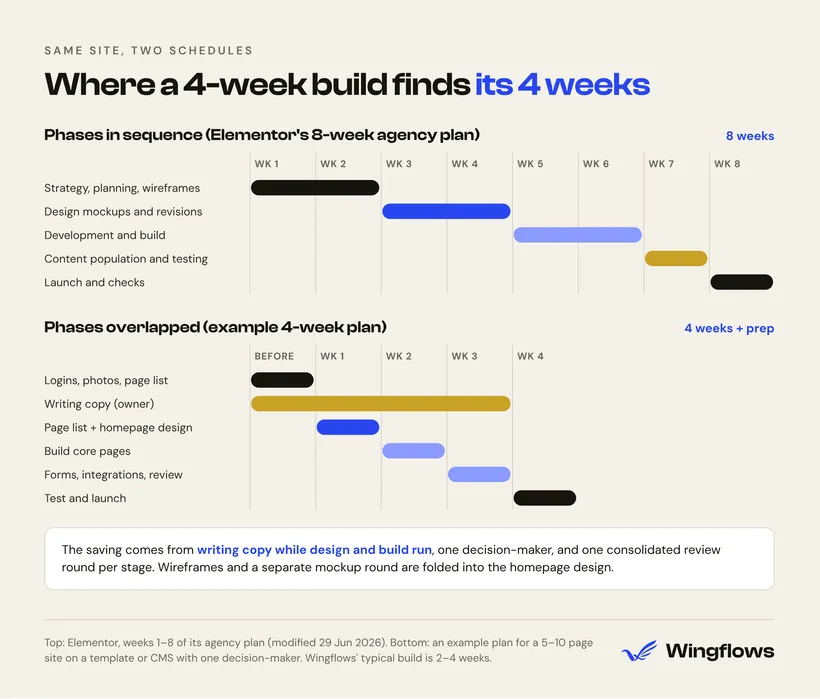
Before kickoff. Gather logins (domain, hosting, Business Profile, booking or payment tools), logo files, photos and the page list. Request the Business Profile postcard and start the payment-account checks. Start writing the home and services copy.
Week 1: plan and first design. Agree the page list, the forms and integrations, and what moves to phase 2. The homepage design comes first and gets one consolidated round of feedback.
Week 2: build the core pages. The approved homepage style is carried to the other pages, built with real copy where it exists. Missing content goes on a list with due dates.
Week 3: forms, integrations and second review. Contact and booking forms, analytics, email notifications and any shop or payment setup. You review the whole site on your own phone and send one list of changes.
Week 4: test and launch. Fix the review list, test every form and link on mobile and desktop, set up redirects if this replaces an old site, point the domain, and submit the sitemap in Google Search Console.
If content arrives late, or the site needs a shop or custom features, the same plan stretches. A week of late copy usually moves launch by a week, because every page after it waits for real text.
How to build a website faster
Each of these removes waiting time, which is where most of the calendar goes:
- Draft the home, services and about pages before kickoff. A rough draft lets the designer lay out real text instead of placeholders.
- Pick one person who approves design, copy and launch. Everyone else sends comments to that person.
- Put a reply window of two working days per review round in writing.
- Freeze the page list and features before work starts. New ideas go to a phase 2 list with its own quote.
- Use a template or CMS where it fits. Elementor claims visual builders “can cut development time by 50-70%” (a vendor figure without published data). Ask your builder which pages need custom design and which a template covers.
- Launch home, services, about and contact on the date, then add blog posts, case studies and extra pages in the weeks after.
After launch, the site is online but not yet in search results. Submit the sitemap in Search Console on launch day and request indexing for the key pages, then expect Google’s “few days to a few weeks”. From then on the site needs updates and checks; our guide to website maintenance cost covers what that costs per month.
Before you sign: three questions about the timeline
Ask any builder these before agreeing a launch date. If you are still comparing builders, our guide on how to hire a web development agency covers the rest of the vetting.
- What do you need from me, and by which date, for this timeline to hold?
- How many review rounds are included, and how long do I have for each?
- What happens to the launch date if I add a page or a feature?
A builder who answers all three in writing has planned for the delays above. Our website services page lists what our builds include, and our portfolio shows recent sites. Clinics with booking and patient-form needs can see our websites for clinics page.
Frequently asked questions
How long does it take to build a website on average?
There is no independent average with a published method. Vendor and agency estimates put a professionally built small business site at 4–8 weeks (Elementor), and Shopify gives a range of one week to five months depending on complexity. A typical website takes our studio 2–4 weeks.
Can you build a website in a week?
A one-page or basic site can be built in a week if the content, photos and logins are ready on day one. Elementor estimates 1–3 days for a DIY builder site and 1–2 weeks for a basic site built by a professional. A store or a custom feature set won’t fit in a week.
How long does it take to build a five-page website?
Elementor’s estimate for a 1–5 page brochure site is 1–2 weeks with a professional and 1–3 days on a DIY builder. Five pages fit that range when the copy for all five exists before design starts.
Can you build a website in a month?
Yes, for most small business sites of 5–10 pages on a template or CMS, as long as one person approves and copy is written alongside the build. A store with a large catalogue, a redesign with many redirects or anything with user accounts usually needs longer.
Can I use AI to build a website quickly?
AI builders produce a first draft fast. Hostinger says its AI Builder makes a first version in 5–15 minutes and that a single-page site “can often be completed in under an hour”. AI shortens the build step only. Your copy, photos, decisions, payment setup and Google verification take the same time as before.
How long does it take to build an ecommerce website?
Elementor estimates 8–12 weeks with a professional for a store under 50 products and 4–8 months for 500 or more. Product data, payment verification and shipping decisions usually decide where you land in that range.
How long does it take to redesign a website?
Webstacks puts a focused redesign at about 6–8 weeks and a standard B2B redesign at 3–4 months. Add time for the redirect list if page addresses change.
How long until a new website shows up on Google?
Google says crawling can take anywhere from a few days to a few weeks after you request it, and asking repeatedly won’t speed it up. Submit your sitemap in Search Console on launch day to start that clock.
Planning a website and need a date you can trust
Talk to us. Tell us what you have ready and when you need to launch, and we’ll tell you plainly whether that date works and what it depends on. Agencies looking for a build partner can use the same page.