Job work under GST is any treatment or process a person carries out on goods that belong to another registered person. The owner, called the principal, can send inputs and capital goods to the job worker without paying GST, on a challan, as long as they come back within one year (inputs) or three years (capital goods). The job worker charges GST only on the job work service, under SAC heading 9988.
Wingflows’ free delivery challan maker has a job work option, and we made a test job work challan in it for the example below. General information, not tax advice: check your own case with your CA.
Key takeaways
- Only a registered principal can use the job work route, and it is optional. Ownership of the goods never moves to the job worker.
- Send the goods on a challan issued by the principal under Rules 45 and 55. Goods going to a job worker in another state need an e-way bill whatever their value.
- Inputs must come back within 1 year and capital goods within 3 years. Moulds, dies, jigs, fixtures and tools don’t have to come back.
- Miss the deadline and the goods count as supplied on the day you sent them, so you pay the tax with interest.
- The principal files Form GST ITC-04: half-yearly above ₹5 crore turnover, once a year up to ₹5 crore.
- Job work services fall under SAC 9988. The rate is 1.5% for diamonds, 5% for most food, textile, leather and printing work, and 18% for the rest.
What is job work under GST?
Section 2(68) of the CGST Act defines job work as “any treatment or process undertaken by a person on goods belonging to another registered person” (CBIC Circular 38/12/2018-GST, para 2). Think of a garment maker sending grey fabric to a dyeing unit, an engineering firm sending castings out for machining or plating, or a printer finishing pages for a publisher.
Whether it is job work or a normal sale comes down to who owns the goods, who is registered and whose material goes in:
- Ownership stays with the principal. The job worker only processes the goods; they remain “goods belonging to another registered person”.
- The principal must be registered. Only a registered person can send goods for job work under these provisions, and using them is optional (Circular 38/12/2018, para 6).
- The job worker can add some of their own material. Whether the activity is still job work then depends on the facts of each case (para 5).
The job work rules at a glance
Section 143 of the CGST Act sets the procedure.
Sources: section 143 of the CGST Act; Rules 45 and 55 of the CGST Rules; Circular 38/12/2018-GST, paras 2, 8.4 and 10; Notification 35/2021-Central Tax for ITC-04.
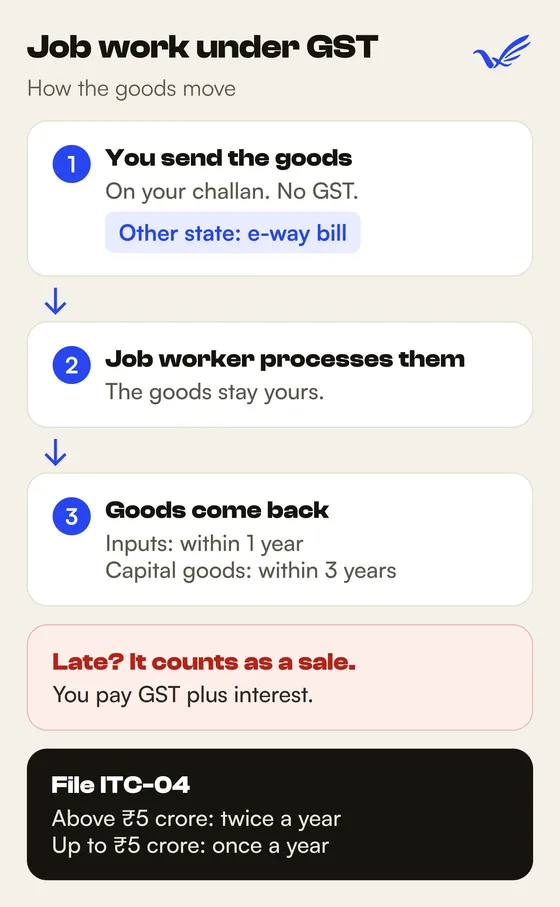
How to send goods for job work: 5 steps
Check the route fits. You are registered, the goods are inputs, semi-finished goods or capital goods, and you want them back processed. If the processor will keep the goods, it is a sale: raise a tax invoice instead.
Issue a job work challan. Rule 45 requires a challan issued by the principal that carries the Rule 55 details. Prepare it in triplicate and send two copies with the goods (Circular 38/12/2018, para 8.4).
Check the e-way bill. If the job worker is in another state, an e-way bill is needed whatever the value, generated by the principal or by the job worker if registered (Rule 138(1)). Inside your state, your state's limit applies.
Write down the return date. One year from the dispatch date for inputs, three years for capital goods. Put it on the challan and in a register of open challans: challan number, date, goods and value, job worker, return due date, quantity back so far and balance.
Report it in ITC-04. Every challan sent, and every lot received back, goes into Form GST ITC-04 for the period. The circular makes the principal responsible for including all of them (para 8.4(vi)).
When the job worker returns goods in parts, the job worker issues a fresh challan for each lot (para 8.4(v)). Goods can also move from one job worker to another: Rule 45 lets the sending job worker issue that challan and brings those challans into the principal’s ITC-04 as well.
Job work challan: what it must show
There is no separate “job work challan format” in the rules. It is a delivery challan under Rule 55, which lists transportation of goods for job work as one of the cases where a challan replaces a tax invoice (Rule 55(1)(b)). The challan number can be at most 16 characters, and the three copies are marked ORIGINAL FOR CONSIGNEE, DUPLICATE FOR TRANSPORTER and TRIPLICATE FOR CONSIGNER (CGST Rules, CBIC consolidated text).
On a job work challan, show the taxable value of the goods but no GST, because sending them is not a supply. The value decides the e-way bill check for movement inside a state, and it is the value on which tax is due if the goods don’t come back in time.
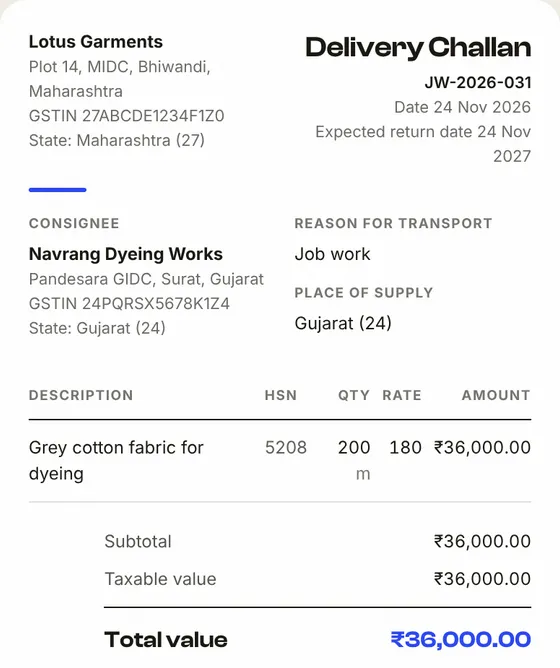
We made a test challan in our delivery challan maker: Lotus Garments in Bhiwandi, Maharashtra, sends 200 metres of grey cotton fabric (HSN 5208) worth ₹36,000 to Navrang Dyeing Works in Surat, Gujarat, for dyeing. Both businesses and GSTINs are made up for the test. With “Job work” picked as the reason, the challan shows the expected return date under the number and charges no tax.
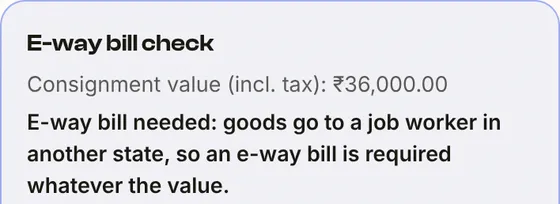
The e-way bill check flags that an e-way bill is needed even though ₹36,000 is under the ₹50,000 limit, because the job worker is in another state.
The test challan shows 24 November 2027 as the expected return date, which is the legal limit for inputs. For a real job, put the date you expect the work to finish; the one-year limit is the outer edge, not the plan.
For more on when the ₹50,000 limit applies and how each state sets its own, see our guide to the e-way bill limit.
Time limits: what happens if goods don’t come back
Inputs must come back within one year and capital goods within three years of dispatch (section 143; Circular 38/12/2018, para 2). Moulds and dies, jigs and fixtures, and tools are left out of this rule: nothing requires them to be returned or supplied.
If the deadline passes, Section 143(3) and (4) treat the goods as “supplied by the principal to the job worker on the day when the said inputs or capital goods were sent out”, and the principal must declare the supply in GSTR-1 and pay the tax with interest. The circular says the principal issues an invoice for it, with interest for the intervening period.
Job work under GST example
Worked through with the test challan:
Interest on tax paid late runs at 18% a year under section 50(1) (Notification 13/2017-Central Tax).
Goods can also leave the job worker without coming back to you first. You can sell them from the job worker’s premises if the job worker is registered or you have declared the premises as an additional place of business, and you issue the invoice. A registered job worker can sell waste and scrap directly from their place of business on payment of tax; if they are unregistered, you do it (Circular 38/12/2018, para 9).
Input tax credit on goods sent for job work
You don’t lose input tax credit by sending goods out. The circular makes ITC available to the principal whether the principal or the job worker receives the goods, which covers goods your supplier ships straight to the job worker (para 10). For that direct route, your supplier’s invoice is in your name and shows the job worker as consignee, and you send your challan to the job worker directly (para 8.4(iv)).
Form GST ITC-04: the job work return
Form GST ITC-04 is the declaration in which the principal reports inputs and capital goods sent to, and received back from, job workers in a period (GST portal, ITC-04 manual). It replaced the separate intimation under section 143: the circular says it serves as that intimation (para 8.4(vi)).
Since 1 October 2021, how often you file depends on your turnover in the previous financial year (Notification 35/2021-Central Tax):
The due dates follow Rule 45: the 25th day of the month after the period, where the period is six months above ₹5 crore and the financial year in any other case. On the form, Table 4 lists goods sent for job work. Table 5A lists goods received back from the same job worker, Table 5B goods received back from a different job worker, and Table 5C goods sent and then supplied from the job worker’s premises. Each of the three also covers losses and wastes.
Job work HSN code and GST rate (SAC 9988)
Job work is a service, so it has a SAC code rather than an HSN code, though most people search for the “job work HSN code”. It sits under heading 9988, “Manufacturing services on physical inputs (goods) owned by others”. Our SAC code guide explains how to pick the full 6-digit code under it.
The rate depends on the goods being processed. These rates apply from 22 September 2025 under Notification 15/2025-Central Tax (Rate), which replaced serial 26 of Notification 11/2017. We read the entry in a published copy of the notification; the official text was not available to us, so check it before you bill. The GST Council’s FAQ on the 22 September changes explains them (Q64 to Q68). The notification gives the CGST rate; the total GST is CGST plus SGST, or the same figure as IGST.
Entry (ii) of the notification has eleven sub-items with conditions, for example Chapter 23 products except dog and cat food. Leather goods and footwear (Chapters 42 and 64) are outside the 5% leather entry. Find your line in the notification before you bill.
The job worker’s bill covers the service charges plus the value of any goods or services used for the job and recovered from the principal (Circular 38/12/2018). The value of moulds, dies, jigs, fixtures or tools supplied by the principal can stay out of it, provided it has been factored into the price.
For job workers: registration and billing
- Registration. A job worker needs GST registration only when all-India aggregate turnover crosses the section 22 limit: ₹20 lakh, or ₹10 lakh in special category states (CGST Act, section 22). It applies whether the principal and the job worker are in the same state or different states (Circular para 6.1).
- Invoice. A job worker who is liable to register issues a tax invoice for the job work service under sections 13 and 31 (Circular 38/12/2018). A job worker’s tax invoice can be made in the GST invoice generator. Place of supply follows the usual service rules; our place of supply guide covers how to pick CGST + SGST or IGST.
Common job work mistakes
- Charging GST on the challan. Goods sent for job work are not a supply. Show the value, not the tax.
- Billing every job at 18%. Textile, food, hides-and-leather (Ch. 41) and printing job work is mostly 5%. Leather goods and footwear are not. Check the notification line.
Job work under GST: FAQ
What is job work under GST?
Any treatment or process done by a person on goods belonging to another registered person (section 2(68), CGST Act). The owner sends the goods without paying GST and gets them back processed.
Is GST applicable on job work?
Yes, on the job worker’s service, under SAC 9988 at the rates above. Sending the goods from the principal to the job worker on a challan under section 143 is not a supply, so no GST is charged on that movement.
What is the difference between job work and sub-contracting?
Job work is processing of goods that belong to another registered person, who stays the owner and gets the goods back (section 2(68); section 143). “Sub-contracting” is a commercial word. For GST, what matters is who owns the goods and whether they come back. If the contractor uses its own material and sells you the finished product, that is a sale of goods; where a job worker adds some of its own material, the circular says the answer depends on the facts of each case (para 5).
What is the time limit for job work under GST?
Inputs must return within one year and capital goods within three years of being sent. Moulds, dies, jigs, fixtures and tools are exempt from the return requirement.
Which return is filed for job work under GST?
Form GST ITC-04, filed by the principal. Above ₹5 crore turnover it is half-yearly, due 25 October and 25 April; up to ₹5 crore it is annual, due 25 April.
What is the HSN code for job work?
Job work is a service, so it uses SAC heading 9988, “Manufacturing services on physical inputs (goods) owned by others”.
What is the GST rate on job work?
Job work on diamonds is 1.5%. Most job work on food products, textiles, hides, skins and leather (Ch. 41), pharmaceuticals and printed matter is 5%, and so is tailoring. Leather goods and footwear are not in that 5% entry. Other job work, including for alcoholic liquor, is 18%. These rates apply from 22 September 2025.
Is an e-way bill required for job work?
Yes when the job worker is in another state, at any value. Inside a state, the state’s own limit applies to the value on the challan.
Can a job worker use his own material?
Yes. A job worker can use his own goods alongside the principal’s, but whether the activity is still job work depends on the facts of each case.
Does an unregistered job worker need to file anything?
A job worker below the registration threshold doesn’t register, so files no GST returns. The principal still issues the challan and reports the goods in ITC-04.
Make your job work challan
Open the free delivery challan maker, pick Job work as the reason for transport, add the expected return date and download all three copies as one PDF. It checks the e-way bill rule for inter-state job work as you type. No sign-up.
If you send dozens of job work lots a month, we can set up return dates, ITC-04 data and stock at the job worker in one place with business systems and automation. Talk to us about how your job work runs today.