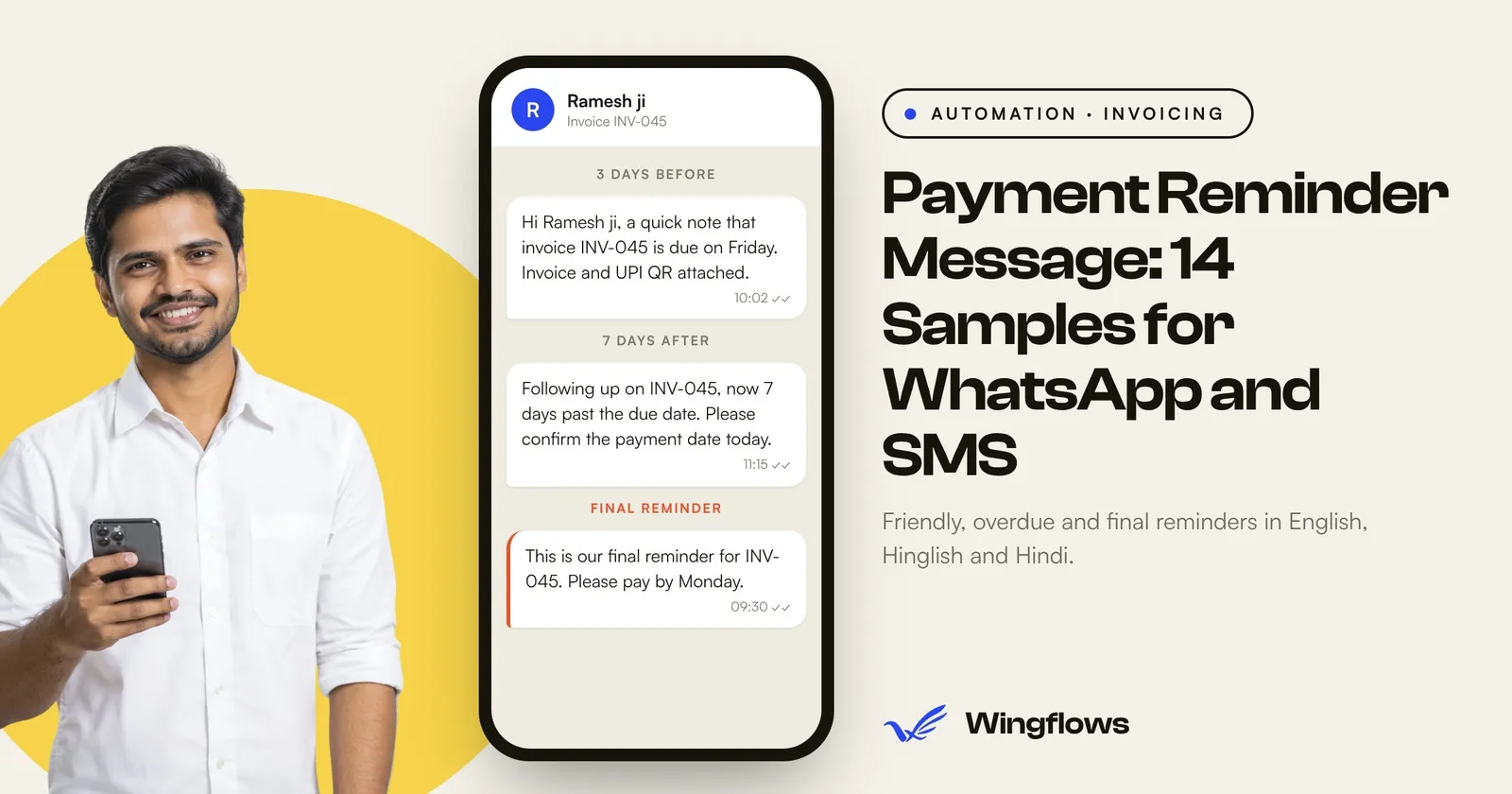
A payment reminder message is a short note that tells a customer which bill is due or overdue and how to pay it. A good one names the invoice, the amount and the due date, gives the payment details, and asks for one clear thing. Often the customer has simply lost the bill in a long WhatsApp chat.
Below are 14 reminders to copy, in English, Hinglish and Hindi, from a friendly note before the due date to a final reminder.
My own invoices carry a due date, and when a client goes quiet after it, I write to them in the same WhatsApp chat the invoice went to. The wordings below are the ones I would send.
Key takeaways
- Every reminder needs five things: the invoice number, the amount, the due date, how to pay (UPI ID, QR or bank details) and one clear request.
- Start friendly and get firmer in steps. A first reminder that reads like a legal notice can cost you the customer.
- Send the invoice PDF or the payment details again with every reminder. “Please pay” with no way to pay gets ignored.
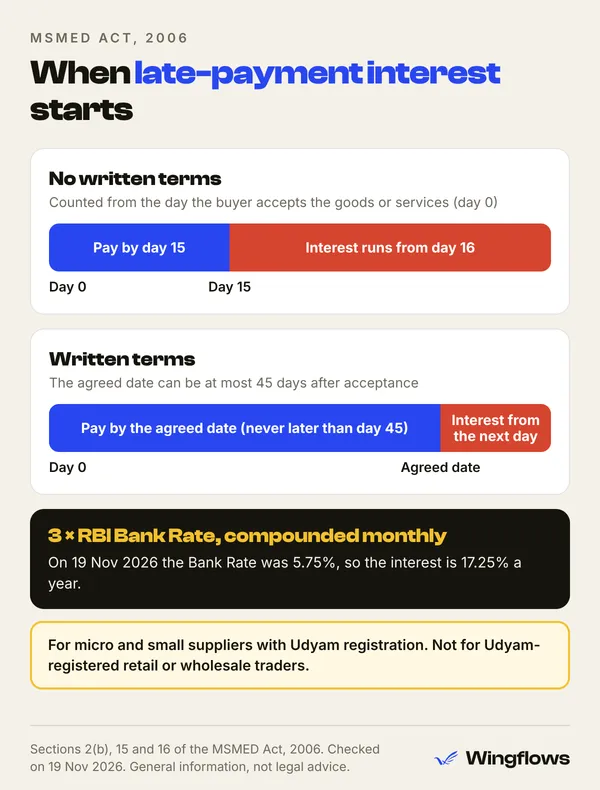
- A micro or small supplier with Udyam registration can use the MSMED Act: the buyer must pay by the agreed date (never more than 45 days after acceptance), or within 15 days if nothing is written. Late payment attracts compound interest at three times the RBI Bank Rate, from the day after the due date.
- This protection is for micro and small manufacturers and service providers. If your Udyam registration is for retail or wholesale trade, the Ministry limits its benefits to priority-sector loans, so the 45-day rule and Samadhaan do not cover you.
- On the WhatsApp Business app, save your reminders as quick replies (up to 50) so each one takes seconds.
What every payment reminder message should include
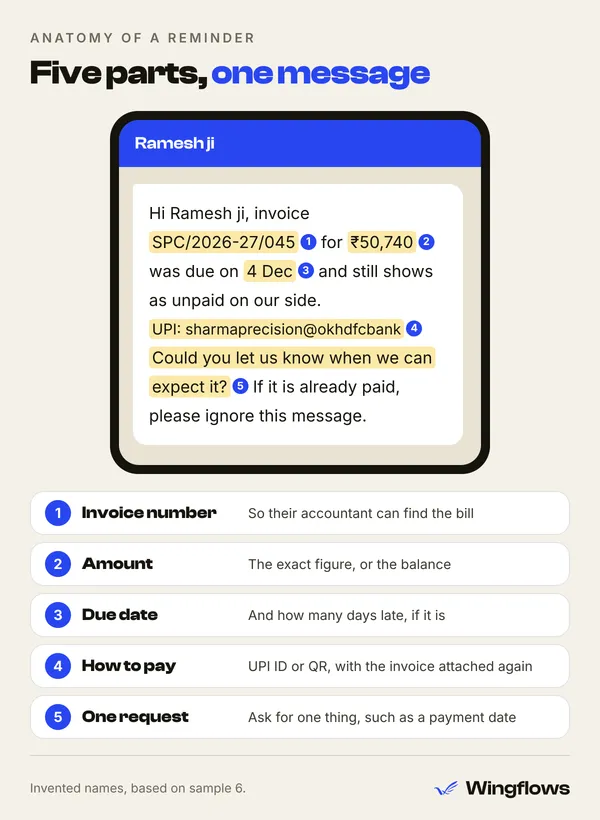
Sign off with your name and business name, so the message comes from a person rather than “Accounts”. If you don’t have a UPI QR on your invoices yet, make one with the UPI QR code generator.
Friendly payment reminder messages (before and on the due date)
Nothing is late yet, so keep it light. These cover a payment reminder message to a client you work with regularly, in English first and then in Hinglish and Hindi.
1. Three days before the due date
Hi [Name], a quick note that invoice [INV-045]
for ₹[amount] is due on [date].
You can pay by UPI to [yourname@bank]
or scan the QR on the invoice (attached again).
Thank you for your business!
[Your name], [Business name]
2. On the due date
Good morning [Name]. Invoice [INV-045]
for ₹[amount] is due today.
UPI: [yourname@bank]
Bank: [Account name], A/c [number], IFSC [code]
Please send a screenshot once paid
so we can mark it received. Thank you!
[Your name], [Business name]
3. Friendly reminder for a regular customer
Hi [Name] ji, hope all is well.
Just a gentle reminder for the bill of [date],
₹[amount] (invoice [INV-045]).
Today or tomorrow, whenever convenient, is fine.
If it's already paid, please ignore this message.
Thank you!
The “please ignore if paid” line matters. Payments and reminders often cross, and the line saves the customer from feeling accused.
4. Friendly, in Hinglish
Namaste [Name] ji, bill no. [INV-045] (₹[amount])
ka payment [date] ko due hai.
Aap UPI [yourname@bank] par bhej sakte hain
ya invoice ka QR scan kar sakte hain.
Dhanyavaad!
[Your name], [Business name]
5. Friendly, in Hindi
नमस्ते [Name] जी,
बिल नंबर [INV-045] (₹[amount]) का पेमेंट [date] को ड्यू है।
आप UPI [yourname@bank] पर भेज सकते हैं
या बिल का QR स्कैन कर सकते हैं। धन्यवाद!
[Your name], [Business name]
Payment due reminder messages after the due date
Now the bill is late. Stay polite, but be specific about the number of days and ask for a date.
6. Three days overdue (gentle reminder for payment)
Hi [Name], invoice [INV-045] for ₹[amount]
was due on [date] and still shows as unpaid
on our side. Invoice attached again.
UPI: [yourname@bank]
Could you let us know when we can expect it?
If it is already paid, please ignore this message.
[Your name], [Business name]
7. Seven days overdue
Hello [Name], following up on invoice [INV-045]
(₹[amount]), now 7 days past the due date of [date].
Please confirm the payment date today.
If there is a problem with the bill or the goods,
tell me and I'll sort it out.
[Your name], [Business name]
8. Fifteen days overdue, firmer
Dear [Name], invoice [INV-045] for ₹[amount]
is now 15 days overdue (due [date]).
We sent reminders on [date] and [date].
Please clear the payment by [new date].
Until it is cleared, we can't take
new orders on credit.
[Your name], [Business name]
Only write a consequence you will actually carry out. If you won’t stop credit, leave that line out.
Final reminder before you escalate
9. Final reminder
Dear [Name], this is our final reminder for
invoice [INV-045], ₹[amount], due on [date]
and now [X] days overdue.
Please pay by [date]. If we don't receive payment
or hear from you by then, we will take the next
step to recover the amount.
[Your name], [Business name], [Phone]
“The next step” is deliberately general. If you are an eligible micro or small supplier, that step can be a complaint on the government’s MSME Samadhaan portal (see below). Before you threaten legal action by name, speak to your CA or a lawyer.
Payment reminder message on WhatsApp in Hinglish and Hindi
Some customers find a reminder in their own language easier to act on. An overdue reminder in Hinglish and in Hindi:
10. Overdue, in Hinglish
Namaste [Name] ji, bill no. [INV-045] (₹[amount])
ka payment [date] ko due tha.
Kripya aaj UPI [yourname@bank] par bhej dijiye
aur screenshot share kar dijiye.
Agar payment ho gaya hai to yeh message ignore kar dijiye.
Dhanyavaad!
[Your name], [Business name]
11. Overdue, in Hindi
नमस्ते [Name] जी,
बिल नंबर [INV-045] (₹[amount]) का पेमेंट [date] को ड्यू था।
कृपया आज UPI [yourname@bank] पर भेज दीजिए
और स्क्रीनशॉट शेयर कर दीजिए।
अगर पेमेंट हो चुका है तो इस मैसेज को इग्नोर कर दीजिए। धन्यवाद!
[Your name], [Business name]
Samples 5 and 11 use the Hindi most people speak on WhatsApp (“पेमेंट”, “मैसेज”). For a formal tone, write “भुगतान” for payment and “कृपया इस संदेश पर ध्यान न दें” for “please ignore this message”.
Short payment reminder messages for SMS
SMS suits customers who don’t use WhatsApp, or a second channel for a final reminder. Keep it to the facts. Write the amount as “Rs” or “₹”, whichever your SMS tool shows correctly.
12. Short reminder
[Business]: Invoice [INV-045] of Rs [amount]
is due on [date]. Pay via UPI [yourname@bank].
Ignore if paid.
13. Overdue reminder
[Business]: Rs [amount] for invoice [INV-045]
is [X] days overdue. Please pay or call
[phone] today.
One SMS from your own phone is simple. Bulk reminders through an SMS provider are regulated under TRAI’s Telecom Commercial Communications Customer Preference Regulations, 2018. Commercial messages must use registered headers, the sender must be registered with a telecom operator, and message templates must be registered before they go out. That is the “DLT registration” your SMS provider will ask you to complete. Checked on 19 November 2026 against TRAI’s consolidated text of the regulations, including the 2026 amendments; TRAI notes that the gazetted text prevails over the consolidation.
When the customer has paid part of the bill
14. Part payment received, balance due
Hi [Name], thank you, we received ₹[paid amount]
against invoice [INV-045] on [date].
The balance of ₹[balance] is due on [date].
Same UPI: [yourname@bank]. Thank you!
[Your name], [Business name]
Thank them first, then state the balance. Both sides now work from the same number. When the last part arrives, send a receipt; invoice vs receipt explains how the two documents differ.
One payment reminder email, for customers who live in their inbox
Some business customers, especially those with an accounts team, handle bills by email. Use the same content with a subject line their accountant can search:
Subject: Payment reminder: Invoice [INV-045],
₹[amount], due [date]

Dear [Name],

This is a reminder that invoice [INV-045]
dated [date] for ₹[amount] is due on
[due date]. The invoice is attached.

UPI: [yourname@bank]
Bank: [Account name], A/c [number], IFSC [code]

If you have already paid, please ignore this email
or reply with the payment reference.

Regards,
[Your name], [Business name], [Phone]
When to send each reminder
No law sets a reminder schedule. This is the sequence we suggest for small businesses: friendly first, then firmer, with a fixed day for each step so you don’t have to decide every time.
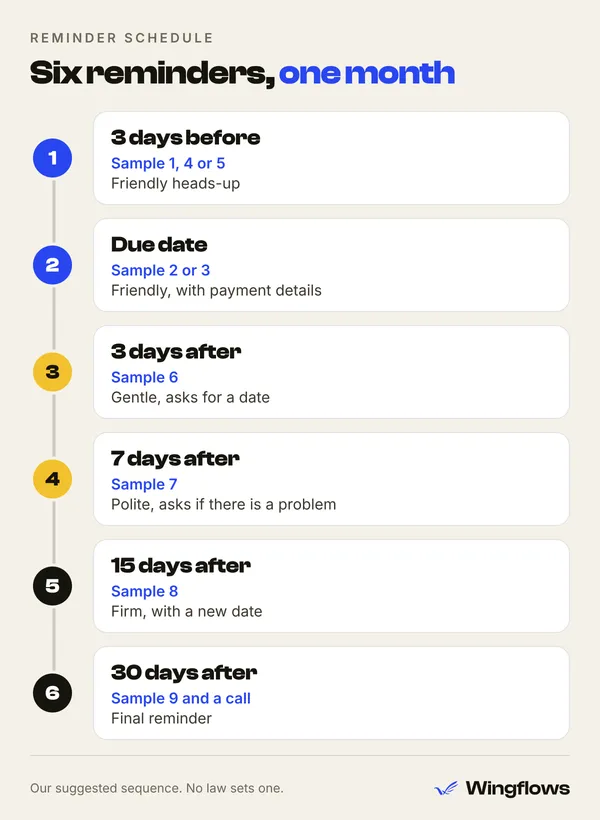
Note the date of each reminder on your copy of the invoice, so sample 8 can say exactly when you wrote before. Call the customer once before you send sample 9.
If you are an eligible micro or small supplier (see the next section), you can mention Section 16 interest from sample 8 onward. With no written terms, interest has been running since day 16 by the time the final reminder goes out.
Your rights as a micro or small supplier: the 45-day rule
The MSMED Act, 2006 gives a micro or small supplier’s reminders some legal weight (the Act on India Code). Checked on 19 November 2026. General information, not legal advice.
The Ministry of MSME summarises it this way: a buyer who does not pay within the period the law allows owes compound interest with monthly rests, at three times the RBI bank rate (Ministry of MSME, legal framework). Section 2(d) defines a buyer as anyone who buys goods or receives services from a supplier for consideration. The Act therefore covers any buyer, though in practice suppliers use it against business customers.
The deadline
Section 15 says the buyer must pay on or before the date agreed with you in writing. Where there is no agreement, payment is due before the “appointed day”. A written period can’t exceed 45 days from the day the buyer accepts, or is deemed to accept, the goods or services (Section 15, unofficial copy of the Act). The appointed day is the day after 15 days from acceptance (Section 2(b), unofficial copy). With no written terms the buyer therefore has 15 days, and with written terms the agreed date can be at most 45 days after acceptance.
The interest
If the buyer pays late, Section 16 makes them liable for compound interest with monthly rests, at three times the bank rate notified by the Reserve Bank. This applies “notwithstanding anything contained in any agreement” (Section 16, unofficial copy). Interest runs from the day after the due date: day 16 with no written terms, or the day after your agreed date.
On 19 November 2026 the RBI’s current rates page showed a Bank Rate of 5.75%. The rate changes, so look it up again before you quote it.
Who it protects
The Act defines a supplier as a micro or small enterprise that has filed a memorandum with the authority under section 8 (Section 2(n), unofficial copy). Today that means Udyam registration. The government’s MSME Samadhaan portal says “Any Micro or small enterprise having valid Udyam Registration can apply” (MSME Samadhaan).
This protection is for micro and small manufacturers and service providers. Retail and wholesale traders can register on Udyam, but the Ministry’s office memorandum of 2 July 2021 says their benefits are “restricted to Priority Sector Lending only” (Ministry of MSME, OM of 2 July 2021). If your registration is for retail or wholesale trade, the 45-day rule and Samadhaan do not cover you.
The buyer’s tax cost
Under Section 43B(h) of the Income-tax Act, 1961, a buyer who owes a micro or small enterprise beyond the Section 15 time limit can deduct that sum only in the year it is actually paid (Income Tax Department, Section 43B). From 1 April 2026 the same rule sits in Section 37(2)(g) of the Income-tax Act, 2025 (Income Tax Department, Section 37); Section 43B(h) of the 1961 Act covers earlier years.
That gives you a polite line for a business buyer, and it holds only for the same eligible suppliers. If you qualify, add this to sample 8 or 9:
As a registered micro/small enterprise, we are covered by
the MSMED Act, 2006, which provides for interest on delayed
payments. Payment by [date] also keeps the amount
deductible for you this year (please check with your CA).
Where to complain
On MSME Samadhaan, a registered supplier files an online application against the buyer. It goes to the Micro and Small Enterprises Facilitation Council of your state. After examining the case, the Council “will issue directions to the buyer unit for payment of due amount along with interest”. A reference to the Council is to be decided within 90 days (MSME Samadhaan; Ministry of MSME).
Print written payment terms (for example “Payment within 30 days of delivery”) and your Udyam number on your invoices today, and keep every reminder. Net 30 meaning explains how such terms work. For a specific dispute, talk to your CA or a lawyer.
Sending reminders on WhatsApp without losing your evening
WhatsApp’s limits and policies change. The Meta documentation below was checked on 19 November 2026; confirm the app settings yourself.
Use quick replies in the WhatsApp Business app. Save each sample above as a quick reply. Go to Business tools, then Quick replies, tap Add, write the message and give it a shortcut. In a chat, type “/” and pick it, edit the name and amount, and send. You can store up to 50 quick replies (WhatsApp Help Center).
Message people who agreed to hear from you. WhatsApp’s Business Policy says you may only contact people who gave you their number and their opt-in permission. You must also respect every request to block or stop messages (WhatsApp Business Policy). A credit customer who gave you their number for billing has opted in; a bought list has not.
If you automate through the WhatsApp Business Platform (API). Automated reminders from software follow stricter rules. When a customer messages you, a 24-hour “customer service window” opens. Outside that window, “you can only send pre-approved template messages” (Meta for Developers). Meta’s template library offers a payment-due-reminder template, and library templates are utility templates (Meta template library). So get your reminder wording approved as a template once; the software then fills in the name, invoice and amount.
Make the invoice and the WhatsApp message in one go
A reminder only works if the invoice shows a due date and a way to pay. The free invoice generator prints a UPI QR on rupee invoices. Its WhatsApp button opens a message with the invoice number, client, total, due date and your UPI ID already filled in. For GST bills, use the GST invoice generator.
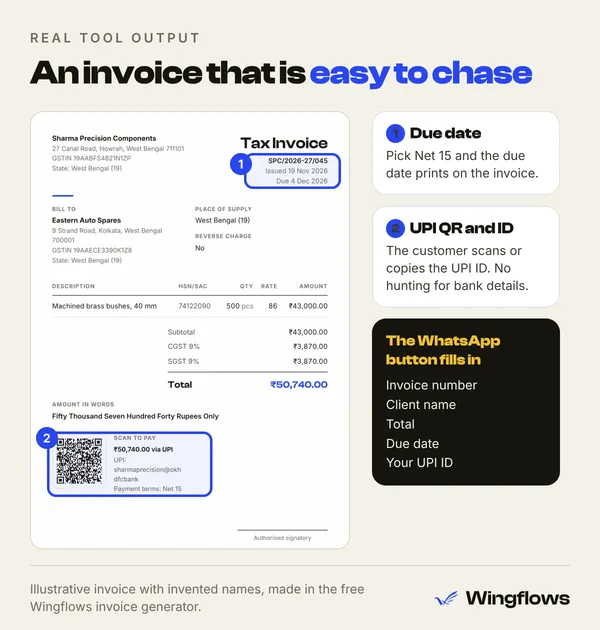
Open the invoice generator and pick the India GST preset and rupees.
Add your details once, including your UPI ID. They are saved in your browser for next time.
Fill in the client and items, and pick the payment terms (for example Net 15 or Net 30, see net 30 meaning) so the due date prints on the invoice.
Download the PDF and send it, then press WhatsApp to open a summary message with the amount, due date and UPI ID.
On the reminder days, reply in the same chat with one of the samples above, so the invoice and every reminder sit together.
Frequently asked questions
How do I write a polite payment reminder message?
Name the invoice, amount and due date, give the payment details, and ask for one thing, such as payment by a date. Add “please ignore this if you’ve already paid”. Samples 1 to 6 above are written for this.
What is a gentle reminder for payment?
It is a short note sent around the due date that names the invoice, amount and date and assumes the customer forgot. Samples 1 to 3 and 6 are gentle ones.
What should I write in a payment reminder on WhatsApp?
The same five details as any reminder: invoice number, amount, due date, how to pay (UPI ID or QR) and a clear request. Keep it to a few short lines and attach the invoice PDF again. Send it in the chat where you sent the invoice, so the history stays in one place.
How do I write a payment reminder message in Hindi?
Use samples 5 and 11. They are written in the Hindi people speak on WhatsApp and carry the amount, due date and UPI ID. Swap “पेमेंट” for “भुगतान” if you want a formal tone, and see the Hinglish versions (samples 4 and 10) if your customer prefers Roman script.
How many payment reminders should I send?
Our schedule uses six over about a month, as in the schedule table above. After the final reminder, stop messaging. Call the customer, and if you are an eligible micro or small supplier, consider MSME Samadhaan.
Can I charge interest on late payments in India?
If you are a micro or small manufacturer or service provider with Udyam registration, Section 16 of the MSMED Act applies. A buyer who misses the Section 15 deadline owes compound interest at three times the RBI Bank Rate, from the day after the due date. If your registration is for retail or wholesale trade, the Ministry limits its benefits to priority-sector loans, so this rule does not cover you. In other cases it depends on your written terms. Ask your CA how this applies to you.
Can I send payment reminders by bulk SMS?
Yes, through a registered sender. TRAI’s regulations require commercial messages to use registered headers, and the message templates must be registered with the telecom operator. Your SMS provider does this “DLT” registration with you.
What if the customer says the bill is wrong?
Stop the reminders and fix the bill. Ask what is wrong, issue a corrected invoice or credit note if needed, and restart the schedule from the corrected due date.
Send the first reminder today
Open your list of unpaid bills, pick the oldest one, and send sample 6 or 7 with the invoice attached. Then save the other samples as quick replies for next time. If your invoices don’t show a due date or a UPI ID yet, make the next one with the free invoice generator.
Reminders can also go out on their own from your billing records once a due date passes. Reminder flows like that are part of our business systems and automation service. The accounting automation guide shows where reminders sit in the wider setup. Write to us with the number of invoices you chase each month.