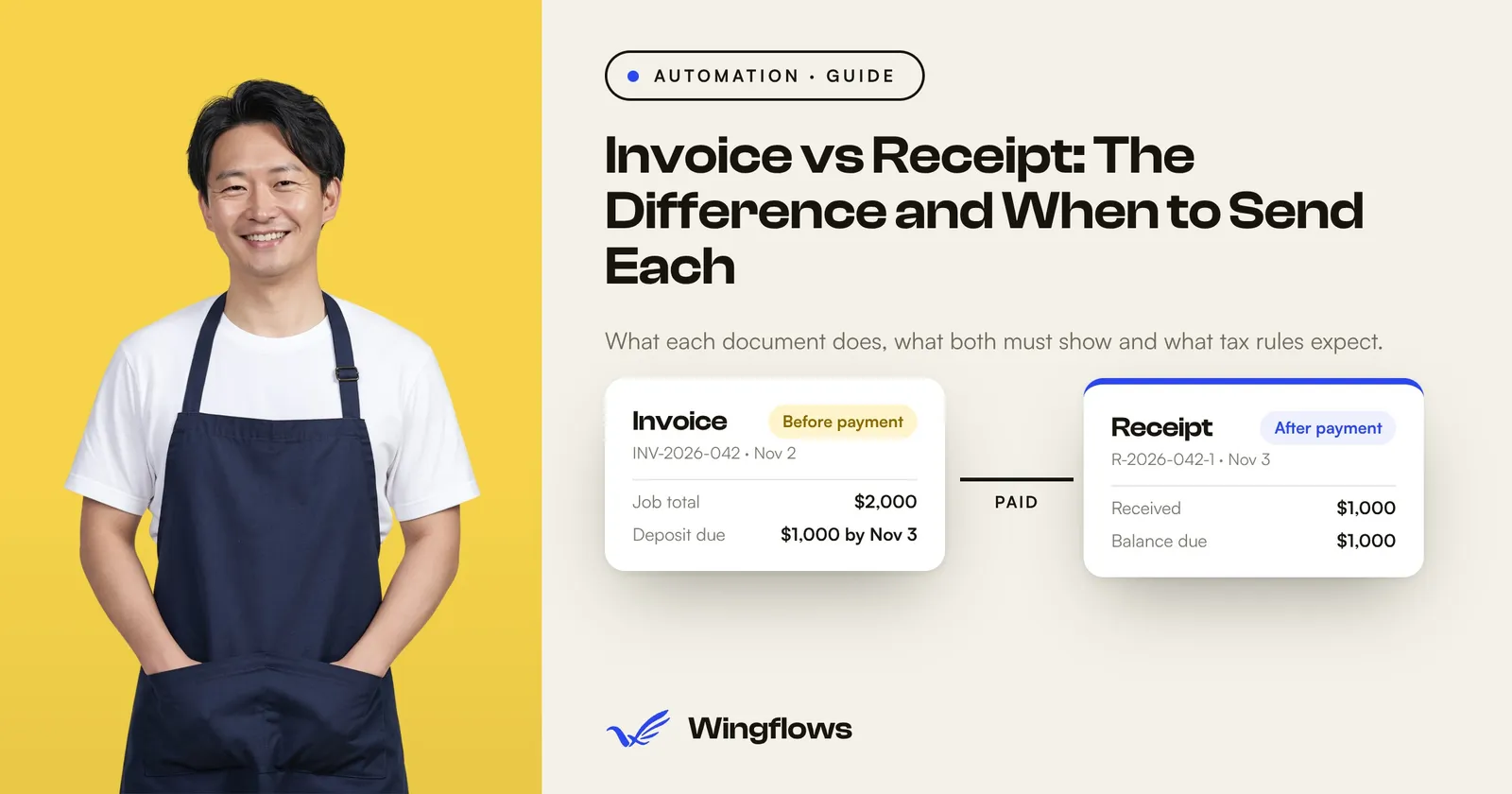
An invoice asks the customer to pay; a receipt confirms they did. Invoice vs receipt comes down to timing. The invoice comes first, before the money moves, and states what is owed and by when. The receipt comes after payment and records what was paid, when and how. If a customer pays on the spot, you usually skip the invoice and hand over a receipt only.
Four questions come up again and again: whether an invoice marked “paid” counts as a receipt, what to send when a client pays a deposit, what “due on receipt” means, and which document the tax office wants to see.
Deposits are where this comes up most in my own work. New clients pay an advance before I start; if their accounts team can only pay against paperwork, they get a proforma invoice first and a receipt once the money is in. I made Wingflows’ free invoice generator for that billing, and it has a deposit field for the advance.
Key takeaways
- An invoice is a request for payment, sent before the customer pays. A receipt is proof of payment, sent after.
- Customer pays now: a receipt is enough. Customer pays later: send an invoice, then a receipt when the money arrives.
- For a US tax deduction, an invoice alone doesn’t prove you paid. The IRS expects proof of payment too, such as a card receipt or bank record.
- “Due on receipt” is a payment term on an invoice. It means “pay when you get this invoice”, not “here is your receipt”.
Checked against IRS, GOV.UK and legislation.gov.uk pages on 19 November 2026. General information, not tax or legal advice.
Invoice vs receipt: what is the difference?
The difference between an invoice and a receipt is timing and purpose. An invoice is issued after you deliver (or agree to deliver) and before you are paid. It creates a debt: the customer owes you the amount on it. A receipt is issued after payment and closes that debt.
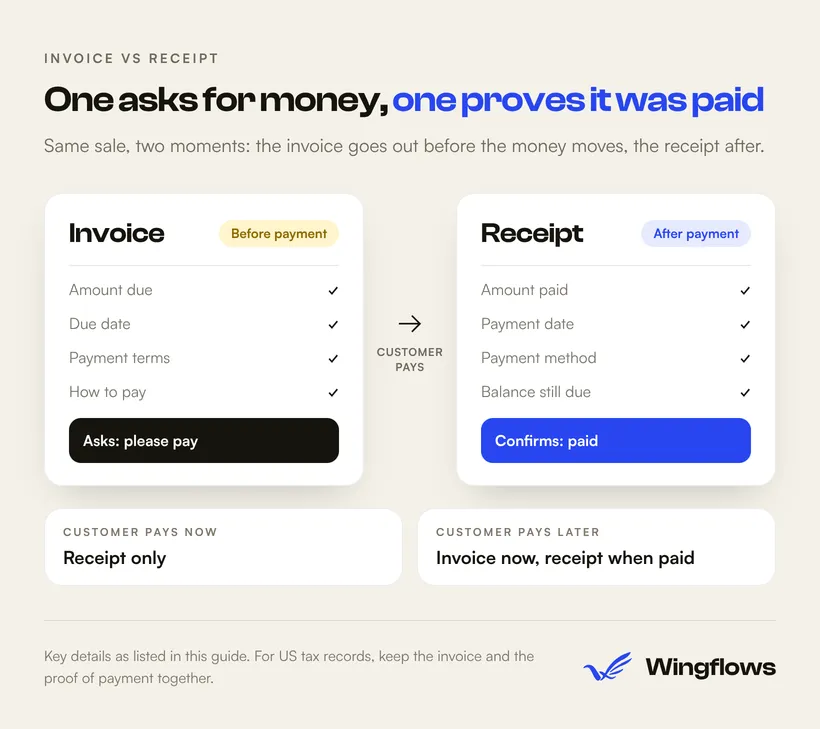
QuickBooks, Intuit’s accounting software, frames it the same way. Its help page separates recording sales when “my customer pays right away (they don’t owe me anything)” with a sales receipt from recording sales when “I give my customer time to pay (I want to track what they owe)” with an invoice (QuickBooks).
What an invoice does and what it should show
An invoice states what the customer owes and by when. It is also your record of who still owes you money.
The IRS doesn’t publish a standard invoice layout. Its record-keeping page simply counts invoices among the supporting documents a business should keep: “sales slips, paid bills, invoices, receipts, deposit slips, and canceled checks” (IRS).
The UK government is more specific. Its guidance says every invoice must include (GOV.UK):
- a unique identification number
- your business name, address and contact details
- the customer’s name and address
- a clear description of what you are charging for
- the date the goods or services were supplied, and the invoice date
- the amount charged, any VAT, and the total amount owed
That list works well as a checklist anywhere. Add the payment terms and due date (“Net 30, due December 14, 2026”) and how to pay, and the customer has no reason to send the invoice back.
What a receipt does and what it should show

A receipt proves a payment happened. For the customer, it’s the evidence they paid: for a return, a warranty claim or an expense deduction. For you, it’s the record that a sale is settled.
A Treasury regulation on travel, meal and gift expenses (26 CFR 1.274-5) is the clearest US statement of what a receipt should show. It requires documentary evidence “such as receipts, paid bills” for lodging while traveling away from home and for any other expense of $75 or more.
That evidence is ordinarily adequate if it has enough information to establish “the amount, date, place, and the essential character of the expenditure” (26 CFR 1.274-5, via Cornell LII). A restaurant receipt, for example, should show the restaurant’s name and location, the date and amount, and the number of people served.
The regulation covers those expense types only, but the same details (amount, date, place, what it was for) make any receipt useful. A receipt you issue should show:
- your business name and contact details
- the receipt date and a receipt number (or the invoice number it settles)
- what was paid for, with quantities and prices if there was no invoice
- the amount paid, any tax included, and the payment method
- the balance still due, if this was a part payment
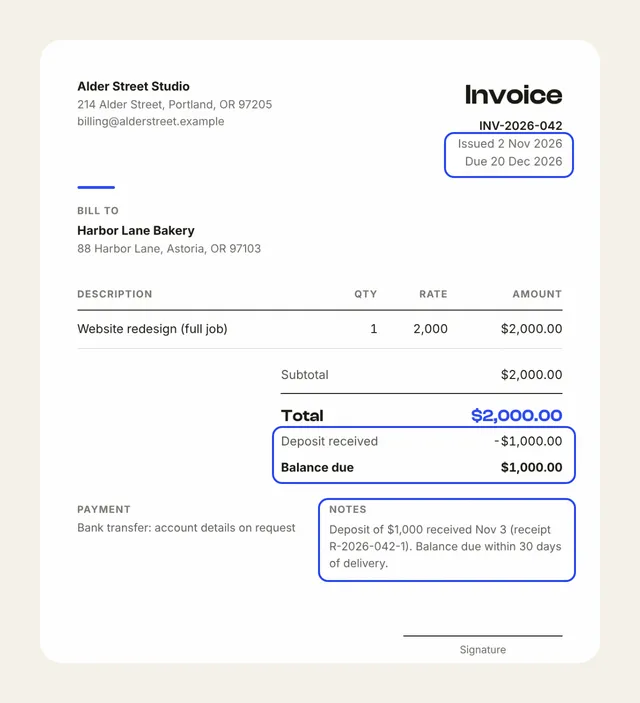
Here is a plain-text receipt for the deposit in the example further down. Copy the layout and swap in your own details:
RECEIPT R-2026-042-1
Date: November 3, 2026
From: Alder Street Studio
Received from: Harbor Lane Bakery
Amount: $1,000.00, bank transfer
For: deposit on INV-2026-042
Invoice total: $2,000.00
Balance due: $1,000.00
When to send an invoice, a receipt or both
Send a receipt for each payment you receive, and show the remaining balance on it. When the final payment lands, the last receipt should show a zero balance. If you quoted the job first, our quotation maker converts an accepted quote into an invoice, so the numbers carry over.
Quote. Before the work, send a quotation with the price, what's included and how long the offer is valid.
Invoice. After delivery (or for a deposit), send an invoice with a unique number, the amount due, the due date and how to pay.
Get paid. Match the payment to the invoice number, so you know exactly which invoice it settles.
Receipt. Confirm the payment with the date, amount, method and any balance left. Reference the invoice number.
File both. Keep the invoice and the receipt together with the bank record, so the whole sale can be traced.
Example: a job with a deposit
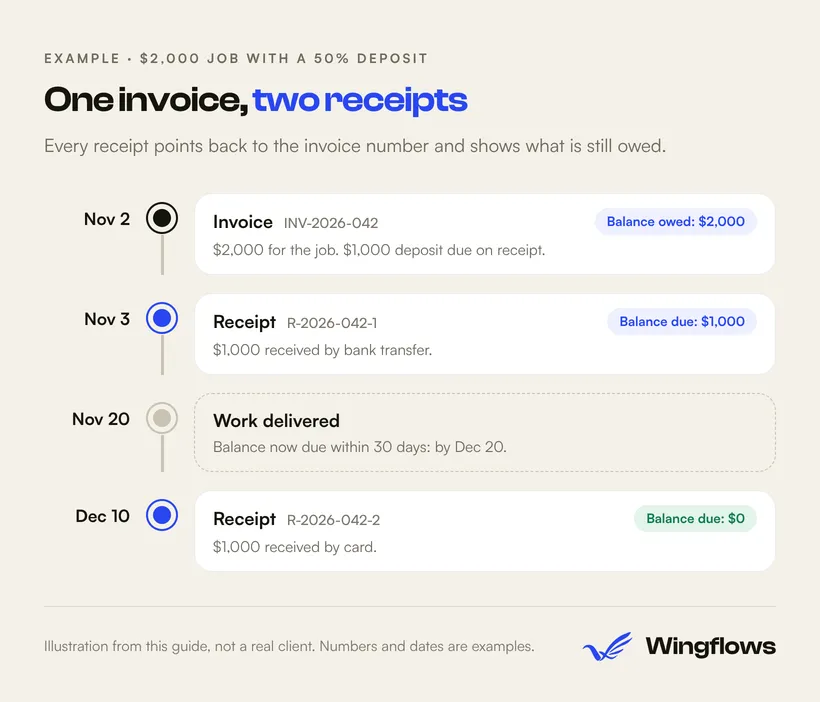
Here is how the documents line up for a $2,000 job with a 50% deposit. The numbers are made up for illustration.
One invoice and two receipts, each pointing back to the invoice number, let anyone checking the books follow the whole sale.
The free invoice generator produces the invoice side of this example. Once the deposit is in, its deposit field and “Balance due” line show what is left, as in this copy of INV-2026-042 re-sent at delivery (Wingflows invoice generator):
Bill vs receipt vs invoice
A bill and an invoice are usually the same document seen from two sides. The seller issues an invoice; the buyer receives it as a bill. Zoho, an accounting software vendor, defines a bill in its guide as “a document issued by the vendor that specifies the amount the buyer owes” (Zoho). Most accounting software follows the same split: the invoices you send sit under sales, and the bills you receive sit under purchases.
In everyday speech, “bill” also means a tab that is due straight away, like a restaurant bill. Either kind of bill asks for money; a receipt is what confirms payment.
Is a paid invoice the same as a receipt?
An invoice marked “paid”, with the payment date and method on it, tells the customer you received their money. For a customer who just wants confirmation, it does the job.
For tax records, though, an invoice on its own shows only what was charged. The IRS says documents for purchases and expenses should identify the payee, the amount paid, proof of payment, the date and a description. It lists canceled checks, card receipts and statements, account statements and invoices as examples, and adds that “a combination of supporting documents may be needed to substantiate all elements of the expense” (IRS). The regulation makes the same point from the other side: a canceled check together with the payee’s bill ordinarily establishes the cost (26 CFR 1.274-5).
Keep the supplier’s invoice together with proof that you paid it. When you are the seller, a short receipt, or a paid invoice that clearly states date, amount and method, saves your customer that extra step.
Why the difference matters for tax and bookkeeping
Cash vs accrual: which document sets the date
Your accounting method decides whether the invoice date or the payment date counts. Under the cash method, the IRS says you “generally report income in the tax year you receive it”. Under the accrual method, you include income in the year the “all events test” is met. That happens when all events have occurred that fix your right to receive the income, and the amount can be determined with reasonable accuracy. Often that is before you are paid (IRS Publication 538).
So an invoice sent on December 20 and paid on January 10 can fall in different tax years depending on your method. The receipt and the bank record show when the cash arrived; the invoice shows when the sale was billed. Keep both, and ask your accountant which date your books use.
VAT countries: the invoice is what lets buyers reclaim tax
In the UK, a VAT-registered business reclaiming VAT on a purchase “must also have valid VAT invoices” (GOV.UK). For UK supplies of £250 or less, a simplified invoice with fewer details is allowed, which is why a UK shop receipt often carries a VAT number (The Value Added Tax Regulations 1995, reg. 16A). US sales tax on receipts is set by each state, so check your state revenue department.
Side by side: what the official sources ask for
This table compares the three official lists above. The overlap is large, which is why one good template covers most cases.
UK invoice is the GOV.UK list, UK simplified is the VAT invoice for supplies up to £250 (reg. 16A), and US receipt is 26 CFR 1.274-5.
How long to keep them
The IRS asks you to keep records for three years in most cases. That rises to six years if income you left off the return is more than 25% of the gross income it shows, seven years for bad-debt or worthless-securities claims, and at least four years for employment tax records (IRS). Keep invoices and receipts for at least as long as the return they support.
Common mistakes with invoices and receipts
- Sending a receipt before the money arrives. A receipt says “paid”. If the payment then bounces, your own document says the customer owes nothing.
- Reusing or skipping invoice numbers. The UK guidance requires a unique identification number on every invoice; a gap-free sequence also makes payments easier to match.
- Reading “due on receipt” as a receipt. It’s a payment term on an invoice. QuickBooks says payment is due as soon as the invoice is received, usually by the next business day at the latest (QuickBooks). Print an actual date next to it.
- No receipt for part payments. Every deposit or instalment deserves its own receipt showing the balance, or the final settlement turns into an argument.
- Keeping only bank statements. A statement shows that money moved but may not say what it was for. The IRS says a combination of documents may be needed to show the payee, amount, proof of payment, date and description (IRS).
FAQ
Is an invoice the same as a receipt?
No. An invoice asks for payment and is sent before the customer pays. A receipt confirms payment and is sent after. A paid invoice that states the date and method can do the receipt’s job for the customer.
Do I need both an invoice and a receipt?
Only when the customer pays later. A sale paid on the spot needs a receipt alone. For a later payment, the invoice requests the money and the receipt confirms it arrived. With deposits, send one receipt per payment.
Is an invoice proof of payment?
An invoice marked paid confirms payment to the customer. For US tax records, though, the IRS may want independent proof too (a canceled check, card or bank statement), since “a combination of supporting documents may be needed” (IRS). An unmarked invoice shows only what was charged and when it is due.
Which comes first, an invoice or a receipt?
The invoice. If the customer pays on the spot, there is no invoice step, only a receipt.
What is the difference between a sales receipt and an invoice?
A sales receipt records a sale that is paid in full at the time of sale. An invoice records a sale the customer will pay later. QuickBooks draws the same line: a sales receipt when the customer pays right away and owes nothing, an invoice when you give them time to pay and want to track what they owe.
What does “due on receipt” mean?
It is a payment term printed on an invoice. It means the customer should pay as soon as they receive the invoice, which QuickBooks says usually means by the next business day at the latest (QuickBooks). It has nothing to do with the receipt document. To avoid arguments, print the actual due date next to the term.
Can a receipt replace an invoice?
For a sale paid on the spot, yes, a receipt is usually all the customer gets. For business customers in VAT countries, the receipt must carry the required invoice details (in the UK, at least the simplified invoice details for supplies up to £250) or they may not be able to reclaim VAT.
How long should I keep invoices and receipts?
In the US, at least three years in most cases, and longer in the situations the IRS lists (six, seven or indefinitely). Other countries set their own periods, so check your tax office’s rules.
Make your next invoice with our free generator
Our free invoice generator builds the invoice side of this: unique numbers, due dates and payment terms like Net 30 or due on receipt, tax lines, and a PDF with no sign-up. Freelancers can start from the freelance invoice template, which handles deposits and milestones.
Writing a receipt by hand for every deposit and balance payment is easy to put off. With a business systems and automation setup, a cleared payment can trigger the receipt, balance included, and a missed due date can trigger the reminder. Ask us what that needs with the tools you already use. For the order to tackle it in, see the accounting automation guide.
If the balance payment runs late, the payment reminder messages give wording from a first nudge through to a final notice.