Under the reverse charge mechanism in GST (RCM), the buyer pays the GST to the government instead of the seller. The CGST Act defines reverse charge as “the liability to pay tax by the recipient of supply of goods or services or both instead of the supplier” (CGST Act, section 2(98)).
It applies only to supplies the government has notified. Common ones for a small business: an advocate’s fees, a goods transport agency’s freight, a director’s fees paid by a company, and, since October 2024, rent for a shop or office paid to an unregistered landlord.
Our free GST invoice generator has a reverse charge option. With it on, the invoice still lists the tax lines, leaves them out of the total and prints “Tax payable on reverse charge basis: Yes”.
The lists below reflect notifications up to 04/2026-Central Tax (Rate) of 27 October 2026. General information, not tax advice.
Key takeaways
- Under RCM, the recipient pays GST on a notified supply. The supplier does not collect it.
- The list lives in Notification 13/2017-Central Tax (Rate) for services and 4/2017-Central Tax (Rate) for goods, with matching IGST notifications for inter-state supplies. All have been amended many times, most recently for goods from 1 November 2026.
- Rent is the big one for shops: a registered business pays GST under reverse charge on a residential dwelling it rents (a proprietor renting a home as their own residence is exempt), and on any other property it rents from an unregistered landlord.
- RCM tax must be paid in cash. It “cannot be discharged by using input tax credit”. After paying it, you can claim it back as input tax credit if you are otherwise eligible.
- Buying RCM goods or services from an unregistered supplier? Issue a self-invoice within 30 days of receipt (rule 47A), and a payment voucher when you pay.
- Section 24(iii) lists persons who must pay tax under reverse charge among those who must register for GST. Check any exemption notification that applies to you with your CA.
What is the reverse charge mechanism in GST?
Normally the seller (supplier) charges GST on the bill, collects it and pays it to the government. That is forward charge. Under reverse charge, the buyer (recipient) works out the GST on the purchase and pays it directly.
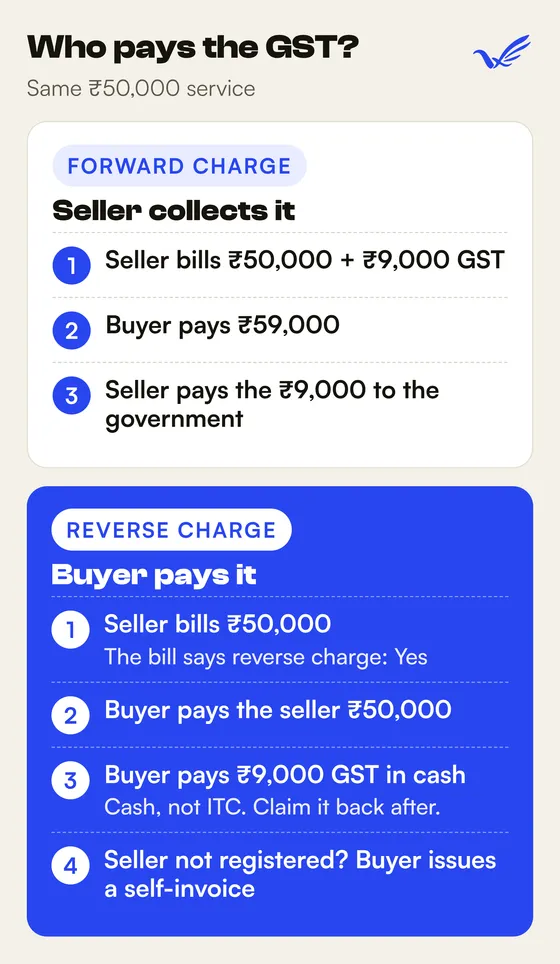
The power to notify these supplies is in section 9 of the CGST Act (CGST Act PDF, CBIC):
For most shop owners, traders and manufacturers, section 9(3) is the one you will meet. Section 9(5) is a separate rule for platforms (cab rides, restaurant orders through apps and similar), not something you pay as a buyer.
RCM full form in GST is simply reverse charge mechanism. The opposite, normal billing, is called forward charge (sometimes shortened to FCM).
Who pays GST under reverse charge?
The recipient pays only when the supply, the supplier and the recipient all match a notification entry. The legal services entry is a good example. GST is on reverse charge only when an individual advocate or a firm of advocates supplies the service, and the recipient is a business entity in the taxable territory (Notification 13/2017-CT(Rate), serial 2). A lawyer you hire for a personal matter, not as a business, is outside this entry.
- You must register. Section 24(iii) lists “persons who are required to pay tax under reverse charge” among those who must register. Exemption notifications can change this for some small recipients, so confirm your case with your CA.
- You pay in cash. The GST Council’s flyer is plain about it: “Any amount payable under reverse charge shall be paid by debiting the electronic cash ledger”, and “reverse charge liability cannot be discharged by using input tax credit” (GST Council, Reverse Charge Mechanism flyer).
- You can claim it back. The same flyer: “after discharging reverse charge liability, credit of the same can be taken by the recipient, if he is otherwise eligible.”
List of services under RCM in GST
The services list is the table in Notification 13/2017-Central Tax (Rate), in force from 1 July 2017 and amended since. These are the entries most small and mid-sized businesses meet (not the full list):
The full table also covers renting of property by the government or a local authority (serial 5A), transfer of development rights and long-term land leases for real estate projects (5B, 5C), insurance agents (7), recovery agents (8) and copyright in dramatic, musical, artistic or literary works (9, 9A).
Sources: Notification 13/2017-CT(Rate); Notification 22/2019-CT(Rate) for serials 9 and 9A; Notification 29/2018-CT(Rate) for serial 14; Notification 05/2022-CT(Rate) for serial 5AA; Notification 09/2024-CT(Rate) for serial 5AB; Notification 07/2025-CT(Rate) of 16 January 2025 for the sponsorship and composition changes.
Read these before you apply the table:
- GTA freight. The person who pays or is liable to pay the freight is the recipient. From 22 September 2025, GTA transport “will continue to be taxed at the merit rate of 5% with no ITC”, and the GTA may opt to charge 18% with full ITC (GST Council FAQ, Q60). Ask your transporter which way they bill: if they opted for 18% and invoice that way, you don’t pay again under RCM.
- GTA small consignments. Transport of goods in a single carriage is exempt when the freight for the consignment is ₹1,500 or less, or ₹750 or less for all goods for one consignee (Notification 12/2017-CT(Rate), serial 21).
- Rent, commercial. If you are GST-registered (and not under composition) and your landlord is not registered, you pay the GST on the rent for a shop, godown or office (5AB, from 10 October 2024).
- Rent, residential. A registered person who rents a residential dwelling, such as a staff flat, pays the GST on it whoever the landlord is (5AA). A proprietor who rents a home in a personal capacity as their own residence is exempt under an explanation added to the exemption notification (Notification 15/2022-CT(Rate), from 1 January 2023).
- Directors. An employee director’s salary is outside GST, but non-employee directors, and fees paid to an employee director that are not part of salary, are on RCM (Circular 140/10/2020-GST).
- Services from abroad. For inter-state supplies the same entries sit in IGST notifications. Notification 10/2017-Integrated Tax (Rate) puts “any service supplied by any person who is located in a non-taxable territory” on reverse charge, with the recipient named as “any person located in the taxable territory other than non-taxable online recipient” (IGST RCM list, GST Council). Software or ad services billed from outside India to a business in India usually fall here.
List of goods under RCM in GST
Goods are fewer, and this table is not the full list. The table in Notification 4/2017-Central Tax (Rate) started with agricultural goods and a few others (Notification 4/2017-CT(Rate)). Metal scrap was added in October 2024 (Notification 06/2024-CT(Rate)). Notification 04/2026-Central Tax (Rate), dated 27 October 2026, adds four more entries and says it comes into force on 1 November 2026. We read it in a published copy; we could not find it on the GST Council notification page, so check the official text before you rely on it.
Time of supply under reverse charge
Time of supply decides the month in which you owe the tax. Under reverse charge it is not the invoice date (CGST Act, sections 12(3) and 13(3)).
Goods (section 12(3)). The earliest of:
- the date you receive the goods;
- the date of payment in your books or bank, whichever is earlier;
- the day after 30 days from the supplier’s invoice.
If none of these can be found, it is the date of entry in your books.
Services (section 13(3)). The earlier of:
- the date of payment in your books or bank, whichever is earlier;
- the day after 60 days from the supplier’s invoice.
If neither can be found, it is the date of entry in your books.
The flyer adds one more point: “Advance paid for reverse charge supplies is also leviable to GST.” Pay an advance to a GTA or an advocate, and the tax on it falls due when you pay.
Self-invoice and payment voucher
When the supplier is unregistered (the landlord, the scrap seller, a farmer), there is no GST invoice to book. So the recipient makes one:
- Self-invoice: section 31(3)(f) says the registered person liable under reverse charge “shall issue an invoice” for supplies received from an unregistered supplier. Since 1 November 2024, rule 47A sets the deadline: issue it “within a period of thirty days from the date of receipt” of the goods or services (Notification 20/2024-Central Tax).
- Payment voucher: section 31(3)(g) says the same person “shall issue a payment voucher at the time of making payment to the supplier.”
- E-invoice from 1 January 2027: if your business already issues e-invoices (aggregate turnover above ₹5 crore), the self-invoice for purchases from unregistered suppliers needs an IRN too, under Notification 04/2026-Central Tax. The same applies to the self-invoice for import of services.
Our GST invoice generator makes the supplier’s bill. It has no self-invoice mode, so a buyer’s self-invoice and payment voucher come from your accounting software or a template.
When the supplier is registered (a GTA, a law firm), they issue the tax invoice. The GST Council flyer notes that “every tax invoice has to mention whether the tax in respect of supply in the invoice is payable on reverse charge.” The supplier reports these sales in GSTR-1.
As the buyer, you report the tax in GSTR-3B. The GST portal’s FAQ names the tables: “Table 3.1(d) Inward supplies liable to reverse charge (relating to liability)” and “Table 4(A)(3) Inward supplies liable to reverse charge (relating to eligible ITC)” (GST portal, GSTR-3B FAQs). Purchases from unregistered suppliers never reach GSTR-2B, because nobody files a GSTR-1 for them, so you enter that RCM tax in GSTR-3B yourself.
RCM on your own sales invoice
If you are the supplier of an RCM service (an advocate or a firm of advocates, an author licensing copyright), your bill marks reverse charge “Yes” and does not collect the tax from the client. Rule 46 requires every tax invoice to state “whether the tax is payable on reverse charge basis”. Also, as the flyer says, “a supplier cannot take ITC of GST paid on goods or services used to make supplies on which recipient is liable to pay tax.”
In our GST invoice generator, tick Reverse charge applies. The PDF prints “Tax payable on reverse charge basis: Yes” and the line “Tax shown is payable by the recipient (reverse charge).” Rule 46 requires the bill to say whether tax is payable on reverse charge; it does not prescribe tax lines. The generator still shows the CGST and SGST (or IGST) lines for reference and leaves them out of the total. Ask your CA whether your RCM bills should show them.
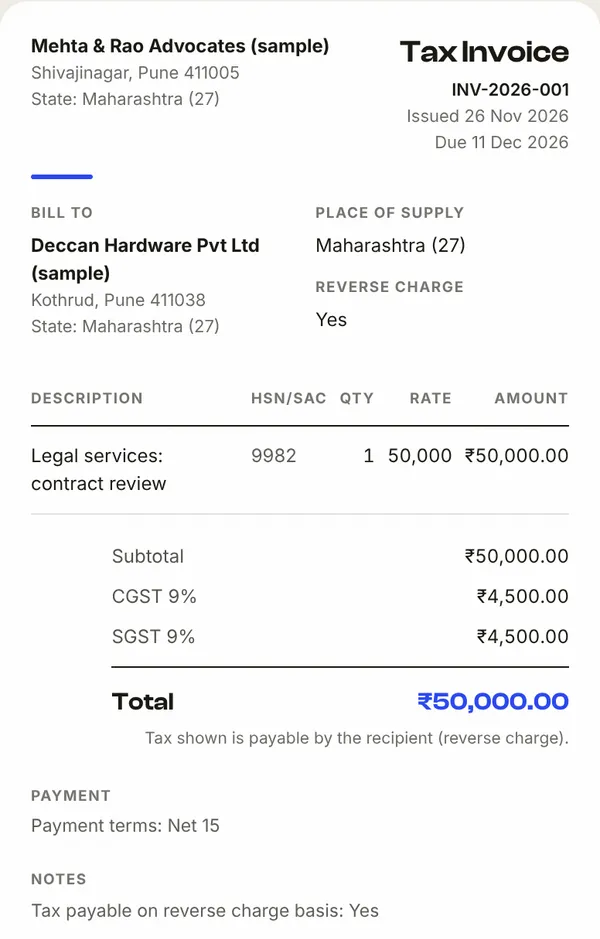
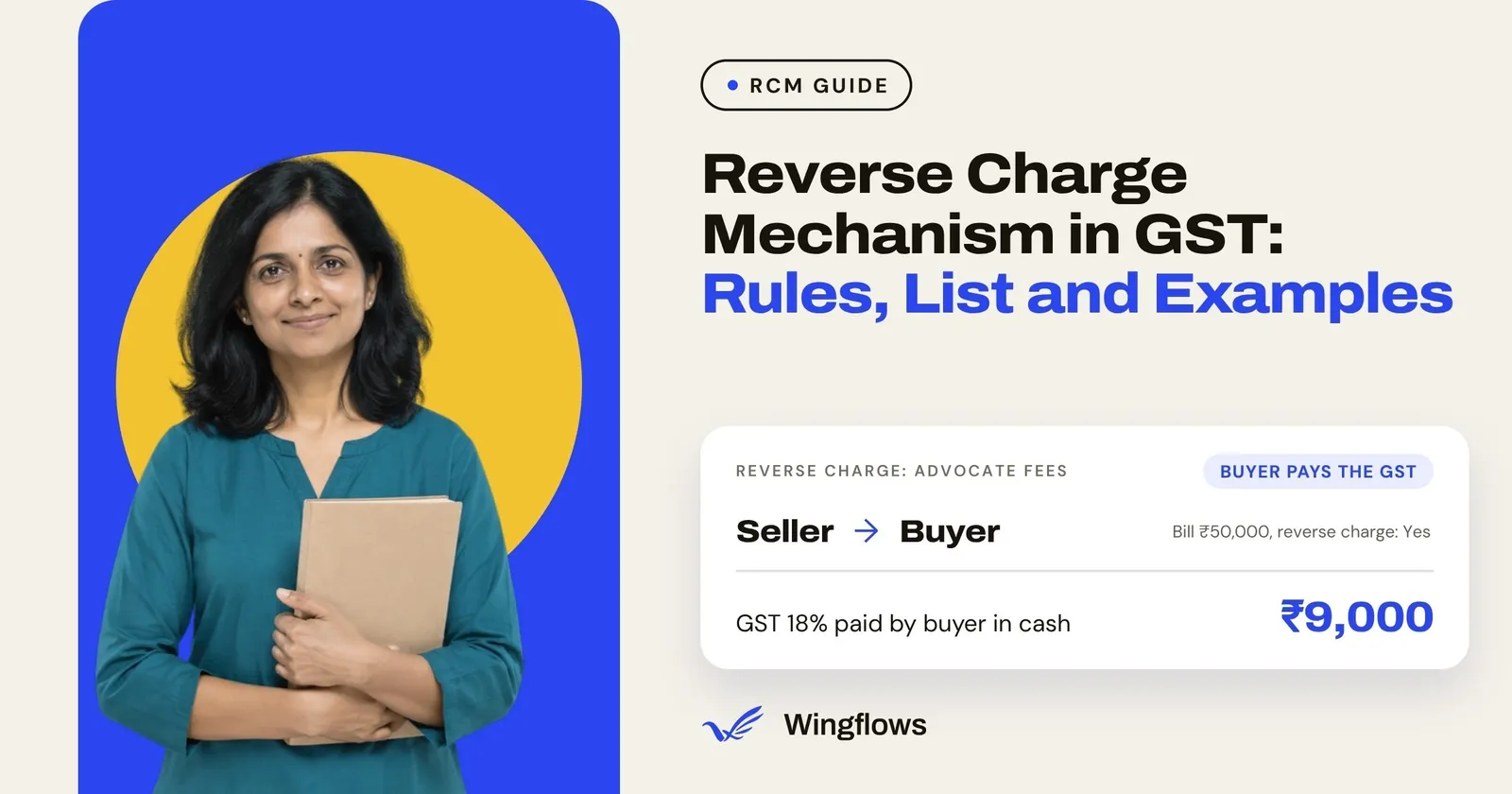
A test bill we made in the generator on 26 November 2026, with made-up names and the GSTIN fields left blank (a real tax invoice shows both GSTINs). The 18% is the generator’s default rate, used only to show the layout: check the rate for your own service. The total is ₹50,000 because the buyer, not the seller, pays the ₹9,000 tax.
Reverse charge mechanism examples
Example 1: rent from an unregistered landlord
A GST-registered hardware shop in Pune rents its shop from a landlord who is not registered for GST. The rent is ₹40,000 a month. The shop is a regular taxpayer, not under composition. Commercial rent falls under real estate services (heading 9972) at 18% (Notification 11/2017-CT(Rate)).
The tax costs the shop nothing in the end if it can use the credit, but the ₹7,200 has to be paid in cash first. If a month is missed, the tax is paid late with interest at 18% a year under section 50(1) (Notification 13/2017-Central Tax).
Example 2: an advocate’s bill to your company
Take the sample bill in the screenshot above. Deccan Hardware, a registered company in Pune, gets a ₹50,000 bill from an advocate firm for contract review, marked reverse charge “Yes”.
- Deccan pays the firm ₹50,000, not ₹59,000. The tax on the bill is not for the firm to collect.
- Using the 18% shown on that sample, Deccan owes ₹4,500 CGST + ₹4,500 SGST under reverse charge.
- It pays the ₹9,000 from its cash ledger and reports it in GSTR-3B Table 3.1(d).
- If eligible, it claims ₹9,000 as input tax credit in Table 4(A)(3).
The time of supply is the payment date, or the day after 60 days from the firm’s invoice date if Deccan has not paid by then.
Common RCM mistakes
- Rent with no GST booked. Check rent paid to unregistered landlords since 10 October 2024, and rent for any residential flat your business takes.
- Charging GST yourself on an RCM sale. If the client must pay under reverse charge, your bill does not collect the tax.
Frequently asked questions
What is RCM in GST in simple words?
The buyer pays the GST on a purchase instead of the seller. It applies only to goods and services the government has notified, such as a lawyer’s fees to a business, GTA freight, director’s fees, rent paid to an unregistered landlord and rent for a residential flat your business takes.
Who is liable to pay GST under reverse charge?
The recipient named in the notification, for example a business entity for legal services, or a registered person for metal scrap bought from an unregistered seller. The supplier and recipient must both match the notification.
Is RCM applicable on rent?
Yes, in two cases. A registered person renting a residential dwelling pays GST under reverse charge (serial 5AA, from 18 July 2022); a proprietor renting a home in a personal capacity as their own residence is exempt. And a registered person renting any other property from an unregistered landlord pays it too (serial 5AB, from 10 October 2024); since a January 2025 amendment, composition taxpayers are left out of 5AB.
Is RCM applicable on purchases from unregistered dealers?
Not on all of them. Only notified goods and services are on reverse charge, such as scrap and used cooking oil from an unregistered seller or rent from an unregistered landlord. Ordinary purchases from an unregistered shop are not.
Can input tax credit be used to pay RCM?
No. RCM tax is paid from the electronic cash ledger, not with input tax credit. After paying it, you can claim it as input tax credit if you are otherwise eligible.
Is RCM applicable on GTA freight?
Yes, for the recipients listed in serial 1 of Notification 13/2017 (a factory, society, registered person, body corporate, partnership firm and similar).
Is RCM applicable on director’s remuneration?
Yes for non-employee directors, and for fees paid to an employee director outside salary. The company pays under serial 6. An employee director’s salary, taxed under section 192 of the Income-tax Act, is outside GST (Circular 140/10/2020-GST).
Is RCM applicable on import of services?
Yes, when a business in India buys a service from a supplier outside India and is not a non-taxable online recipient. Notification 10/2017-Integrated Tax (Rate) puts any service supplied by a person in a non-taxable territory on reverse charge. The buyer pays IGST in cash and can claim it as ITC if eligible. Check the notification text if the service is for personal use.
What is the time limit to issue a self-invoice under RCM?
Thirty days from the date of receipt of the goods or services, under rule 47A of the CGST Rules, in force from 1 November 2024.
Get your RCM bills right
List your recurring expenses this week: rent, legal fees, freight, director’s fees, scrap purchases. Mark which ones are on reverse charge, and set a monthly reminder to pay that tax in cash.
If you are the supplier, make your GST invoices with the free GST invoice generator: tick reverse charge and it prints the line and keeps the tax out of the total.
If your team books RCM entries by hand every month, we can automate the self-invoices and the cash-ledger reminder inside your billing or ERP with business systems and automation. Talk to us about how your books run today.