A proforma invoice is an advance copy of the bill, sent before you deliver. It lists the same items, prices and terms as the final invoice, but it isn’t one. The buyer uses it to pay an advance, get a purchase approved, open a letter of credit or, in some cases, get goods through customs before the commercial invoice is ready. Once you deliver or get paid, you send the real invoice.
I ask most new clients for up to 40% upfront before I start. When their finance team needs a document to pay against, I send a proforma invoice. Some of the businesses I work with ship goods abroad, and for them the proforma comes up a second time, at customs.
Key takeaways
- A proforma isn’t a tax invoice and doesn’t go in your books. The UK tax authority, HMRC, says a buyer can’t use one to reclaim VAT.
- Use one to collect an advance, to give a client’s finance team something to pay against, or for an export buyer’s import license or letter of credit.
- Give proformas their own number series, such as PF-2026-001, and a “valid until” date.
What is a proforma invoice?
HMRC defines pro-forma invoices as “commercial documents that contain some or all of the information” found on an invoice, without formally confirming a supply (HMRC VATREC9010). The US International Trade Administration puts it more simply: “A pro forma invoice is a quote in an invoice format” (trade.gov). The spellings proforma, pro forma and pro-forma all mean the same document.
On its own, a proforma doesn’t create a debt. FreeAgent, the UK accounting software, calls it “a management document only”: it doesn’t count toward your sales or the money customers owe you (FreeAgent).
When to use a proforma invoice
To collect an advance. HMRC notes that suppliers send pro-forma invoices to customers they don’t know or whose creditworthiness is doubtful, setting out what will be supplied once payment is made (HMRC).
For a client’s finance team. Larger clients often can’t release money without an invoice-shaped document tied to a purchase order. If they gave you a PO number, put it on the proforma. It saves a round of emails.
For an export buyer. Buyers may need one “to apply for an import license, contract for pre-shipment inspection, open a letter of credit or arrange for transfer of hard currency” (trade.gov). If the buyer opens a letter of credit, its goods description, quantities and prices come from your proforma. Keep the wording identical on the commercial invoice you send later. The ICC’s trade finance academy warns that “even minor spelling or numerical errors can lead to discrepancies if they differ from the credit”, and that discrepancies “can delay payment or even lead to refusal by the issuing bank” (ICC Academy).
What to put on a proforma invoice
Based on the trade.gov checklist, plus HMRC’s labelling advice, with the export-only lines at the end:
- The heading “Proforma invoice” and the line “This is not a tax invoice”
- Your name and address, and the buyer’s
- The buyer’s reference or PO number
- A reference number from its own series, such as PF-2026-001
- Each item or service with quantity, unit price and total, plus any discount
- Tax shown as an estimate
- Payment terms: the advance due, the currency and how to pay
- A “valid until” date
- For goods: weights and dimensions, the Incoterm with its named place (for example “FCA seller’s warehouse, Atlanta, GA, USA, Incoterms® 2020”), and an estimated shipping date
Here is a filled example for an export order. It is illustrative, not a real deal.
For a service job, drop the HS code, delivery, origin and package rows, and show estimated sales tax if your state charges it. The rest stays the same.
HMRC says pro-forma invoices “should always be clearly described as such” and should preferably carry the words “This is not a VAT invoice” (HMRC VATREC9010). Outside the UK, “This is not a tax invoice” does the same job.
Keep proformas out of your invoice number series. Many never turn into sales, and the unused numbers leave gaps in your invoice sequence.
A proforma that asks for money also carries your bank details. Tell new buyers you will never change those details by email, and to call you if a message says otherwise.
Quote vs proforma invoice vs invoice
QuickBooks UK draws the quote line by timing. A quote covers what the customer can expect “before it has been agreed”. A proforma gives “full and final details once the customer has committed” (QuickBooks UK).
On how binding a proforma is, sources disagree. FreeAgent says it “is not binding on your business” (FreeAgent). The trade.gov guidance says that once an export proforma is sent, “changes should not be made without the buyer’s consent” (trade.gov). I’d only send prices I’m prepared to honour.
Proforma invoice vs commercial invoice
A proforma invoice comes first, while the deal is being set up. A commercial invoice travels with the shipment. In the buyer’s country, “it is the document that is used by their customs officials to assess import duties and taxes” (trade.gov). It also carries the final shipment details the proforma could only estimate, such as the actual ship date, weights and packing.
Skip the rest of this section if you don’t ship goods across borders.
US imports. If the commercial invoice isn’t available when goods are entered, the importer (not the exporter) can file a pro forma invoice, but only in set cases. US customs must accept that the delay is “due to a cause beyond the control of the importer”. The importer files a bond for “one and one-half the invoice value”, and the required invoice “must be produced within 120 days after the date of the filing of the entry summary”, with a shorter 50-day limit when it’s needed for statistics (19 CFR 141.91).
Couriers. DHL eCommerce advises heading the document simply “invoice”, because “proforma invoices are not used or not accepted in a number of countries” (DHL eCommerce). For gifts and samples, the same guide asks for the line “Gift shipment/Sample shipment, no commercial value, value for customs purposes only”. Check your courier’s rules for the destination before you print.
Tax: VAT and US sales tax
In VAT countries the proforma never replaces the VAT invoice. HMRC’s manual says a pro-forma is not acceptable evidence for a buyer to reclaim input tax. If you’re VAT-registered and you get paid against a proforma, or make the supply, you must issue a full VAT invoice within 30 days (HMRC VATREC9020).
The US has no VAT. If your work is subject to sales tax, label the tax on the proforma as an estimate and charge it on the final invoice. Some states tax services as well as goods, so check your state’s rules before you leave tax off. Selling abroad? Each country sets its own invoice rules; ask your accountant.
Example: a 40% advance, start to finish
This is an illustrative example based on how I structure my own advances, not a real client.
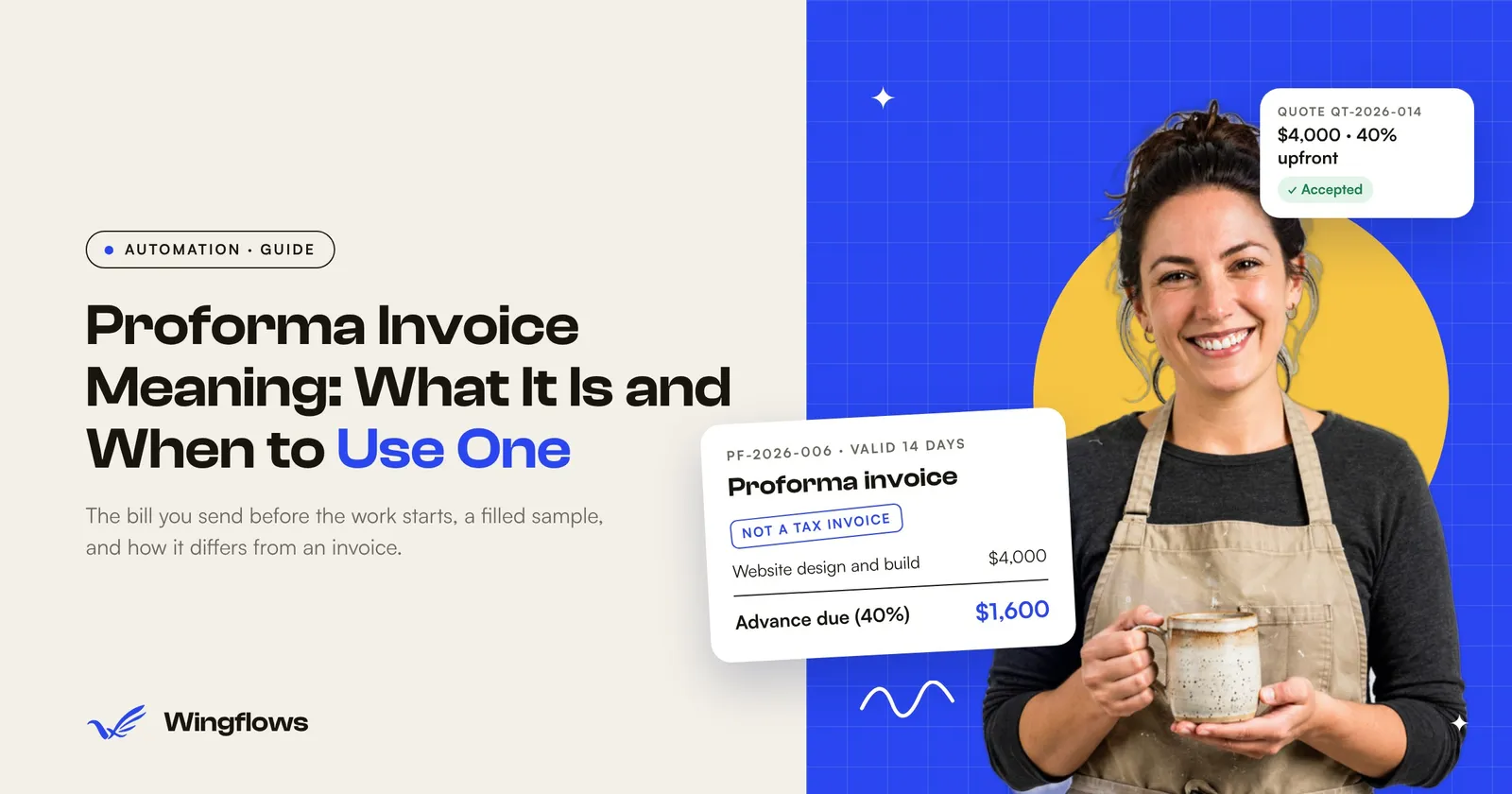
A small web studio agrees on a $4,000 website project with a new client: 40% before work starts, 60% at launch. The client’s finance team asks for a document they can pay against.
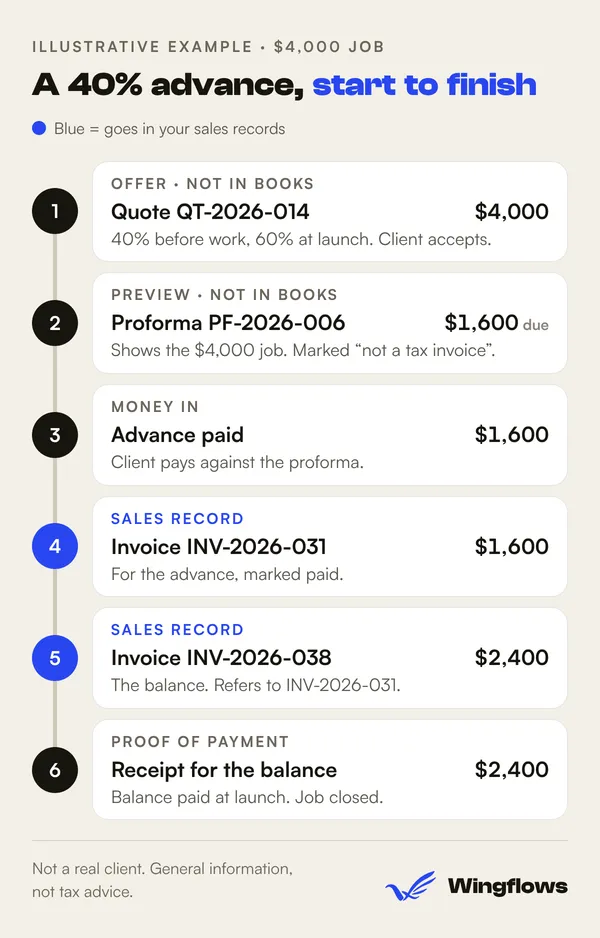
The proforma shows the full $4,000 job, “Advance due now: $1,600”, “This is not a tax invoice” and a 14-day validity. When the $1,600 arrives, the studio issues invoice INV-2026-031 for the advance and marks it paid. At launch it sends INV-2026-038 for the $2,400 balance, referring to advance invoice INV-2026-031. Together the two invoices total the $4,000 job.
The quote and the proforma never touch the books; the two invoices do. Some accounting systems record an advance as its own invoice, as here, and others as a deposit against the final invoice. Agree the method with your accountant once and keep to it.
Common mistakes
- Treating the paid proforma as the end of the job. Without the real invoice you have no sales record.
- Listing tax as if it’s already charged. Label it “estimated tax”; the real charge goes on the invoice.
- Leaving out a “valid until” date, then being held to old prices or exchange rates.
FAQ
Is a proforma invoice legally binding?
Not on its own. Once the buyer signs or accepts it, it can form part of the contract, so be ready to honour its prices and terms.
Can I accept payment against a proforma invoice?
Yes. HMRC describes suppliers sending them to new customers to collect payment before supplying. Once the money arrives, issue a proper invoice for it.
What is the difference between a proforma invoice and an invoice?
A proforma previews the bill and isn’t recorded; an invoice asks for payment, takes the next number in your invoice series and goes in your books.
Do I need a proforma for a domestic job?
Only if the client asks for one. Many small jobs go straight from quote to invoice. A quote that states the advance due often does the same job.
What if the final amount changes?
If nothing has been paid yet, send a new proforma with a new reference. If the advance is already paid, invoice the balance at the final amount and refer to the advance invoice.
Make the quote and invoices for free
Our tools don’t make a document headed “proforma invoice” yet. The quotation maker covers most of the same ground: set “Advance required (%)” and the quote shows the advance due on acceptance. If the client’s finance team insists on a document headed “proforma”, ask whether that quote will do, or make the proforma in your accounting software. When the advance arrives, “Convert to invoice” moves everything into the invoice generator with a new invoice number and a “deposit received” line, so the balance is right.
If you chase advances and part payments by hand every week, it’s worth automating. We set up business systems where quotes become invoices and deposits match to payments; our guide to accounting automation shows where to start. Talk to us if you want it built.