A quotation letter is a formal letter in which a seller offers a buyer a price for goods or services, on stated terms, until a stated date. In India it goes on your letterhead with your GSTIN, usually in reply to an enquiry or a request for quotation (RFQ), and it should end by telling the buyer how to accept: a purchase order quoting your reference, or a signed copy.
This guide is for shop owners, traders, manufacturers, contractors and agencies who reply to enquiries from companies, schools, hospitals or government offices. It gives the 8-part format, five samples you can copy (four seller replies and one buyer’s RFQ), and the GST and contract points that most quotation letter templates leave out.
I built the free quotation maker on Wingflows because I needed one for my own client quotes. For this guide I typed Sample 1 into it and converted the quote into a tax invoice, to see which invoice details a good quote already gives you. Checked against the Indian Contract Act, the CGST Act and Rules, CBIC material and the MSMED Act on 23 November 2026. General information, not legal or tax advice.
Key takeaways
- A quotation letter has eight parts: letterhead with GSTIN, reference number and date, the buyer’s details, a subject line, a one-line opening, an itemised price table, terms, and a close that says how to accept.
- Write a “valid until” date. Under section 6 of the Indian Contract Act, an offer with no time limit stays open for a “reasonable time”, which is easy to argue about.
- Show the taxable value, the GST split and HSN or SAC codes. In our test, 11 of the 13 tax invoice details that applied to Sample 1 came straight from the quote.
- An advance on services carries GST when you receive it. An advance on goods (outside the composition scheme) does not.
- “We accept, but at ₹3,000” is a counter-offer. Answer with a revised quote (QT-2026-041-R1), not a phone “OK”.
What a quotation letter is, and when to use one
It is your offer in letter form. The price table is the same one you would put in a quotation PDF. The letter wraps it in a reply: who you are writing to, what they asked for, and what happens next.
Write the letter form when:
- A company or institution sent an enquiry or RFQ with its own rules. An Indian Institute of Science RFQ, for example, asks for a signed “Letter of Quotation”, wants taxes shown separately, and says the quote “shall remain valid for the period not less than 15 days after the deadline date” (IISc RFQ). Read those rules before you use any template, including ours.
- The job needs context: scope, site conditions, what is excluded.
- The buyer is a school, hospital, housing society or office that files paper.
For a repeat customer who wants a number, a quotation PDF on WhatsApp is enough. The quotation maker gives you that PDF, and the letter text below can go in the covering email.
Quotation letter format: the 8 parts
There is no format fixed by law; Tally’s guide for small businesses says the same (Tally Solutions). Purchase teams still expect the same eight blocks, in this order.
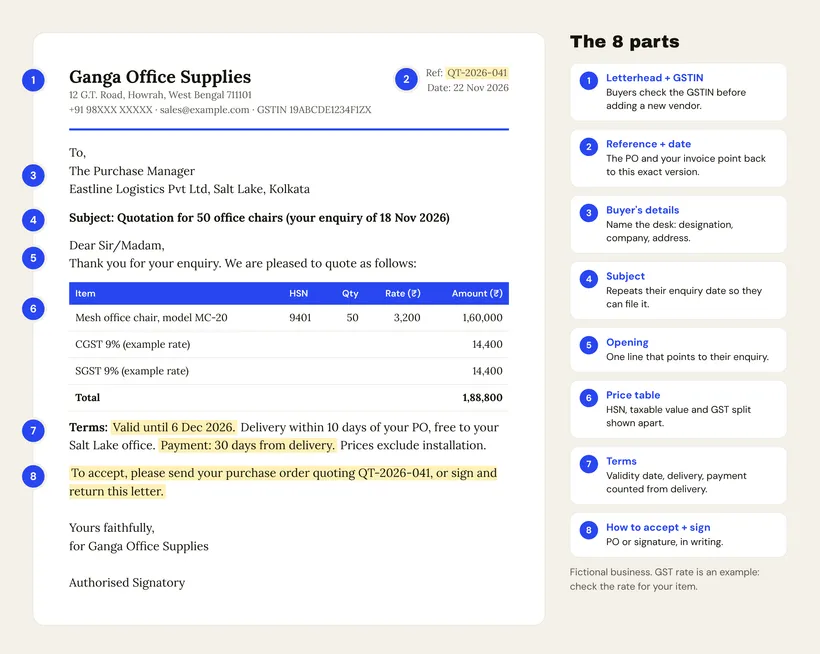
How to write a quotation letter in 6 steps
Read the enquiry twice. Note the quantity, specification, delivery address and the date they want quotes by. Quote for exactly that. Put any alternative you'd suggest in a separate, clearly labelled line.
Give it a reference number. One running series, such as QT-2026-041. A revision keeps the number and adds a suffix (QT-2026-041-R1), so both sides know which version the PO refers to.
Write a subject line that matches their request. "Quotation for 50 office chairs (your enquiry of 18 Nov 2026)" gets filed. "Quotation" gets lost.
Build the price table. One line per item with its HSN code (goods) or SAC code (services), quantity, unit, rate and amount. Then the taxable value, the GST split and the total.
Write the terms as plain sentences. A validity date, delivery time, payment terms counted from a named event, the advance, and what is not included.
Say how to accept, then sign. "To accept, please send your purchase order quoting QT-2026-041, or sign and return this letter." Sign for the business as Authorised Signatory.
5 quotation letter samples
All five use fictional businesses. Replace the parts in square brackets. GST rates are examples to show the maths: check the rate for your own HSN or SAC code.
Sample 1: supply of goods, buyer in the same state
Ganga Office Supplies
12 G.T. Road, Howrah 711101
GSTIN 19ABCDE1234F1ZX
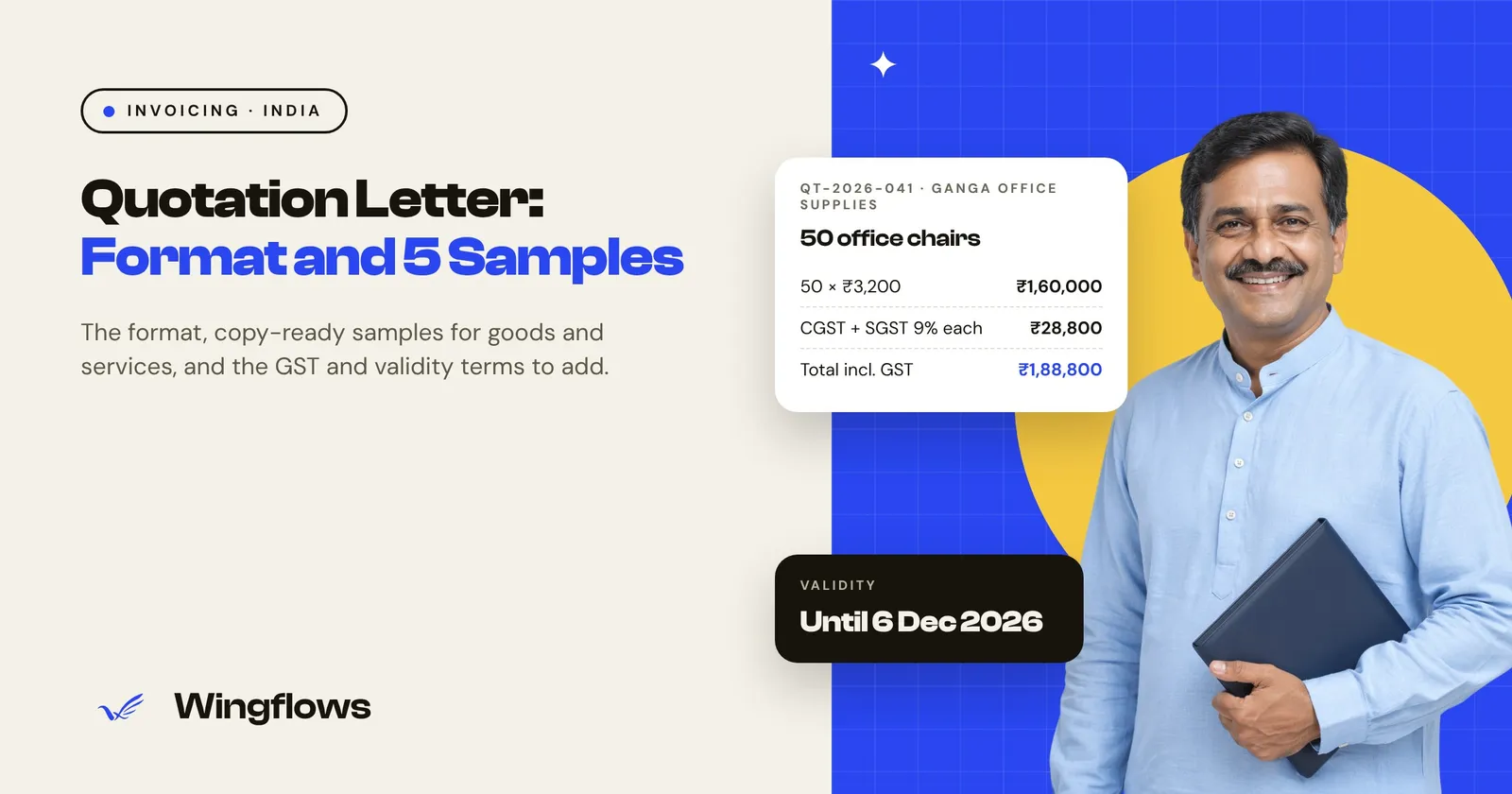
Ref: QT-2026-041   Date: 22 Nov 2026

To,
The Purchase Manager
Eastline Logistics Pvt Ltd, Salt Lake, Kolkata

Subject: Quotation for 50 office chairs
(your enquiry of 18 Nov 2026)

Dear Sir/Madam,

Thank you for your enquiry.
We are pleased to quote as follows:

Mesh office chair, model MC-20
HSN 9401
50 nos @ ₹3,200 = ₹1,60,000
CGST 9% (example rate): ₹14,400
SGST 9% (example rate): ₹14,400
Total: ₹1,88,800

Terms:
- Valid until 6 December 2026.
- Delivery within 10 days of your PO,
  free to your Salt Lake office.
- Payment within 30 days from delivery.
- Prices exclude installation.

To accept, please send your purchase
order quoting QT-2026-041, or sign
and return this letter.

Yours faithfully,
for Ganga Office Supplies
Authorised Signatory
Seller and buyer are both in West Bengal, so GST is split into CGST and SGST. A buyer in another state would see one IGST line instead. Our place of supply guide explains how to decide.
Sample 2: services to a client in another state
Subject: Quotation for website redesign
and 12 months' maintenance
Ref: QT-2026-057

Dear [Name],

Thank you for the call on [date].
As discussed, here is our quotation
for redesigning [company]'s website.

1. Website redesign, 8 pages,
   2 rounds of revisions
   SAC [code]: ₹60,000
2. Maintenance, 12 months
   SAC [code]: ₹24,000

Taxable value: ₹84,000
IGST 18% (example rate): ₹15,120
Total: ₹99,120

Scope: you supply content and photos.
Extra pages or features are quoted
separately before we start them.

Payment: 50% advance (₹49,560) on
acceptance, 50% on launch.
Timeline: 4 weeks from receipt of
the advance and content.
Validity: 30 days from the date
of this letter.

To go ahead, please reply to this email
confirming QT-2026-057, or sign and
return the attached copy.

Regards,
[Name], for [Business]
Service lines take SAC codes, not HSN. Our SAC code guide shows how to find yours.
Sample 3: contractor quoting for site work
Subject: Quotation for false ceiling
work at [site address]
Ref: QT-2026-063

Dear Sir,

With reference to our site visit on
[date], we quote for gypsum false
ceiling work as below:

Gypsum false ceiling with frame
[area] sq ft @ ₹[rate] per sq ft
Amount: ₹[amount]
GST @ [rate]%: ₹[amount]
Total: ₹[amount]

Measurement: final bill on actual
measured area, checked jointly
on completion.
Not included: electrical work,
painting, scaffolding above [height].
Payment: [x]% advance, [y]% when
framing is complete, balance
on handover.
Validity: 15 days, as material
prices change often.

Please confirm the order in writing
quoting QT-2026-063.

Yours faithfully,
for [Business], Authorised Signatory
On site work, the measurement rule and the “not included” line settle most arguments before they start.
Sample 4: the short covering email or WhatsApp message
When the quotation itself is a PDF, keep the message short:
Dear [Name],

Please find attached our quotation
QT-2026-071 for [items], as requested
on [date].

Total ₹[amount] including GST,
valid until [date].
Delivery [x] days from your PO.

Shall I block the stock for you
until [date]?

Regards,
[Name], [Business], [phone]
A closing question the buyer can answer with one word (“Shall I block the stock?”) gives them an easy reason to reply. “Please let us know if you have any queries” gives them none.
Sample 5: request for quotation (RFQ), from the buyer’s side
Several pages ranking for “quotation letter” are request letters, written from the buyer’s side. If you are the buyer, this gets you quotes you can compare line by line:
Subject: Request for quotation:
50 office chairs

Dear Sir/Madam,

We invite your quotation for:
50 mesh office chairs with arms,
delivered to [address].

Please quote:
- rate per unit, HSN code and GST
  shown separately
- delivery time from our PO
- payment terms and any advance
- warranty
- validity of your offer

Please send your quotation on your
letterhead, with your GSTIN, by
[date] to [email].

Regards,
[Name], Purchase, [Company]
Asking every supplier for the same fields is what makes the replies comparable.

GST in a quotation letter
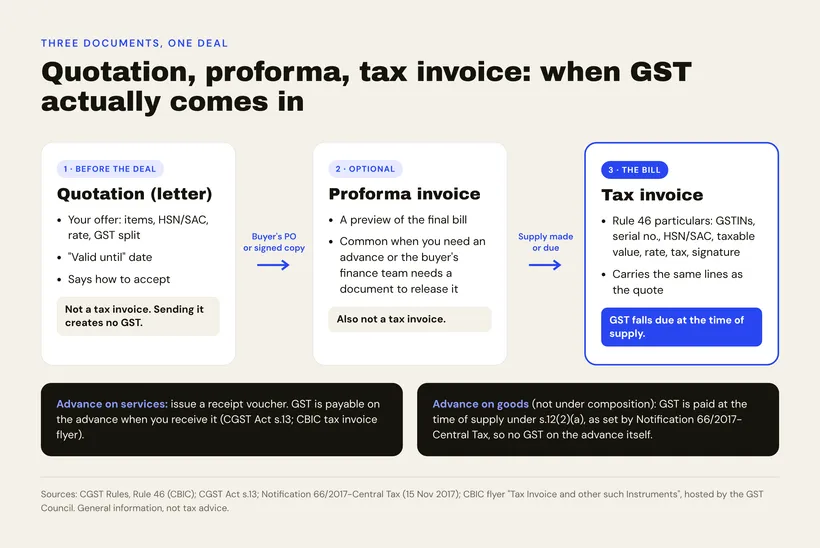
Sending a quotation creates no GST. GST falls due on the supply, on an advance for services, or with the tax invoice. What you put in the quote still decides how cleanly that invoice goes out.
HSN or SAC on every line. Rule 46 of the CGST Rules lists the “Harmonised System of Nomenclature code for goods or services” among the particulars of a tax invoice, along with description, quantity, taxable value, rate and tax amount (CBIC, Rule 46). How many digits depends on turnover. Under Notification 78/2020-Central Tax, in force from 1 April 2021, businesses with turnover up to ₹5 crore use 4 digits and those above ₹5 crore use 6. Put the same code on the quote and the invoice can copy it.
Taxable value and GST on separate lines. “₹1,88,800 all inclusive” makes the buyer’s accountant work backwards to find their input tax credit. ₹1,60,000 plus CGST and SGST of ₹14,400 each does not.
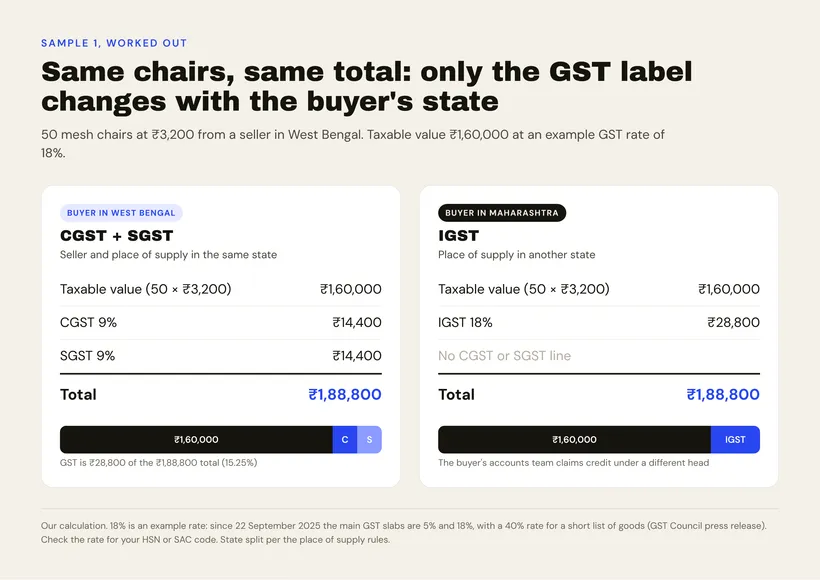
Say which GST rate applies if it changes. GST rates were reworked “with effect from 22 September 2025” into “a 2 rate structure with a Standard Rate of 18% and a Merit Rate of 5%”, plus a 40% rate for a short list of goods (GST Council press release). A quote that is valid for 30 days, or a long project quoted once, can straddle a change like that. Quote your price before GST and add one line: “GST extra at the rate in force on the date of invoice.”
Composition dealers. If you are under the composition scheme, you cannot charge GST on the quote. Tally’s guide suggests stating clearly that GST is not charged separately. Our bill of supply guide covers the document you issue instead of a tax invoice.
Advances: the GST rule to plan before you ask for one
CBIC’s tax invoice flyer says that on receiving an advance you issue a receipt voucher, and “GST is payable on receipt of advance in case of services only” (CBIC flyer, hosted by the GST Council). For services, the time of supply is the date of the invoice (if issued on time) or the date you receive payment, “whichever is earlier”, and the supply is treated as made “to the extent it is covered by the invoice or, as the case may be, the payment” (CGST Act, section 13). For goods, Notification 66/2017-Central Tax of 15 November 2017 lets registered persons outside the composition levy pay tax “at the time of supply as specified in clause (a) of sub-section (2) of section 12”, so the advance on goods carries no GST by itself.
What that means in money, using the samples:
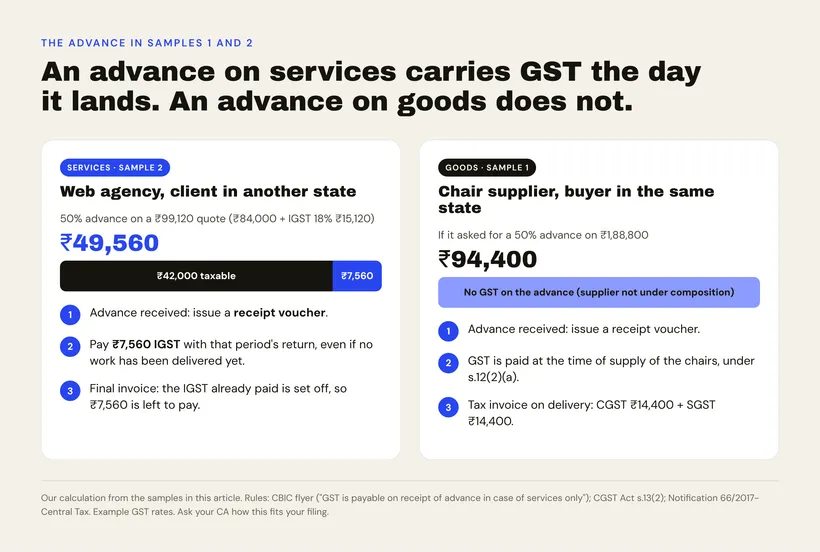
The cost owners forget on the services side: the agency in Sample 2 owes ₹7,560 to the government before it has finished any work, out of money it has not yet earned. If the project stalls, the flyer’s answer is a refund voucher when no supply follows. At Wingflows we ask most new clients for up to 40% upfront, so this is a rule we plan around too.
The terms that protect you
A validity date
The Indian Contract Act says a proposal is revoked “by the lapse of the time prescribed in such proposal for its acceptance, or, if no time is so prescribed, by the lapse of a reasonable time” (Indian Contract Act, 1872, section 6). No law fixes the period. Tally’s guide says “Most SMEs use 15 to 30 days, after which prices may change due to material costs, GST rate revisions or availability.” Go shorter when your input prices move every week, as in Sample 3.
Whether your quote is a binding proposal at all depends on its wording. The Act calls it a proposal when you signify willingness “with a view to obtaining the assent” of the other side (section 2(a)). A bare price list may be read as an invitation to offer. A letter with fixed rates, a validity date and “to accept, send your PO” reads as a proposal, which is what you want when the buyer sends that PO.
A clear way to accept
Section 7 says acceptance must “be absolute and unqualified” and be expressed “in some usual and reasonable manner, unless the proposal prescribes the manner”. So prescribe it: a PO quoting your reference, a signed copy or a reply email. The same section says that if the buyer accepts some other way and you do not insist on your manner within a reasonable time, you accept their acceptance. In practice: if they confirm on WhatsApp and you dispatch, you are bound.
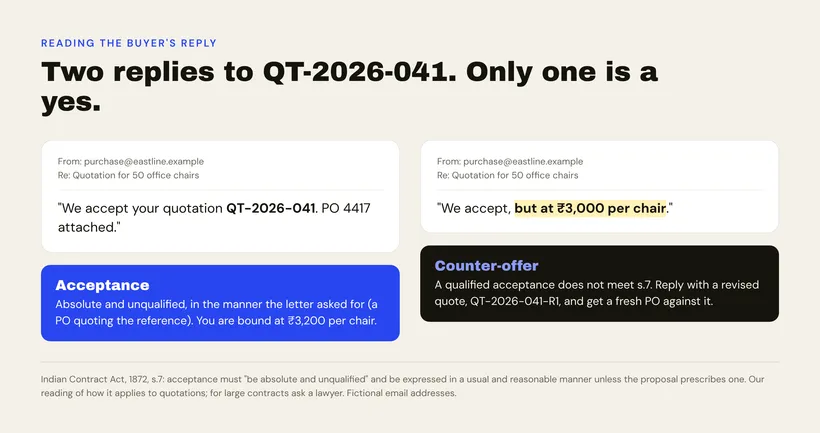
Section 4 says acceptance is complete as against the proposer “when it is put in a course of transmission to him”. On our reading, a PO emailed at 11:50 pm on your validity date counts, even if you open it the next morning. For large contracts, ask a lawyer to read your standard terms.
Payment terms counted from a named date
“30 days” from what? Write “30 days from delivery” or “30 days from the date of invoice”.
If you are a micro or small enterprise with Udyam registration, the MSMED Act sets the outer limit. The buyer must pay by the date agreed in writing or, with no written agreement, within 15 days of accepting the goods or services. A written period cannot “exceed forty-five days from the day of acceptance or the day of deemed acceptance” (section 15). Late payment carries “compound interest with monthly rests” at “three times of the bank rate notified by the Reserve Bank” (section 16) (MSMED Act 2006, DC-MSME copy). Buyers’ accounts teams watch this closely because tax deductions for amounts owed to micro and small suppliers depend on paying on time: section 43B(h) for FY 2025-26, continuing as section 37(2)(g) from Tax Year 2026-27 (Tally Solutions).
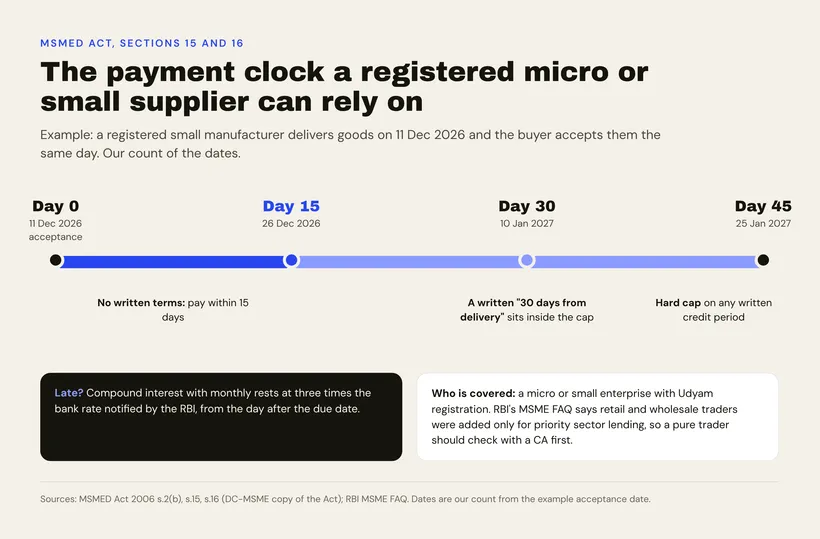
A trading business like Ganga Office Supplies may not be covered. RBI’s MSME FAQ says retail and wholesale trade were included “for the limited purpose of Priority Sector Lending” (RBI, MSME FAQ). If you only buy and resell, check with your CA before you rely on the 45-day rule in a quote. If a buyer does pay late, our payment reminder guide has the wording.
Scope and exclusions
List what is in and what is out. “Extra work is quoted separately before we start it” saves an argument on most service jobs.
Every clock a quotation letter starts
We compiled these from the Acts and rules above and applied them to Sample 1. The dates are our count.
Our calculation and compilation, November 2026. Sources linked in the sections above.
From quotation to tax invoice: what our test showed
To see how much of a tax invoice a quotation letter already contains, we typed Sample 1 into the free quotation maker on 23 November 2026, India GST mode. Twenty fields covered both businesses, the quote number and dates, the chair line and the terms.
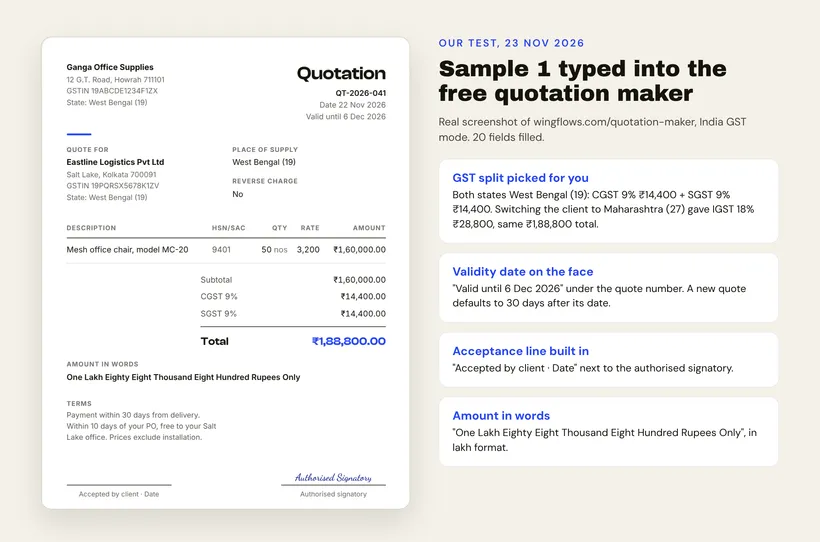
What we saw:
- With both states set to West Bengal (19), the tool split GST into CGST and SGST. Changing the client to Maharashtra (27) switched it to one IGST line of ₹28,800, with the same ₹1,88,800 total.
- A new quote starts with “Valid until” 30 days after its date. We changed it to 6 December to match the letter.
- Our first made-up GSTIN failed the checksum and the tool flagged it, which is the kind of typo a buyer’s vendor form rejects.
Then we pressed “Convert to invoice” and compared the fields before and after against the Rule 46 list.
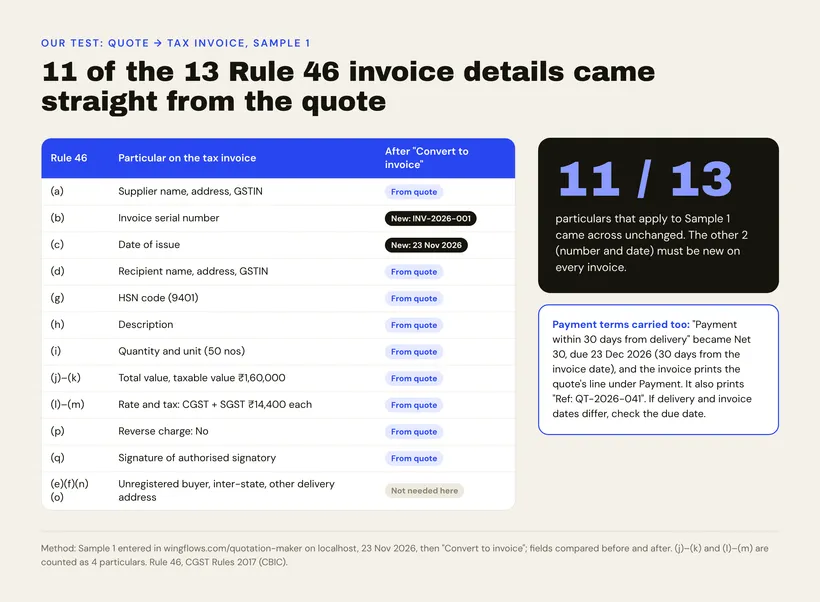
Eleven of the 13 Rule 46 particulars that apply to Sample 1 came across unchanged. The other two, invoice number and date, are meant to be new. The payment term came across too: “Payment within 30 days from delivery” set the invoice to Net 30, due 23 December 2026, and the quote’s sentence is printed under Payment on the PDF. One catch remains. The tool counts the 30 days from the invoice date (23 November), while the quote counts from delivery. If the chairs arrive a week after you invoice, the printed due date is a week early, so match the due date to the delivery date before you send it.
Quotation letter vs quotation vs proforma invoice vs tax invoice
A quotation letter is the offer written as a letter. A quotation is the same offer as a document with a price table, often a PDF. A proforma invoice previews the final bill once the buyer agrees, often so their finance team can release an advance; when a client’s finance team asks for one, we send it. A tax invoice is the bill with the Rule 46 particulars, and it is the one GST attaches to. Our guide on what a proforma invoice is covers when to send one, and how to write an invoice covers the last step.
Common quotation letter mistakes
Quotation letter FAQ
These questions come from competitor FAQs and related searches for “quotation letter” in India.
What is a quotation letter?
A formal letter in which a seller offers a price for goods or services, on stated terms, valid until a stated date. It usually replies to a buyer’s enquiry or RFQ and goes on the seller’s letterhead with the GSTIN.
How do I write a simple quotation letter?
Letterhead, reference number and date. The buyer’s name and address, a subject line naming their enquiry, and one line of thanks. Then an itemised price table with product or service codes and GST, your terms (validity, delivery, payment), a line saying how to accept, and your signature as Authorised Signatory.
What is the difference between a quotation letter and a quotation request letter?
The buyer sends the request (an RFQ) to ask suppliers for prices. The supplier replies with a quotation letter giving the price and terms. Sample 5 above is a request; Samples 1 to 4 are replies.
Is GST included in a quotation?
Show it, but separately. List the taxable value, GST rate and amount, and HSN or SAC codes, so the buyer sees the full cost and can check input tax credit. No GST is payable on sending a quotation; it falls due on the supply, the invoice or, for services, an advance.
How long is a quotation valid?
As long as you say. No law sets a period; 15 to 30 days is common for small businesses. Without a date, the offer stays open for a “reasonable time” under section 6 of the Indian Contract Act.
Is a quotation letter legally binding?
Not by itself. It becomes a contract when the buyer accepts it as written, within the validity date, for example with a PO quoting your reference. A letter with fixed rates, a validity date and a stated way to accept reads as a proposal under section 2(a) of the Indian Contract Act; a bare price list may be treated as an invitation to offer.
How do I send a quotation by email?
Attach the quotation as a PDF and keep the email to four or five lines: the reference number, what it covers, the total including GST, the validity date, and one question the buyer can answer quickly. Sample 4 is a template. Name the file with the reference, such as QT-2026-071.pdf.
What is the difference between a quotation, a proforma invoice and a tax invoice?
The quotation is your offer before the deal. The proforma invoice previews the bill after the buyer agrees, often to collect an advance. The tax invoice is the actual bill with the Rule 46 particulars, and GST is payable with it.
Can I change a quotation after sending it?
Before acceptance, yes: send a revised quote with a suffixed reference (QT-2026-041-R1) that says it replaces the earlier one. After the buyer has accepted, any change needs their agreement.
Make your quotation now
Write the letter from the samples above, then build the price table in the free quotation maker: items with HSN/SAC codes, GST split, validity date and terms, downloaded as a PDF. When the PO arrives, convert it to an invoice and check the due date before you send it.
If your team sends dozens of quotes a month and retypes each one into an invoice and then into Tally, that is a process worth fixing. We build quoting and billing flows as part of our business systems and automation work, and our guide on how to automate your accounting process shows where to start. Talk to us about how your quotes are made today.