How to write an invoice: put the word “Invoice” at the top, then your business details, the client’s details, a unique invoice number, the invoice date and due date, one line per product or service with quantity and price, the tax, the total and how to pay. Save it as a PDF, email it to the person who pays, and keep a copy.
That matches the official UK and EU checklists we compare below; the US has no federal list. The rest of this guide is about the small details that decide whether an accounts team pays on the due date or sends the invoice back with a question.
This guide is for freelancers, small studios and small businesses that bill other businesses in the US, UK or EU. We run a small web and automation studio, send our own invoices every month, and built the free invoice generator on this site because we needed one.
Key takeaways
- The official UK and EU lists overlap almost completely: a unique number, the invoice date, the supply date, both parties’ names and addresses, a description, the tax and the amount. The US has no federal invoice checklist.
- Number invoices in one unbroken series, such as INV-2026-014. HMRC allows letters in the number and accepts gaps only if you can account for them.
- Print the actual due date (“Due December 21, 2026”), not just “Net 30”.
- If you took a deposit, show the full total first, then the deposit, then the balance due.
- In three UK Small Business Commissioner case studies, a missing PO number, a vague description and a missing due date held up more than £138,000 between them (our tally).
Checked on 23 November 2026 against the IRS, HMRC, GOV.UK, mygov.scot, the European Commission and the Office of the Small Business Commissioner. General information, not legal or tax advice.
What to include in an invoice
Rules differ by country, but the official lists agree on most of it. The Scottish Government’s business guidance says you must “clearly display the word ‘invoice’” and include a unique identification number, your company name, address and contact information, the customer’s name and address, a clear description of what you are charging for, the supply date, the invoice date, the amount charged, the VAT amount if applicable, and the total owed (mygov.scot). UK limited companies also show “the full company name as it appears on the certificate of incorporation”.
We put four official sources next to each other and checked which of ten common details each one names.
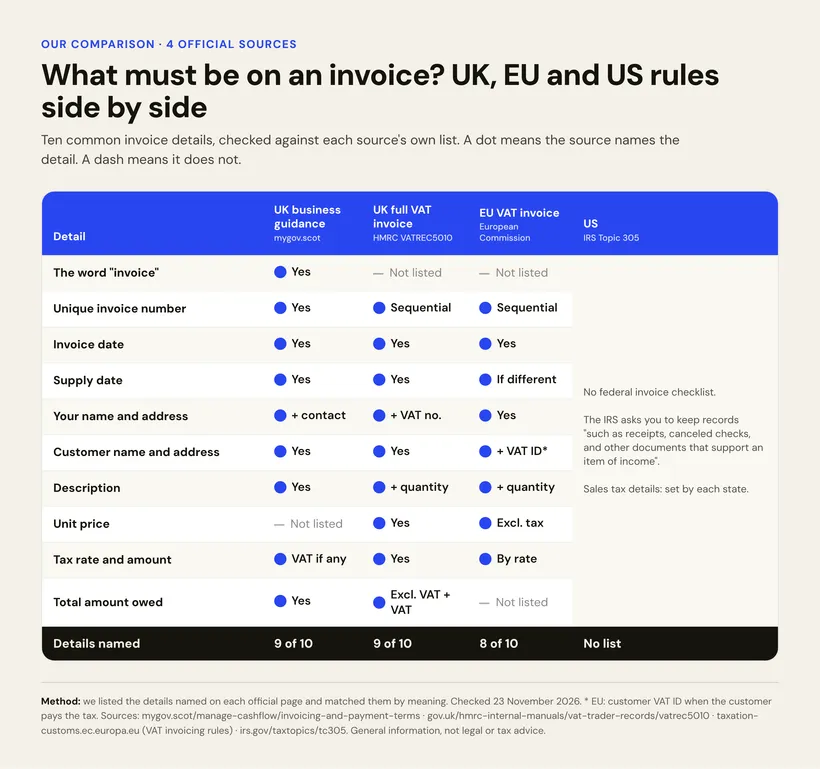
Three differences stand out from that comparison:
- The word “invoice” is named only by the UK business guidance. HMRC’s VAT list and the EU list don’t mention it. We put it on every invoice anyway, because an unlabelled document can be mistaken for a quote.
- Unit price is on both VAT lists (HMRC VATREC5010; European Commission) but not on the general UK list. Show quantity and unit price on every line and you are covered by all three.
- The US has no federal list. The IRS says you must keep “records, such as receipts, canceled checks, and other documents that support an item of income” (IRS Topic 305). An invoice with the details above does that job. Sales tax wording is set by each state, so check your state tax agency’s site if you charge it.
You can add more than the list asks for. The European Commission says businesses “may always include information on their invoices additional to that described above”. A purchase order number, a project name or your logo won’t make an invoice invalid.
Invoice, quote, proforma or receipt?
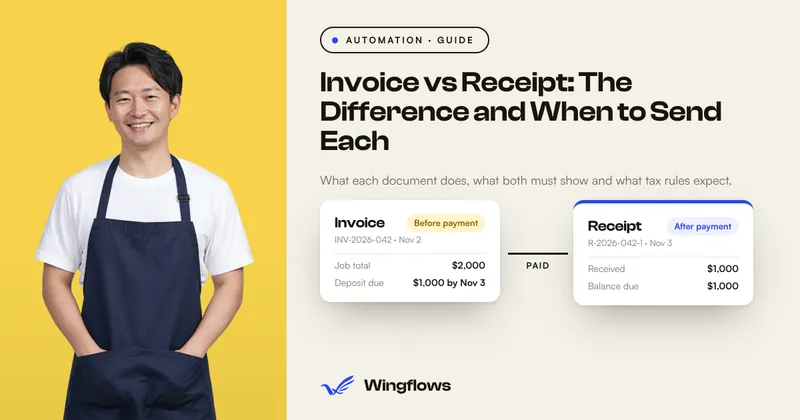
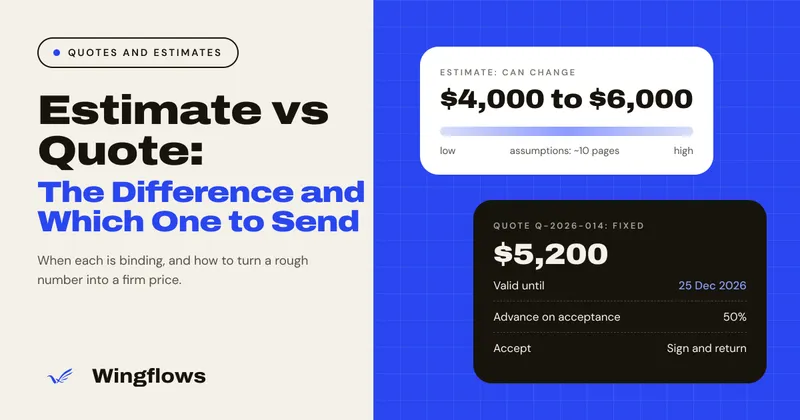
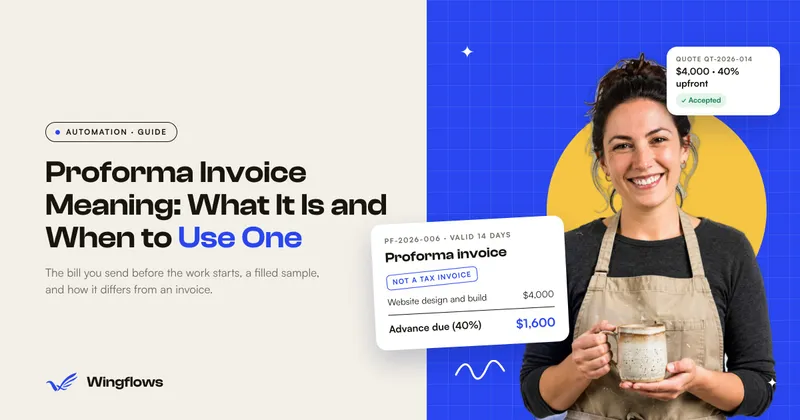
An invoice is one of four documents that look alike. Label each one clearly so the client’s accounts team files it in the right place.
How to write an invoice in 9 steps
These steps follow the order the details appear on the page, top to bottom. The order is the same in a word processor, a spreadsheet, accounting software or a free generator.
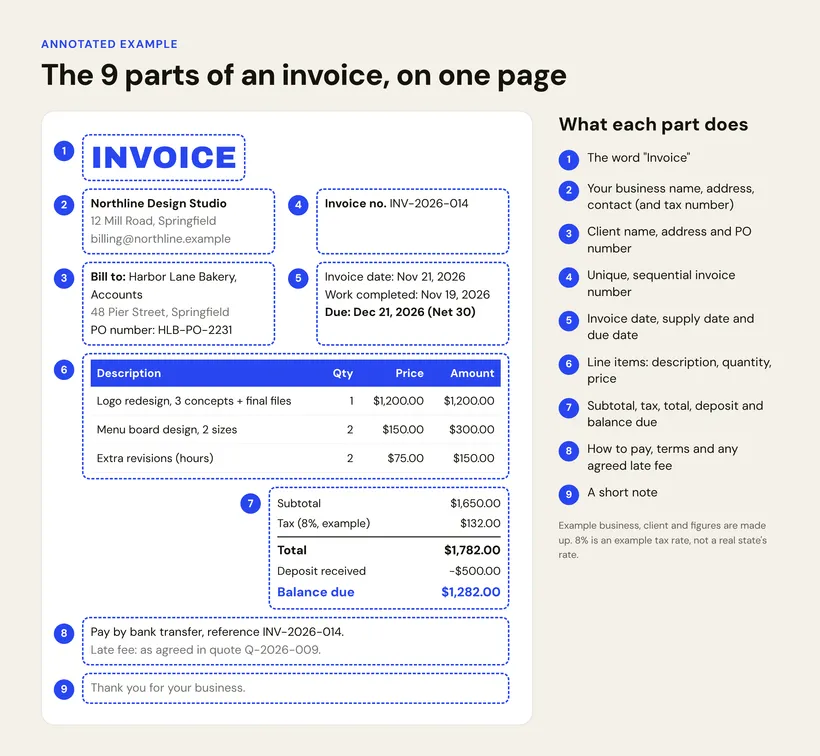
Label it "Invoice". Put the word at the top, in large type. If it's a different document, label it as that instead: a quote, a proforma invoice or a credit note.
Add your business details. Business name, address, email and phone, plus your tax number if you have one, such as a VAT number. UK limited companies use the full name from the certificate of incorporation.
Add the client's details. Company name and address, and the person or department that approves payment. If the client gave you a purchase order (PO) number, copy it exactly.
Give it a unique invoice number. One series, never reused. INV-2026-001 is a simple format: it sorts well and shows the year.
Write three dates. The invoice date, the date you delivered the goods or finished the work, and the due date written out in full, even if you also print the term, like "Net 30".
List each item on its own line. Description, quantity (hours, units or a fixed fee) and unit price. "Website design" is vague. "Homepage and 4 inner pages, design and build, as in quote Q-2026-009" is clear.
Add the subtotal, tax and total. Subtotal, then each tax with its rate and amount, then the total. If a deposit was paid, deduct it below the total and show the balance due.
Say how and when to pay. Payment terms, the due date again, bank details or a payment link, and any late fee your contract or quote already set.
Add a short note, then send it. A thank-you line or a reference the client asked for. Save as PDF, email it to the person who pays, and log it so you know when it falls due.
Invoice numbers: pick a format and never break it
Both the HMRC and European Commission lists ask for a unique sequential number. HMRC’s manual adds two practical rules: the number “can be a combination of numbers and letters”, and a gap in the series is acceptable if you keep the cancelled or spoiled invoice in your records or can explain the break (HMRC VATREC5010).
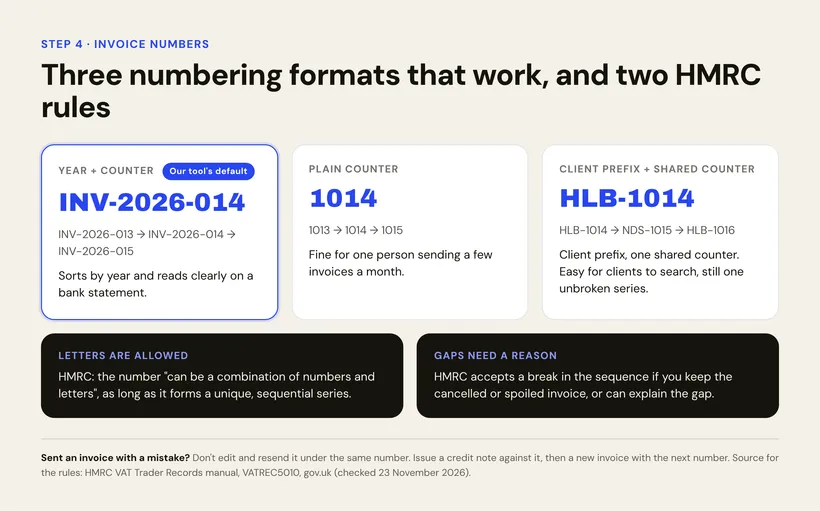
If you spot a mistake on an invoice you already sent, don’t edit it and resend it under the same number. Issue a credit note against it and a new invoice with the next number. The client’s system already holds the first one, and when two different documents share one number, the client usually queries both.
Due dates and payment terms
If you don’t agree a payment date, GOV.UK says “the customer must pay you within 30 days of getting your invoice or the goods or service” (GOV.UK). That is a UK default. Other countries set their own, so agree the term in the quote and print the exact date on the invoice.
In the UK, a business paid late by another business can claim statutory interest of “8% plus the Bank of England base rate” (GOV.UK), plus a fixed recovery sum of £40 on debts up to £999.99, £70 from £1,000 to £9,999.99, and £100 from £10,000 (GOV.UK). In the US we found no single federal rule on late fees, so we only print a late fee that is already in the signed quote or contract.
If “Net 30” is new to you, our guide to net 30 meaning shows how to count the days and how early-payment discounts like 2/10 net 30 work.
How to fill out an invoice template
Fill the fields top to bottom in the order of the nine steps, and replace every placeholder, including the sample number and dates. Then check two things before you send: the number follows on from your last invoice, and the total matches the quote.
We ran that check on our own tool. We typed the worked example from the next section into the free invoice generator with a browser script and counted the inputs.
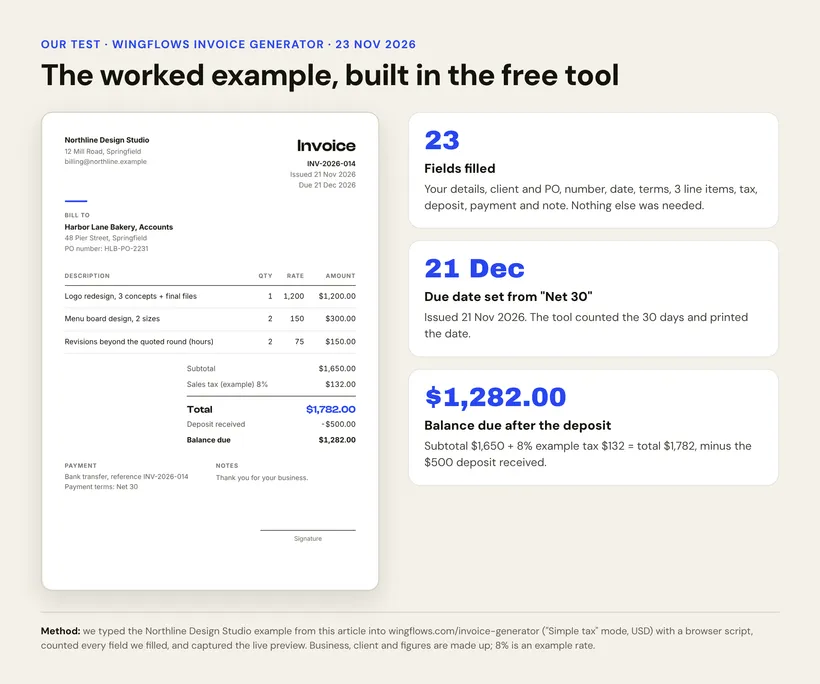
Twenty-three fields produced the invoice above. One gap showed up: in “Simple tax” mode the tool has no separate supply date field, while its India GST, EU / NL VAT and UAE VAT modes do. If you need a supply date on a US-style invoice, put it in the line description or the notes. The two things no template can fill for you are the PO number and a clear description, and those cause most of the delays in the case studies further down.
A worked invoice example
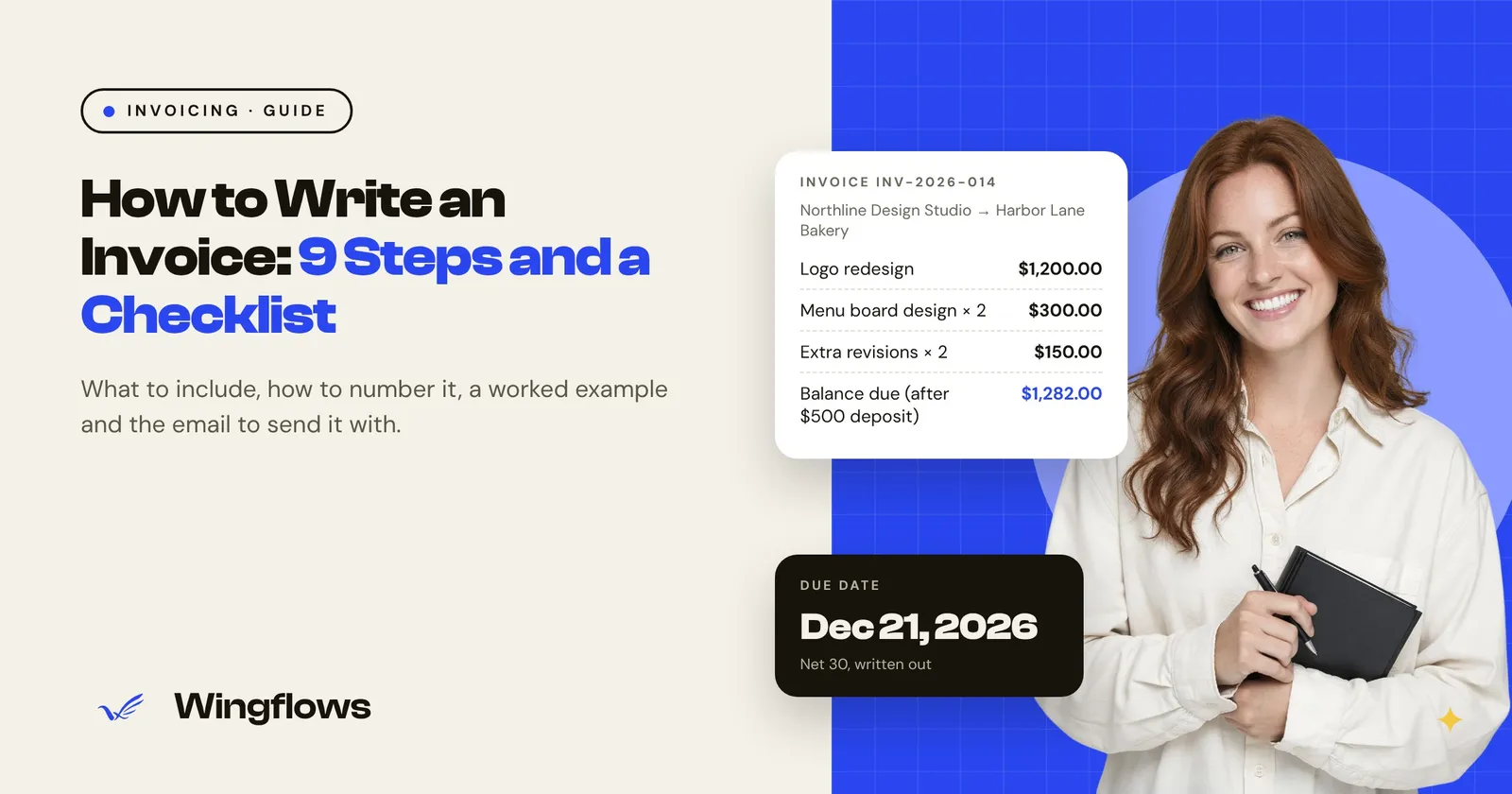
A complete invoice for a small design job. The business, client and numbers are made up, and 8% is an example tax rate, not the rate for any real state or country.
INVOICE                       No.:  INV-2026-014
                              Date: Nov 21, 2026
Northline Design Studio       Work done: Nov 19, 2026
12 Mill Road, Springfield     Due:  Dec 21, 2026 (Net 30)
billing@northline.example

Bill to: Harbor Lane Bakery, Accounts
48 Pier Street, Springfield
PO number: HLB-PO-2231

Description                    Qty   Price     Amount
Logo redesign, 3 concepts        1  1,200.00  1,200.00
  + final files
Menu board design, 2 sizes       2    150.00    300.00
Revisions beyond the quoted      2     75.00    150.00
  round (hours)

                       Subtotal           $1,650.00
                       Tax (8%, example)    $132.00
                       TOTAL              $1,782.00
                       Deposit received    -$500.00
                       BALANCE DUE        $1,282.00

Pay by bank transfer to Northline Design Studio,
account and routing number here,
reference INV-2026-014.
Late fee: as agreed in quote Q-2026-009.

Thank you for your business.
Our maths, line by line: $1,200 + (2 × $150) + (2 × $75) = $1,650. 8% of $1,650 is $132, so the total is $1,782. Minus the $500 deposit, $1,282 is left to pay.
Invoicing a deposit: show the total, then the deposit
We ask most new clients for up to 40% upfront. When their finance team needs a document to release that money, we send a proforma invoice first. The final invoice then has to line up with everything the client already holds: the quote, the PO and the deposit payment.
That is why the example shows the full $1,782 total before it deducts the deposit. An invoice that only says “$1,282 due” doesn’t match the PO value, and whoever approves it has to work out why. Show the total, the deposit received and the balance due as three separate lines, and send a receipt for the deposit when it lands.

How to write the invoice email
Attach the invoice as a PDF and keep the email short. Put the invoice number, amount and due date in the subject line, so it is easy to find later in a crowded inbox.
Subject: Invoice INV-2026-014, Northline Design Studio,
         $1,282.00 due December 21

Hi Maria,

Please find attached invoice INV-2026-014 for the logo
and menu board work (PO HLB-PO-2231). The balance due is
$1,282.00 after the $500 deposit, and payment is due by
December 21, 2026.

Bank details are on the invoice. Let me know if your team
needs anything else to process it.

Thanks,
Sam
Send it to the person who pays invoices, and copy your project contact. If the due date passes, follow up with a polite reminder. Our payment reminder messages give wording from a first nudge to a final notice.
Common invoice mistakes that delay payment
The UK Office of the Small Business Commissioner publishes complaint case studies in its invoicing guide. Three of them come down to a single missing or vague detail on the invoice (Small Business Commissioner). We added up the amounts.
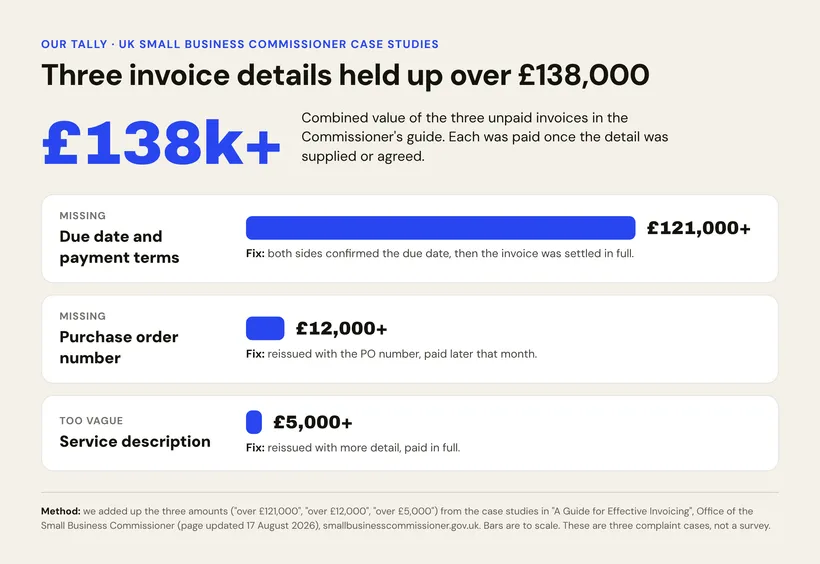
In each case the business got paid once it supplied the detail: the PO invoice was reissued and paid later that month, the vague one was reissued with more detail and paid in full, and the £121,000 invoice was settled once both sides confirmed a due date. These are three complaints, not a survey, but they match the checklist below.
- No due date. “Payment terms: 30 days” leaves room to argue about when the 30 days started. Print the date.
- Missing PO number. If the client uses purchase orders, accounts may not be able to process an invoice they can’t match to one.
- Vague descriptions. If the approver can’t tell what a line is for, they ask, and the clock stops while they wait.
- A total that differs from the quote. If the price changed, get the change approved first and reference it on the invoice.
- Reused or skipped numbers. They confuse both sets of books, and VAT rules ask for an unbroken sequence.
- No way to pay. Bank details, a card link or a payment QR belong on the invoice itself.
- Sent to the wrong person. Your project contact often doesn’t pay invoices. At kickoff, we ask two questions: who approves invoices, and do you need a PO number on them?
How long to keep invoices
Keep a copy of every invoice you send. In the US, the IRS ties record-keeping to the period it can still assess a return: “generally 3 years from the date you filed the return” (IRS Topic 305).
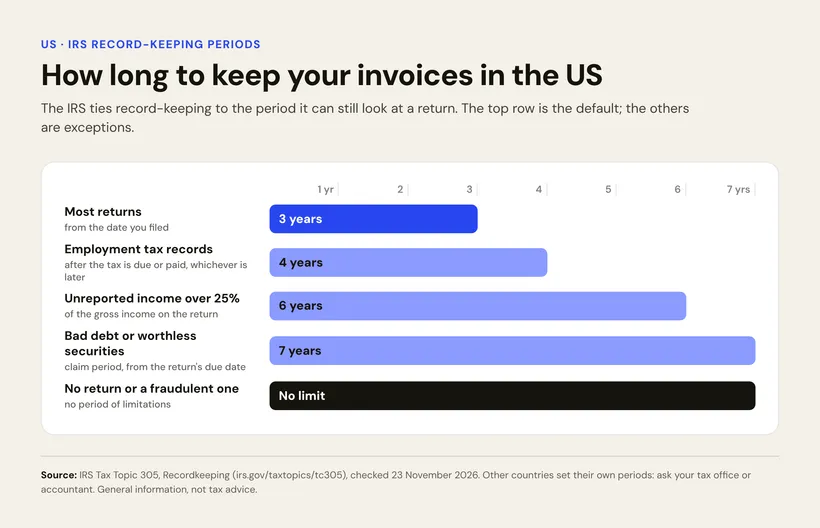
The longer periods apply to specific cases: 4 years after the tax is due or paid for employment tax records, 6 years if you leave out income worth more than 25% of the gross income on the return, and 7 years for a claim on a bad debt or worthless securities. If no return or a fraudulent return was filed, there is no limit. Other countries set their own periods, so check with your tax office or accountant.
A PDF folder named by invoice number is enough to start. Once you send more than a handful a month, a simple log with the number, client, amount, due date and paid date shows at a glance who still owes you.
When writing invoices by hand stops working
Typing each invoice works for a few a month. It gets slow when the same details live in three places: the quote, the timesheet or order, and the invoice. Every copy is another chance for a wrong number.
At that point a small system helps. The invoice is built from the accepted quote or the logged hours, numbered automatically, sent on the right day, and followed by a reminder if it isn’t paid. We set this up as part of business systems and automation work, usually with the tools a business already uses. Our accounting automation guide covers the order to automate things in.
FAQ
How do I write a simple invoice?
Follow the nine steps and skip what doesn’t apply. A simple invoice still needs the word “invoice”, your details, the client’s details, an invoice number, the date, what you are charging for, the total and how to pay.
What should be included in an invoice?
Your name and contact details, the client’s name and address, a unique invoice number, the invoice date, the supply date, a description with quantity and unit price, any tax with its rate, the total, the due date and payment details. VAT-registered businesses in the UK and EU also add their VAT number.
How do I number my invoices?
Use one series that never repeats, such as INV-2026-001, INV-2026-002. HMRC allows letters in the number and accepts a gap only if you keep the cancelled invoice or can explain it (HMRC VATREC5010).
Can I write my own invoice without software?
Yes. The official lists cover what an invoice contains, not what made it. A word processor, a spreadsheet or a free invoice generator all work, as long as every required detail is there and each invoice has its own number.
How do I write an invoice for freelance work?
One line per piece of work or per block of hours, with your rate, the hours or fee, and the dates the work covers. Show any deposit as a deduction below the total. Our freelance invoice template handles hourly or fixed fees and deposits.
Will my US client send me a 1099 for these invoices?
Possibly. US businesses report payments to independent contractors on Form 1099-NEC. The IRS says “for payments made in 2026, the reporting threshold is $2,000”, up from $600 for earlier years (IRS). Your own invoices are the record to check that form against.
Why does a client ask for a PO number on the invoice?
Their accounts team matches each invoice to an approved purchase order before paying. In one Small Business Commissioner case, an invoice of over £12,000 sat unpaid because the PO number was missing, and it was paid later the same month once it was reissued with it.
When should I send an invoice?
As soon as the work is delivered or the agreed milestone is reached. The payment term usually runs from the invoice date, so every day you wait moves the due date back by a day.
What should I write in the payment terms?
When the invoice is due, how to pay and any late fee you already agreed. For example: “Due December 21, 2026 (Net 30). Pay by bank transfer, reference INV-2026-014.” In the UK you have the right to charge interest for late payment, “but you can choose not to” (GOV.UK).
Write your next invoice with our free generator
The free Wingflows invoice generator follows the steps above: your details, the client, the invoice number, dates set from your payment terms, line items, tax, a deposit line and a balance that updates as you type. Add your logo and bank details, plus a UPI or SEPA payment QR for rupee or euro invoices, then download a PDF. There is no sign-up, and your details stay in your browser.
If you invoice often and want it to run on its own, from quote to invoice to reminder, talk to us about your setup.